Drafting Demand Letters: Common Mistakes That Cut Value
.png)

A demand letter is more than a formality. It is your first (and sometimes only) chance to set the anchor, control the narrative, and signal trial readiness. Small drafting errors can quietly shave thousands off a case by weakening credibility, inviting lowball counters, or creating “easy outs” for the adjuster.
Below are the most common value-cutting mistakes in drafting demand letters, plus practical fixes you can apply before you hit send.
Why demand letters lose value
Carriers and defense counsel rarely “discount” a claim because they dislike your tone. They discount because the demand reads like it would be painful to defend at trial, or easy to defend.
A high-value demand letter typically does three things well:
- Proves damages with clean math and clean exhibits
- Connects liability to injury with a simple causation story
- Creates urgency and risk (credible venue, credible witness list, credible trial plan)
When any of those fail, your number starts to look aspirational instead of inevitable.
Common mistakes that cut settlement value (and how to fix them)
| Mistake | Why it cuts value | What to do instead |
|---|---|---|
| 1) Unsupported totals and fuzzy math | If specials, liens, write-downs, and paid vs billed are unclear, the carrier assumes you are inflating or you cannot prove it. | Provide a damages table (paid, billed, outstanding) and cite the exact exhibit pages for each subtotal. |
| 2) Missing causation bridge | “Crash happened, client treated” is not causation. Defense will point to gaps, degenerative findings, and prior complaints. | Write a short causation paragraph that ties mechanism of injury, first complaints, objective findings, and treating opinions into one chain. |
| 3) Overstating liability (or ignoring comparative fault) | If your liability section sounds like advocacy without evidence, it invites a “disputed liability” discount. | Acknowledge weak points briefly, then neutralize them with specific facts (photos, admissions, statutes, scene diagram). |
| 4) Demand number with no rationale | A big number without structure reads like posturing. Adjusters respond by anchoring low. | Explain the demand with a framework: specials, wage loss, future care, and a clear non-economic rationale (duration, invasiveness, permanency, activities impacted). |
| 5) Injury summary that is chronological but not persuasive | A timeline is not a story. If the reader has to infer severity, they usually infer “moderate.” | Use a “problem list” style summary: key diagnoses, key imaging, key procedures, work restrictions, and durable limitations. |
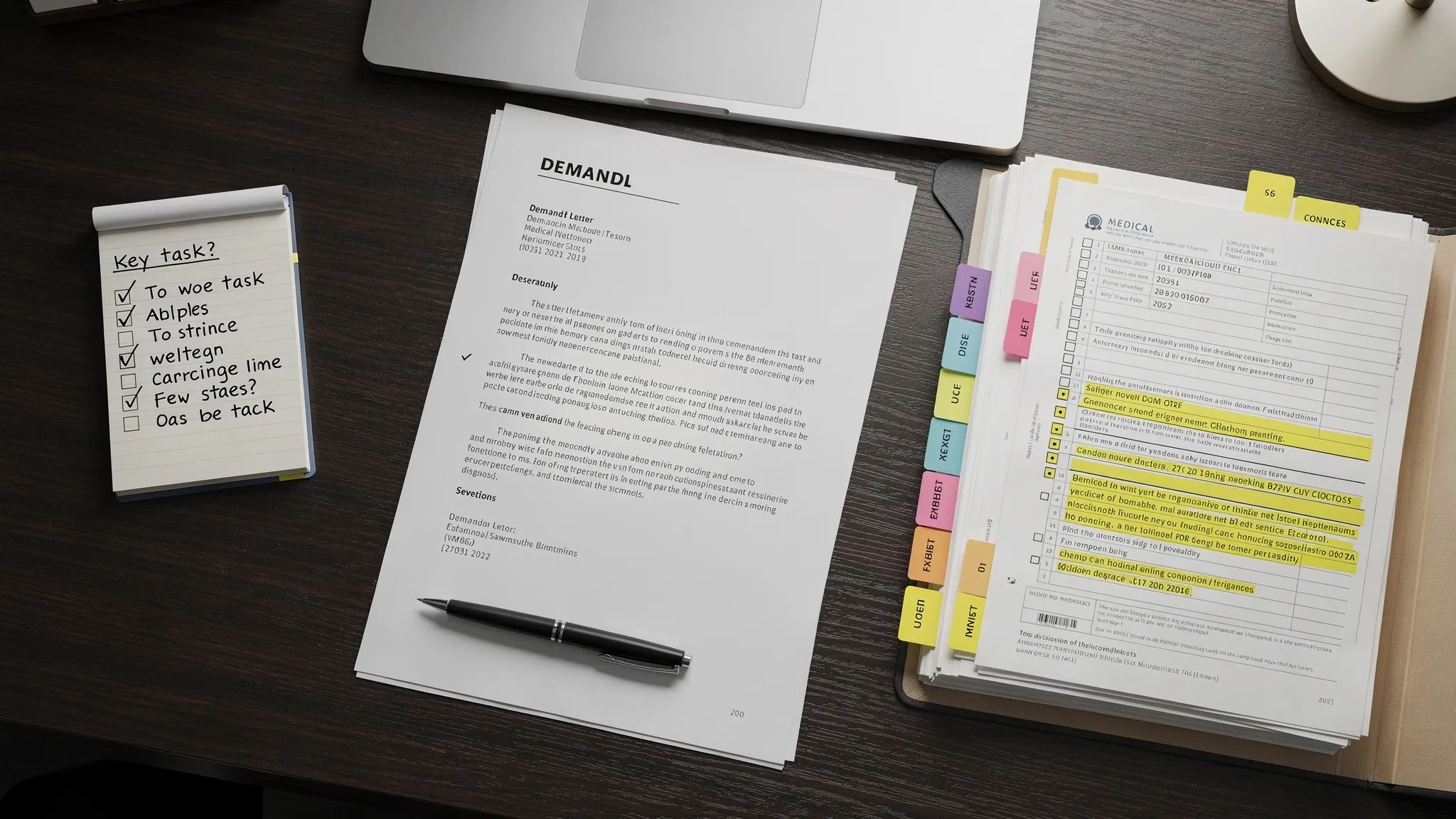
| 6) Exhibit dump with no map | When attachments are unlabeled or enormous, the carrier skims, misses the best facts, and prices uncertainty. | Create an exhibit index. In the letter, cite to exhibit numbers and page ranges (for example, “Ex. 4 at TB000123-000129”). |
| 7) Aggressive tone that threatens without showing readiness | Threats without trial signals are easy to ignore. Hostility can also make a reasonable adjuster defensive. | Be firm and professional. Show readiness with specifics: venue, liability theory, treating providers, and what you will prove. |
| 8) Medical specials that ignore reasonableness issues | If you present billed charges without addressing write-downs, usual and customary, or lien posture, you invite a “phantom specials” argument. | Clarify the lien status and present a defensible number (paid + outstanding) while preserving any jurisdictional positions on recoverability. |
| 9) Failing to document out-of-pocket life disruption | Moving costs, replacement services, and household help often get ignored, even when real. That is money left on the table. | Itemize disruption damages with receipts, logs, and a short explanation of necessity. If a client had to secure temporary or long-term housing during recovery, document the terms and costs clearly. For clients navigating relocations or longer stays, a service like Movely: stress-free long-term rentals & home services can help them organize housing logistics and support documentation. |
| 10) Sloppy errors (dates, provider names, wrong pronouns, wrong venue) | Nothing lowers perceived case quality faster. If your letter is careless, the carrier assumes your proof is too. | Run a pre-send audit: dates, amounts, provider list, accident facts, and exhibit citations. Then have a second set of eyes review. |
A pre-send checklist that protects value
Use this quick checklist to tighten the letter without making it longer.
- Liability: One paragraph theory, one paragraph evidence. If comparative fault exists, address it directly.
- Injuries: Summarize the “headline” items (diagnoses, imaging, procedures) before the visit-by-visit detail.
- Gaps: If there is a treatment gap or delayed onset, explain it.
- Damages math: Specials, wage loss, and future care totals should reconcile cleanly.
- Exhibits: Index them and cite them precisely in the narrative.
- Settlement posture: Clear deadline, clear method of response, and a realistic “next step” if not resolved.
Draft faster without sending weaker letters
Speed helps only if accuracy keeps up. A practical way to reduce drafting time while improving consistency is to generate a structured first draft from the underlying documents, then do a lawyer-led review for judgment calls (comparative fault, venue risk, causation weaknesses, lien strategy).
TrialBase AI is designed for this workflow: you upload records and case materials, and the system turns them into litigation-ready outputs like demand letters, medical summaries, and other case-prep materials in minutes. The time savings matters, but the bigger upside is standardization: consistent exhibit references, consistent issue-spotting, and fewer “forgot to include that” moments.
If you use AI in demand drafting, keep these guardrails:
- Verify every number (specials totals, CPT dates, wage computations).
- Confirm the theory (do not let a draft imply facts you cannot prove).
- Make causation explicit (especially with degenerative findings or prior history).
- Preserve your voice (jurisdiction-specific language, venue strategy, and credibility choices should be human-led).
Frequently Asked Questions
How long should a demand letter be? Most strong demand letters are as short as they can be while still proving the case. If it is longer than necessary, use an exhibit index and keep the body focused on the value drivers.
Should I include a settlement deadline? Yes, a reasonable deadline helps create urgency and keeps the claim moving. Make sure the deadline matches the complexity of the package and the volume of records.
Do I need to address comparative negligence in the demand? If comparative fault is a foreseeable defense, addressing it proactively (with evidence) often protects value more than ignoring it.
What is the biggest “silent” mistake that reduces value? Unclear damages math. When totals do not reconcile, the carrier prices uncertainty, and uncertainty reduces offers.
Make your next demand letter harder to discount
If you want to reduce drafting time while improving consistency, you can use TrialBase AI to turn uploaded case documents into demand letters, medical summaries, deposition outlines, and other litigation-ready materials.
Explore the platform at TrialBase AI.