Cross Examine Questions That Expose Gaps in Testimony
.png)
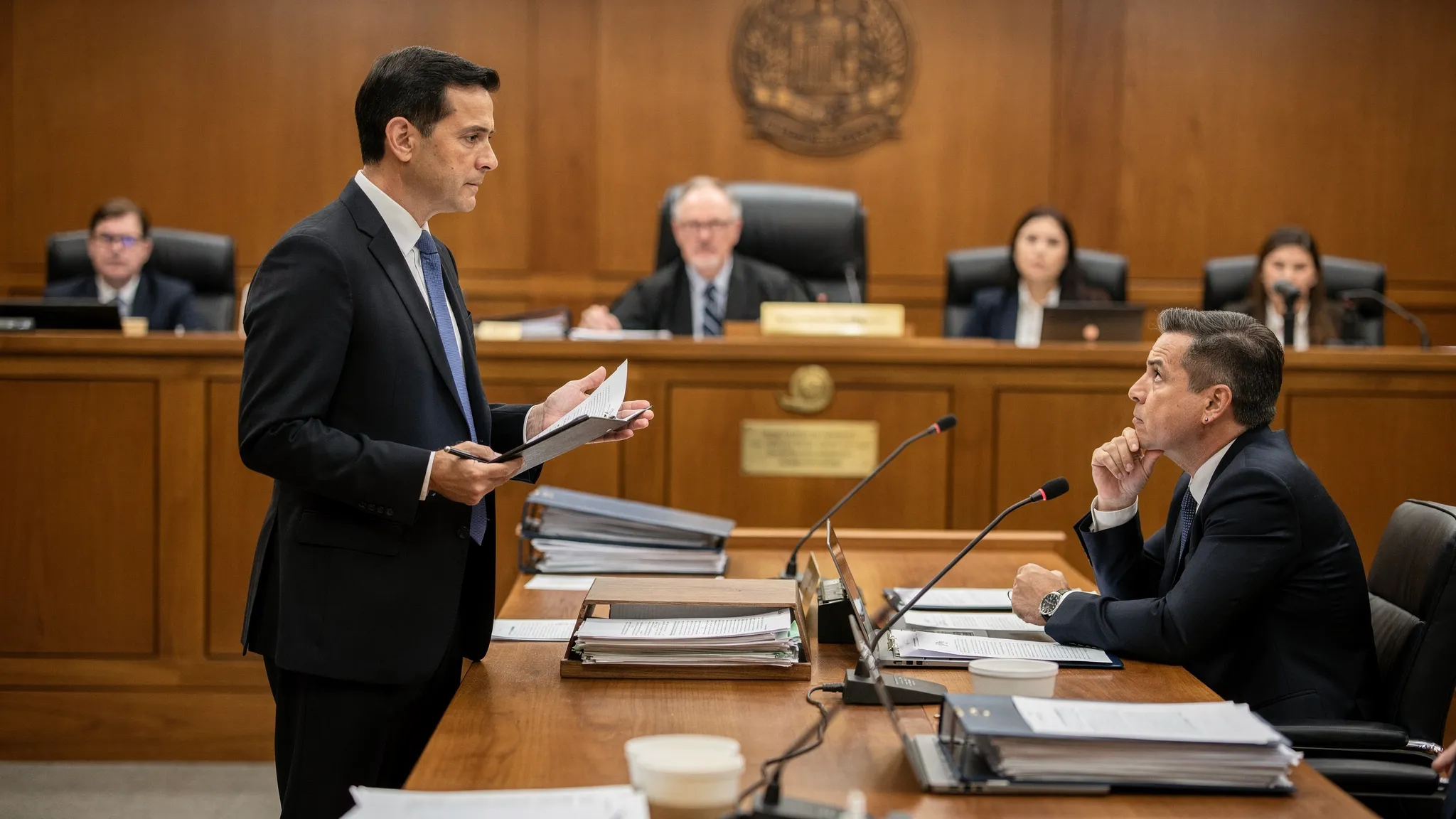
Cross examination is less about “gotcha” moments and more about controlled, incremental admissions that make the gap obvious to the judge or jury. The best cross examine questions expose what the witness can’t say with confidence: missing facts, shaky memory, inconsistent timelines, and conclusions that outpace the foundation.
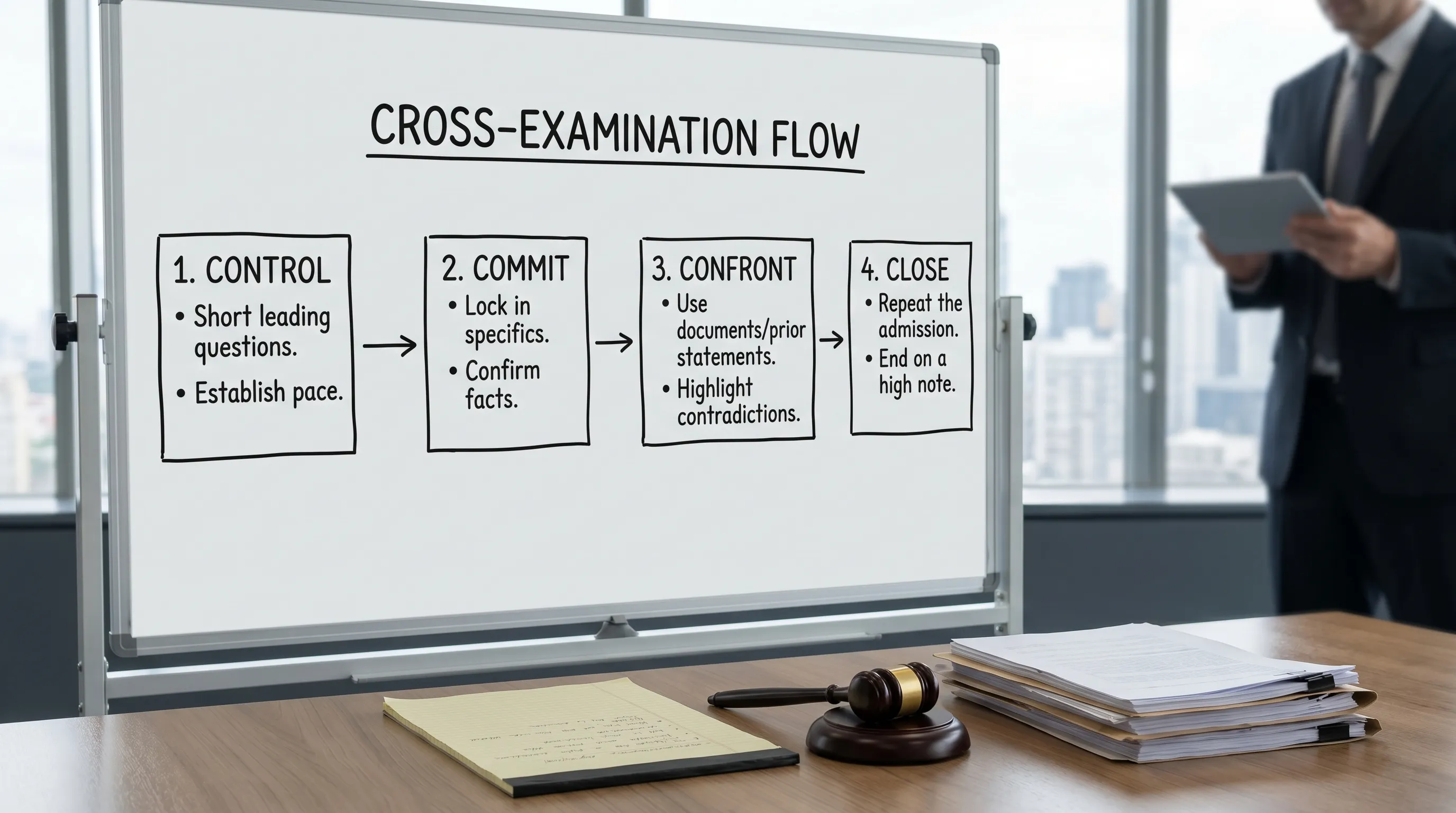
The fastest way to expose gaps: control, commit, then confront
Most testimony gaps appear when you force specificity.
- Control with short, leading questions (ideally yes/no).
- Commit the witness to a clear position (time, distance, sequence, “you did not,” “you never”).
- Confront with the document, prior statement, or common-sense constraint.
- Close the loop so the factfinder hears the takeaway in plain language.
This approach aligns with core trial practice norms around managing interrogation and avoiding narrative answers (see Federal Rule of Evidence 611).
Cross examine questions that reliably expose testimony gaps
Use these question sets as “stems.” Swap in your case facts, exhibit references, and dates.
1) Timeline gaps (when the story lacks anchors)
If a witness cannot place events on a timeline, their certainty shrinks.
Examples:
- “You can’t tell the jury the exact time that happened, correct?”
- “You didn’t write down the time anywhere that day, did you?”
- “You’re estimating, not recalling an exact time, right?”
- “Between 2:00 and 4:00 p.m., you cannot say where you were the entire time, correct?”
- “Your first statement with a specific time appears only after you spoke with (person/lawyer/insurance), correct?”
2) Perception gaps (what the witness could not actually observe)
Many confident accounts collapse when you quantify distance, lighting, angle, speed, or obstructions.
Examples:
- “You were (X) feet away, correct?”
- “There was traffic between you and the intersection, right?”
- “Your view was through glass, correct?”
- “It was dark (or raining), yes?”
- “So you never had an unobstructed view of (critical event), correct?”
3) Memory gaps (confidence without refreshers or contemporaneous notes)
Memory improves when documented and worsens when reconstructed.
Examples:
- “You did not record this conversation, correct?”
- “You didn’t take notes at the time, did you?”
- “You’re relying on memory from (months/years) ago, correct?”
- “You reviewed documents to prepare for today, right?”
- “Without those documents, you cannot recall the exact wording, correct?”
4) Foundation gaps (conclusions that outrun facts)
This is where opinions masquerade as facts.
Examples:
- “You’re not trained in (field), correct?”
- “You didn’t measure (speed/distance/force), right?”
- “You didn’t inspect (item/location), correct?”
- “So when you said ‘(conclusion),’ that was your assumption, yes?”
If you are impeaching with a prior statement, be precise and fair. FRE 613 is the common starting point for prior statement impeachment mechanics.
5) Inconsistency gaps (what changed and when)
Don’t argue. Just make the change undeniable.
Examples:
- “In your first statement, you said (A), correct?”
- “Today you said (B), correct?”
- “Those two statements cannot both be true, right?”
- “The first time you mentioned (new detail) was (later event), correct?”
- “You agree your memory did not get better with time, correct?”
6) Documentation gaps (missing records where records should exist)
If the event mattered, someone usually documented it.
Examples:
- “There is no email confirming that, correct?”
- “No incident report was made that day, right?”
- “You didn’t take photographs, correct?”
- “Nothing in the chart notes (or log) says (critical fact), correct?”
- “If it had happened the way you describe, you would expect to see it documented, correct?”
7) Bias and incentive gaps (why the testimony may lean)
Bias is often shown by relationships and consequences.
Examples:
- “You work with (party) currently, correct?”
- “You want to keep that job, yes?”
- “You met with counsel to prepare, correct?”
- “You understand the outcome could affect you financially, right?”
Quick reference table: gap type to question stems
Use this to outline your cross in minutes.
| Gap you want to expose | Question stems that work | What the admission proves |
|---|---|---|
| Timeline uncertainty | “You can’t give an exact time…”, “You’re estimating…” | The sequence is reconstruction, not recall |
| Limited perception | “Your view was obstructed…”, “You were (distance) away…” | The witness could not reliably see/hear |
| Weak memory | “No notes…”, “You reviewed records to prepare…” | Confidence is not backed by contemporaneous memory |
| No foundation | “You didn’t measure…”, “You’re not trained in…” | The conclusion is assumption |
| Changed story | “You said (A) then… today (B)…” | Inconsistency undermines credibility |
| Missing documentation | “No report/email/note exists…” | The claimed event is unsupported |
| Bias/incentive | “You benefit if…”, “You work for…” | Motive to shade testimony |
A practical pattern you can reuse: “narrow, narrow, nail it”
When you find a weak spot, don’t jump to the punchline. Narrow the witness into a corner, then seal it.
Example pattern:
- “You never saw the impact, correct?”
- “You only heard a sound, right?”
- “And you turned after the sound, yes?”
- “So you cannot testify who caused the impact, correct?”
That is a clean, gap-exposing sequence without argument.
Make these questions stronger with better inputs (documents, transcripts, medical records)
Cross examine questions land best when they are exhibit-driven and chronology-accurate. If your case has dense records, multiple providers, or conflicting statements across reports, pulling the right contradiction quickly is the real bottleneck.
TrialBase AI is built for that workflow: upload your documents and generate litigation-ready outputs like medical summaries, deposition outlines, and demand letters in minutes. When your outline is tied to the record, it gets easier to lock in commitments and confront inconsistencies without wasting prep time.
Frequently Asked Questions
What are the best cross examine questions to expose a lie? The most reliable questions don’t accuse anyone of lying. They expose gaps: missing documentation, changing details, limited perception, and timelines the witness cannot anchor.
Should cross examination questions be yes or no? Usually, yes. Leading yes/no questions help you control pace and prevent narrative explanations. If you need context, get it on direct (your witness) or through exhibits.
How do I impeach with a prior inconsistent statement without arguing? Lock in today’s version, confirm the earlier statement, then ask the witness to agree the two cannot both be true. Keep your tone neutral and let the inconsistency speak.
What if the witness keeps explaining? Shorten the question, repeat it, and ask the court for the witness to answer responsively if needed. Your goal is control, not debate.
CTA: Build cross examinations from the record, not from memory
If you want cross examine questions that reliably expose gaps in testimony, start with a clean chronology, a tight issue list, and the exact lines that matter.
Explore TrialBase AI to turn case documents into deposition outlines, medical summaries, and other litigation-ready materials faster, so you can spend your time on strategy and delivery in the courtroom.