Litigation Strategy: From Case Theory to Task Lists
.png)

Strategy fails most often at the handoff, when a strong case theory never becomes a day to day plan the team can execute. The fix is not more brainstorming, it is a repeatable way to translate theory into tasks, outputs, owners, and deadlines.
This guide walks through a practical litigation strategy framework you can use from intake through verdict, with a simple method for turning the story of your case into a task list that actually drives results.
Step 1: Write a case theory that is testable (not just persuasive)
A usable case theory is more than a theme. It is a set of claims you can prove with admissible evidence, tied to the elements you must satisfy and the defenses you must defeat.
A quick quality check is to ask:
- What must we prove, element by element?
- What facts do we need for each element?
- What evidence will actually carry those facts (documents, testimony, admissions, experts)?
- What will the other side say, and what neutralizes it?
This is where many teams lose time later: they start discovery with broad requests, then spend months sorting what matters. If your theory is element based, your discovery becomes purpose built.
If you need a refresher on early disclosure obligations that can shape your plan, review FRCP 26 and your local rules.
Step 2: Turn the case theory into an “issues map” (your translation layer)
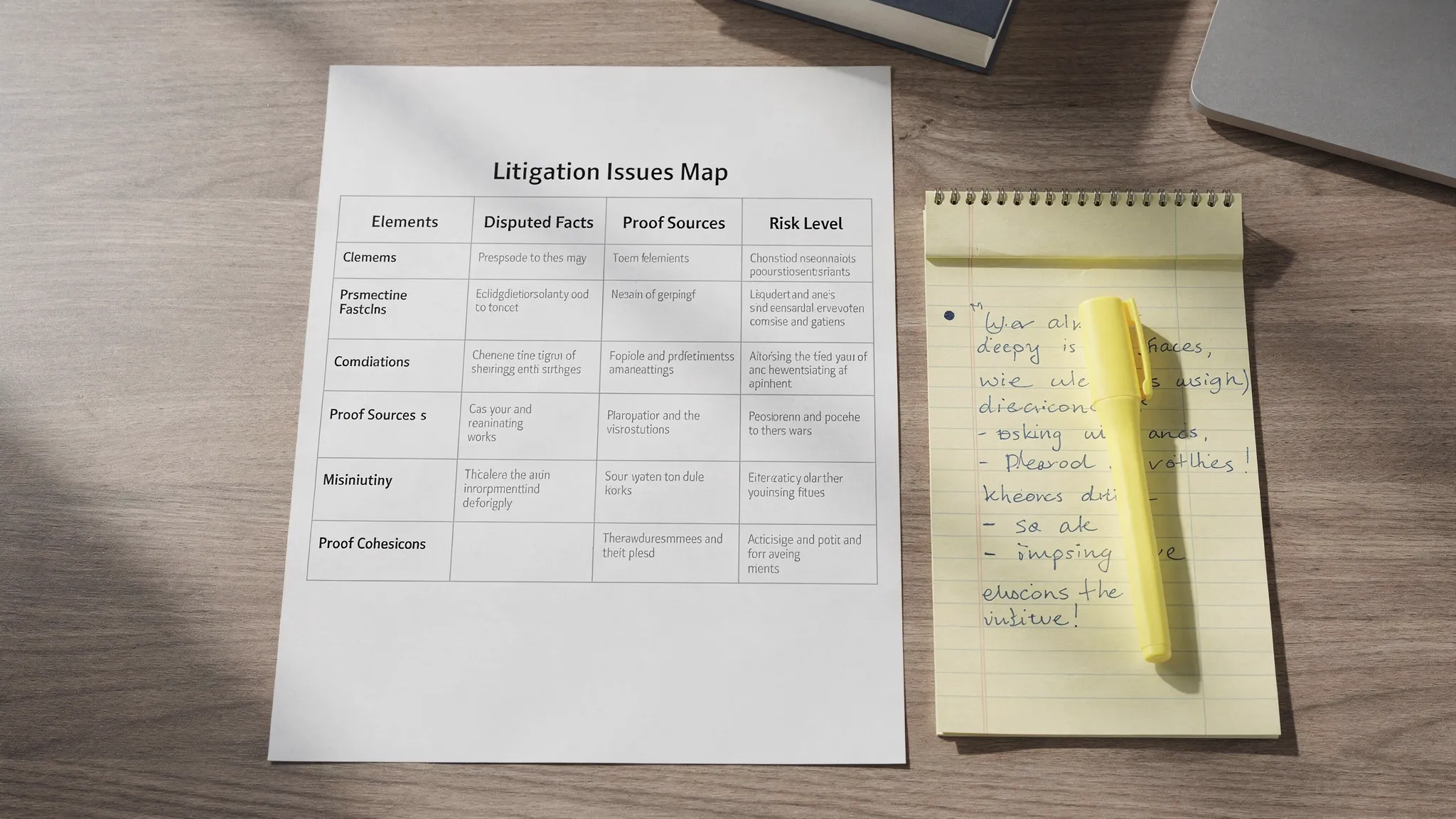
Before you create tasks, create a one page issues map that links:
- Legal elements and key defenses
- Disputed facts
- Proof sources (who, what document, what record)
- Risk level (high, medium, low)
This issues map becomes the bridge between “our story” and “what we do next.” It also reduces rework when a new attorney joins the matter or when you are preparing for mediation.
Step 3: Convert each issue into deliverables (the outputs that win motions and move settlement)
Litigation is output driven. Judges, mediators, adjusters, and opposing counsel respond to what you can show.
For each major issue, define the deliverable that would make that issue easier to win. Examples include a medical summary that clarifies causation, a deposition outline that locks in concessions, or a demand package that frames damages in a way the carrier can evaluate.
A simple way to keep it concrete is to use this table as your planning template.
| Case theory component | What “winning” looks like | Litigation output to build | Where the proof usually lives | When it matters most |
|---|---|---|---|---|
| Liability (duty, breach, causation) | Clean narrative, minimal factual gaps | Deposition outlines, timeline, exhibit list | Incident reports, photos, policies, witness statements | Early discovery, summary judgment briefing |
| Damages (economic, noneconomic) | Credible, well supported valuation | Medical summary, wage loss summary, demand letter | Medical records, billing, employment records | Demand, mediation, trial |
| Defense themes (comparative fault, causation break) | Defense is narrowed or undermined | Targeted depo modules, impeachment file | Prior records, surveillance, inconsistent statements | Expert discovery, mediation, trial prep |
| Procedural leverage | Deadlines and obligations are controlled | Discovery plan, motion calendar | Scheduling order, local rules, stipulations | From Rule 26(f) through pretrial |
The point is not to create paperwork. The point is to decide, in advance, what artifacts you need to produce to pressure the case toward your desired outcome.
Step 4: Turn deliverables into task lists (the smallest actions that create momentum)
Now you can safely build the task list, because you know what you are building and why.
A strong litigation task list has five fields:
- Task (verb first): “Draft depo outline for treating physician”
- Owner: Named person, not “team”
- Input: Specific documents or data required
- Definition of done: “Outline includes admissions goals, key exhibits, and 10 core questions per issue”
- Due date tied to an event: Deposition date, expert deadline, mediation date
If you want fewer dropped balls, tie due dates to events, not vague weeks on the calendar.
Step 5: Build your “critical path” around 3 litigation events
Most cases can be managed around three anchors:
- First meaningful case narrative: when you can explain liability and damages with a defensible record
- First leverage point: a deposition, dispositive motion, or expert report that changes the risk profile
- Settlement or trial readiness: when your file is organized enough that you could pick a jury without scrambling
If your tasks do not serve one of these anchors, they are probably noise.
Step 6: Use documents as your single source of truth (and stop rewriting the same facts)
Legal teams lose massive time to duplicate summarizing: someone reads records, someone else re-reads them for a demand, then again for depos, then again for trial.
A better approach is to create a canonical set of case materials once and reuse them:
- Master chronology (with citations)
- Medical summary (with key diagnoses, treatment, and causation notes)
- Witness and provider list
- Damages worksheet
- Core exhibit set
This is also where intelligent litigation support can help. If you can upload records once and generate consistent case ready outputs, you reduce rework and minimize contradictions across demand letters, deposition prep, and trial materials.
Where TrialBase AI fits in this workflow
TrialBase AI is designed for the translation problem described above: converting messy case documents into litigation ready outputs quickly. Based on the features provided, legal teams can use it to accelerate key deliverables such as demand letters, medical summaries, deposition outlines, and trial materials, while keeping work organized in a unified workflow.
A practical way to pilot it without changing your whole process is:
- Start with one matter and upload the core record set
- Generate a medical summary and use it to validate your damages narrative
- Generate a first deposition outline and align it to your issues map
- Use the outputs to populate your task list with clearer “inputs” and “definitions of done”
If your litigation strategy is already sound, the fastest win is usually not new tactics. It is faster, more consistent execution.
To learn more, explore TrialBase AI and evaluate whether document to deliverable automation would remove bottlenecks in your current case prep.