Deposition Summaries: Formats That Support Motions and Trial
.png)

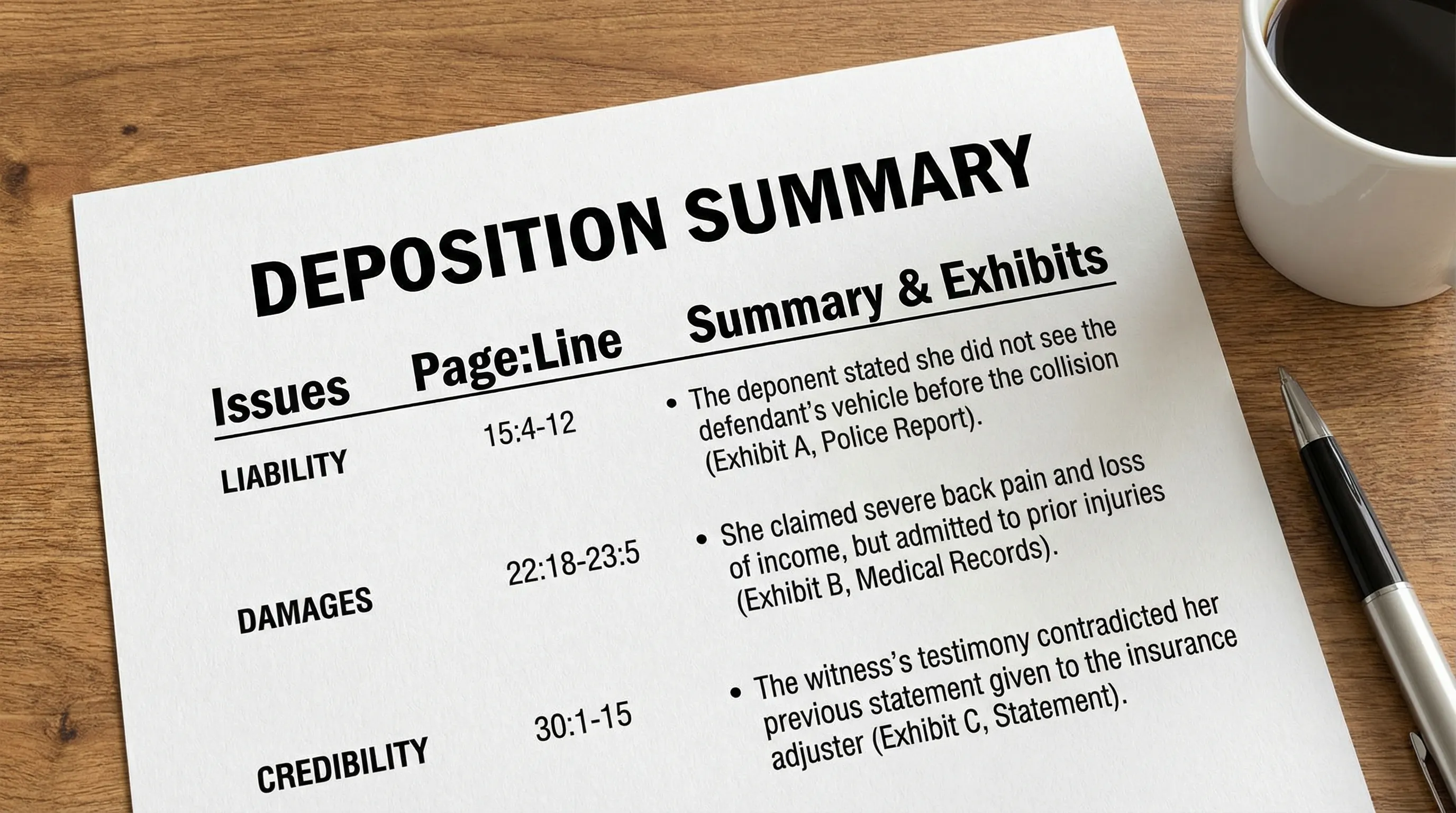
Deposition testimony only becomes useful when it is easy to cite, easy to search by issue, and easy to drop into a motion or trial binder. The best deposition summaries do that work upfront, they turn a 250-page transcript into a set of reliable “handles” you can pull when drafting (or when a witness changes their story).
Below are deposition summaries formats that consistently support motions and trial, plus what to include so your team can use them without re-reading the transcript.
What a “motion-ready” deposition summary must do
A summary that supports dispositive motions or evidentiary motions is built for pinpoint citation and legal relevance, not just storytelling. In practice, that means:
- Pin cites you can trust (page:line, witness, date, and exhibit references)
- Issue mapping (so you can find admissions and denials by claim/defense element)
- Designation awareness (so you can later select excerpts that are actually usable at trial)
If you expect to use testimony at hearing or trial, keep admissibility in mind early. For federal practice, see FRCP 32 (Using Depositions in Court Proceedings). For impeachment and prior statements, FRE 613 and FRE 801(d)(1) are common touchpoints.
The formats that work best (and when to use each)
Most teams use more than one format, because different tasks require different “views” of the same testimony.
| Deposition summary format | Best for | What it looks like in practice | Common failure to avoid |
|---|---|---|---|
| Page-line (condensed) summary | Quick retrieval for drafting motions | 1 to 3 lines per transcript page with page:line ranges | Too vague (“witness discusses incident”) without the key admission/denial |
| Narrative summary | Case storyline, mediation packets | Clean narrative with headings and exhibit callouts | Losing pin cites, which makes it hard to use in briefing |
| Issue-based summary (by claim/defense element) | Summary judgment, oppositions, jury instructions prep | Sections like duty, breach, causation, damages, notice, comparative fault | Mixing issues so admissions get buried |
| Chronology (fact timeline from testimony) | “Undisputed facts” sections, trial sequencing | Date-stamped events with supporting transcript cites | Treating assumptions as facts, or missing disputed qualifiers |
| Impeachment / admissions tracker | Cross-exam, motions in limine, settlement leverage | Q/A snippets with “lock-in” testimony and contradictions | Failing to capture the exact words and the context around them |
| Exhibit foundation index | Trial exhibit admission | Notes on authentication, chain of custody, who created what, when | Not tying foundation testimony back to the exhibit number and page:line |
A practical approach is to produce a page-line summary first (speed and coverage), then add an issue-based layer and an impeachment tracker for the witnesses that matter.
How to structure deposition summaries for summary judgment and other motions
When deposition summaries are intended to support briefing, your format should mirror how motions are drafted.
For summary judgment (or opposition)
Build sections that map to the legal test. Even if your jurisdiction has its own framing, the structure is similar: elements, facts supporting each element, and citations.
What to include:
- Element headers (for example, notice, defect, causation, damages)
- Pointed fact statements (each with a pin cite)
- Helpful qualifiers (for example, “witness did not know,” “witness could not identify,” “witness testified ‘I don’t recall’”) because those can matter as much as affirmative admissions
If you have to write a statement of undisputed facts, the “atomic” unit is: one fact, one cite. Deposition summaries that preserve atomic facts reduce briefing time dramatically.
For Daubert and expert-related motions
Expert depositions are often used to attack methodology, data inputs, and opinions. Create an opinions index:
- Opinion (quoted or tightly paraphrased)
- Basis (what data the expert relied on)
- Concessions (limitations, assumptions, “not my field,” “I did not test,” etc.)
- Pin cites and exhibit references (reports, literature, demonstratives)
For motions in limine
Your summary should highlight the “why” behind exclusion or limitation. Create a short section per topic with:
- The testimony excerpt
- The relevance hook (what issue it purports to address)
- The prejudice or reliability problem (if any)
- The citation block (page:line and exhibit)
How to structure deposition summaries for trial
Trial use is about speed and precision in the courtroom. Your trial-ready deposition summaries should make it easy to create designations, prep cross, and respond to surprises.
Add a “trial toolkit” page for key witnesses
For your top witnesses, append a short toolkit at the front of the summary:
- Top admissions (with pin cites)
- Top denials / gaps (useful for argument and cross)
- Impeachment set pieces (prior inconsistent statements, contradictions with documents)
- Exhibit hooks (where the witness authenticated, adopted, or disclaimed an exhibit)
This is also where you note anything impacted by errata sheets or later corrections, so you do not get blindsided.
Quality control that prevents “dead” summaries
Deposition summaries fail most often due to small reliability problems that make lawyers re-check everything. A lightweight QC pass saves far more time than it costs.
Recommended QC checks:
- Confirm speaker and context (question versus answer, on/off the record)
- Verify all pin cites (spot-check each section, especially impeachment excerpts)
- Normalize names and exhibit numbers (same spellings and numbering across the case)
- Flag ambiguity (“could,” “might,” “I think”) so it is not later misused as a firm admission
Making deposition summaries faster without sacrificing cite accuracy
Teams are increasingly using automation to reduce the first-draft burden, then applying attorney oversight for legal judgment and accuracy. If you want a workflow that turns transcripts and exhibits into usable litigation materials quickly, TrialBase AI is designed to generate deposition outlines, medical summaries, demand letters, and other case-ready outputs from uploaded documents.
One adjacent tip for litigation teams that also handle intake and marketing: tracking how potential clients describe incidents and injuries can help you build better deposition topic checklists. Tools like Redditor AI for Reddit lead monitoring can surface recurring real-world narratives that inform the questions you prioritize later.
Frequently Asked Questions
What is the best format for deposition summaries used in motions? Issue-based deposition summaries with atomic fact statements and page:line pin cites are typically the most motion-friendly, especially for summary judgment.
Do deposition summaries need page and line citations? Yes. Without page:line citations, deposition summaries are hard to rely on for briefing, exhibit prep, and impeachment because someone must re-find the testimony in the transcript.
Should I use a narrative summary or a page-line summary? Use both when possible. Page-line summaries are best for fast retrieval, and narrative summaries are best for understanding the story and preparing mediation or settlement materials.
How do I build deposition summaries that support impeachment at trial? Create an admissions and impeachment tracker that preserves the witness’s exact wording, includes page:line cites, and notes the document or prior statement that contradicts the testimony.
How long should deposition summaries be? Long enough to capture every important admission, denial, and foundation point with citations, but short enough to scan. Many teams aim for a condensed page-line summary plus deeper issue sections for key topics.
Turn transcripts into trial-ready work product faster
If deposition summaries are slowing down motions, mediation prep, or trial organization, consider standardizing your summary format (page-line plus issue-based sections) and using automation for first drafts. With TrialBase AI, you can upload case documents and generate litigation-ready outputs in minutes, then spend your time on strategy, not transcription cleanup.