Verdict Research Basics: Finding Comparable Outcomes Fast
.png)

Verdict research is one of the fastest ways to sanity-check case value, pressure-test your theme, and anticipate what a neutral decision-maker has actually done in similar fact patterns. The challenge is that “similar” is rarely obvious, and digging through outcomes can quickly turn into a time sink.
Below is a practical, repeatable approach to verdict research that helps you find truly comparable outcomes fast, then turn them into usable negotiation and trial prep inputs.
What “comparable” really means in verdict research
A comparable verdict is not just “same injury” or “same county.” It is a cluster of case facts that drive value.
The core comparability variables (start here)
Focus on variables that predict outcome more than surface labels:
- Venue and decision-maker: county, division, judge tendencies (when relevant), jury pool characteristics.
- Liability profile: clear liability vs disputed, comparative negligence allegations, evidentiary problems.
- Injury mechanism and objective findings: diagnostic imaging, surgical recommendation, permanency, complications.
- Medical timeline: gaps in treatment, compliance, prior injuries, preexisting conditions.
- Economic damages support: wage loss proof, future care documentation, life care plans.
- Plaintiff story and credibility: prior claims, social media issues, inconsistent records.
- Defense narrative and anchors: “degenerative changes,” “minor impact,” “treatment excessive,” and similar themes.
A quick comparability checklist
Use this as a gut-check before you save a verdict as a “comp.”
| Factor | What you want to match | What you can flex (with notes) |
|---|---|---|
| Venue | Same county or closest proxy | Nearby county with similar jury profile |
| Liability | Similar dispute level | Slightly stronger/weaker if you adjust expectations |
| Injury | Similar objective findings and treatment | Similar diagnosis but different treatment intensity |
| Specials | Similar medical billing range and reasonableness | Different totals if billing norms differ |
| Plaintiff profile | Similar work, age band, and credibility flags | One mismatch if everything else is tight |
Where to find comparable outcomes quickly (without boiling the ocean)
You typically have three buckets of sources. The “fast” strategy is to start narrow, then widen only if you must.
1) Local intelligence and internal firm history
If your firm has handled similar matters in the same venue, your best comps may already exist in your own files: prior demands, mediations, settlement memos, deposition outlines, and trial notebooks.
The advantage is context, you know what moved the number and what nearly sank it.
2) Court records and public-facing sources
Court dockets can help you confirm case posture, parties, and sometimes key filings. Public institutions like the National Center for State Courts also publish research and data projects that help you understand broader civil justice patterns (useful for framing, even if not a verdict-by-verdict database).
3) Commercial verdict and settlement databases
These tools are often the fastest way to pull a first set of comps by venue and injury category. The key is filtering aggressively (see the workflow below) and not over-trusting headnotes.
A fast workflow: from “too many results” to 5 usable comps
The biggest time-waster in verdict research is saving 30 outcomes that are only superficially similar. Aim for five strong comps you can explain.
Step 1: Write your “case fingerprint” in one paragraph
Before searching, write a short fingerprint that forces specificity. Example elements:
- venue
- liability dispute in one sentence
- top 2 injury drivers
- critical treatment facts (surgery, injections, PT, gaps)
- key damages documentation
This paragraph becomes your filter when you are tempted to keep a weak comp.
Step 2: Search narrow, then expand one variable at a time
Start with venue + injury + treatment level.
If results are sparse, expand in a controlled way:
- expand venue to adjacent counties
- broaden injury to mechanism-based (for example, “lumbar radiculopathy with objective findings” rather than “back injury”)
- expand years (recent is better, but a strong match from earlier can still anchor your story)
Step 3: Extract the “value drivers,” not just the number
For each comp, capture what actually moved the outcome:
- why liability stuck or failed
- which medical facts the jury believed
- whether damages were discounted, and why
- any standout credibility issues
A verdict amount without drivers is rarely persuasive in negotiation, and it is even less useful for building your trial plan.
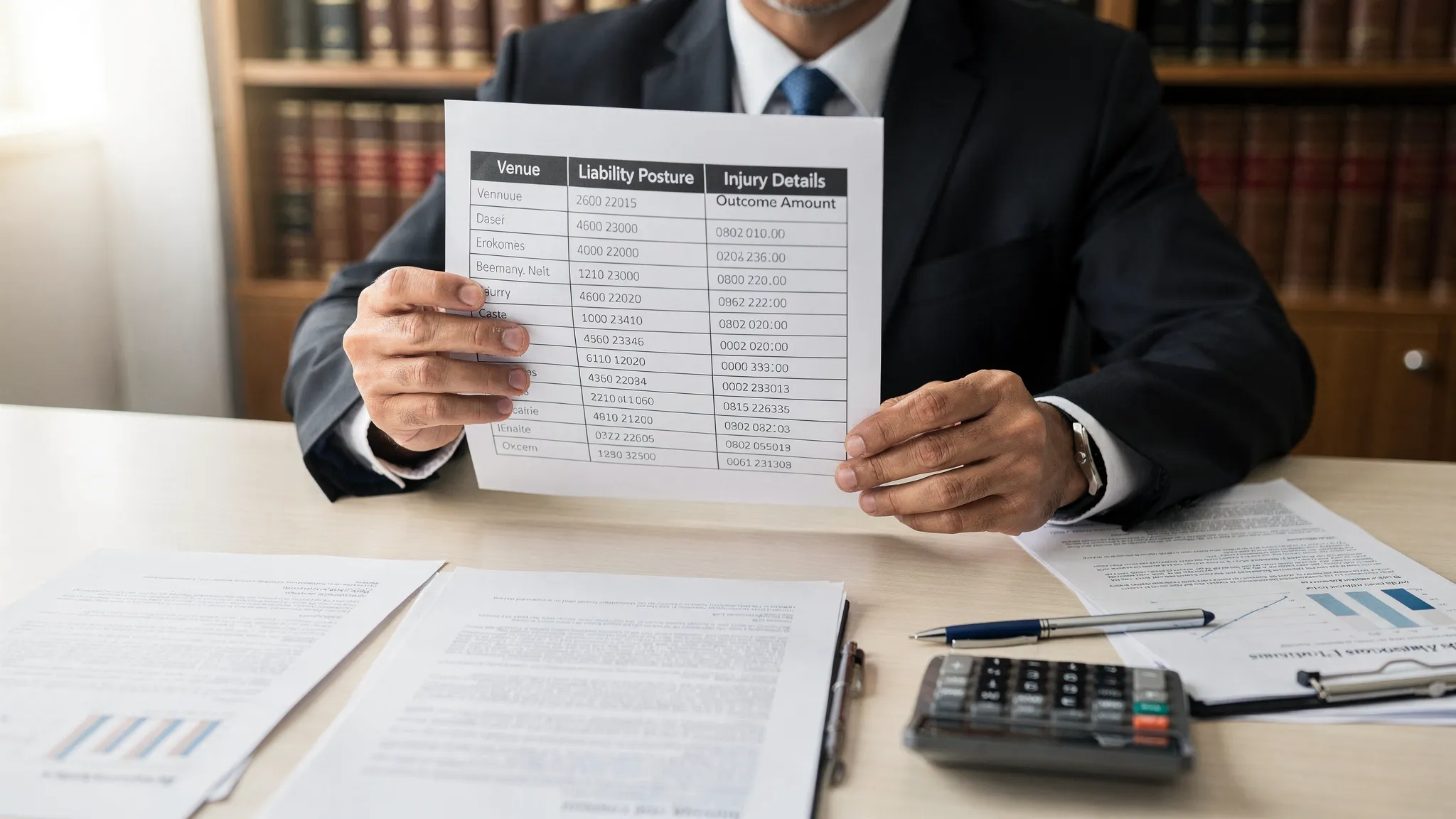
Step 4: Build a one-page comp sheet you can reuse
Keep it simple so it is easy to cite in a mediation statement or internal evaluation.
| Comp case | Venue | Liability posture | Injury and treatment | Verdict / settlement | Key driver (1 line) |
|---|---|---|---|---|---|
| Comp #1 | |||||
| Comp #2 | |||||
| Comp #3 | |||||
| Comp #4 | |||||
| Comp #5 |
Common mistakes that slow you down (and weaken your comps)
Mistake 1: Over-weighting the diagnosis name
A “herniation” verdict can be worth wildly different amounts depending on objective findings, symptom correlation, and treatment intensity. Mechanism, imaging, and clinical course usually matter more than labels.
Mistake 2: Ignoring the liability story
Two identical injuries can diverge dramatically if one case has clean liability and the other has comparative fault, low property damage arguments, surveillance, or inconsistent prior statements.
Mistake 3: Saving comps you cannot explain
If you cannot articulate in two sentences why a comp is similar, it will not hold up when opposing counsel challenges it.
Turning verdict research into work product (demands, depo, and trial)
Verdict research is most valuable when it feeds your next document, not when it lives in a spreadsheet.
Practical outputs you can generate from your comp set:
- Demand letter positioning: use comps to justify a range, then tie the range to your case drivers.
- Deposition outline targets: identify what sank similar cases (gaps in treatment, prior injuries, inconsistent complaints), then build clean deposition checkpoints.
- Settlement-focused insights: anticipate defense anchors you saw repeatedly in comps, and preempt them with exhibits and record excerpts.
If you want a lightweight way to draft non-litigation letters quickly (for example, a complaint letter to a vendor or a professional request), an AI letter generator can be useful for general-purpose correspondence. For case-critical legal drafting, keep your workflow anchored in your evidence and jurisdictional requirements.
How TrialBase AI can help you move from documents to comps faster
Verdict research usually requires you to cross-reference records, timelines, and themes. That is hard to do quickly when your medical records, discovery, and notes are scattered.
TrialBase AI is designed for intelligent litigation support from intake to verdict, helping legal teams turn uploaded documents into litigation-ready outputs in minutes, including:
- medical summaries
- deposition outlines
- demand letters
- trial material preparation
- instant case analytics and unified workflow management
The practical advantage for verdict research is speed to clarity. When your core facts are organized and summarized, it becomes much easier to filter for true comparables and explain why your case belongs in a specific value band.
Frequently Asked Questions
What is verdict research? Verdict research is the process of finding and analyzing prior verdicts and settlements to understand how similar cases resolved, especially within a given venue.
How many comparable outcomes do I need? Typically 3 to 7 strong comparables are more useful than 20 weak ones. You want enough to show a pattern, without diluting similarity.
What matters more, venue or injury similarity? In many cases, venue is the first filter. Then you refine by liability posture and treatment facts. A perfect injury match in a very different venue can mislead.
Can I rely on verdict summaries alone? Summaries are a starting point, but they can omit key drivers (credibility issues, treatment gaps, contested causation). Whenever possible, verify the facts through underlying documents or docket context.
CTA: Make verdict research actionable, not just searchable
If you are spending hours hunting for comps because your case file is not distilled into clean facts, timelines, and themes, consider using TrialBase AI to streamline your workflow. Upload your documents and generate medical summaries, deposition outlines, demand letters, and other litigation-ready materials in minutes at TrialBase AI.