Trial Themes: How to Build One Story From Messy Facts
.png)

Messy cases rarely lose because the law is wrong. They lose because the story is unclear. Trial themes are how you turn scattered documents, competing timelines, and technical details into one repeatable idea the jury can hold onto from voir dire to verdict.
A good theme is not your whole case. It is the organizing principle that makes your evidence feel inevitable.
What a trial theme actually is (and isn’t)
A trial theme is a short, plain-language statement that answers: “What is this case really about, in human terms?”
It is not:
- A closing argument packed with facts
- A legal standard recited in jury-instruction language
- A slogan so vague it fits any lawsuit
It is:
- Repeatable (you can say it 20 times without sounding scripted)
- Specific (it only fits your case)
- Provable (each key word can be supported by evidence)
- Fair-minded (it sounds like common sense, not spin)
Start with the “one sentence” that you can prove
When facts are chaotic, start by drafting a single sentence with three parts:
Actor + choice + consequence.
Examples (generic, not legal advice):
- Plaintiff: “They chose speed over safety, and someone paid the price.”
- Defense: “A bad outcome does not prove a bad decision.”
The goal is not perfection on day one. The goal is a sentence that helps you decide what matters and what is noise.
A practical method: from messy facts to a clean story
1) Build a ruthless case timeline
Before you write themes, make the case chronological. “Messy facts” are often just facts without sequence.
Create a working timeline that includes:
- What happened
- Who knew what, and when
- What was done (or not done)
- What changed after the event (repairs, charting, policy updates, denials)
You are looking for inflection points, the moments where a person had a choice.
2) Identify your “hinge moment”
Most trials revolve around one moment the jury will replay:
- The missed warning
- The shortcut
- The ignored policy
- The decision made with incomplete information
If you can name the hinge moment clearly, you can usually write a theme that explains why that moment happened and why it matters.
3) Choose a moral frame that fits the evidence
Jurors process cases through familiar “everyday rules.” Your theme should connect to one of those rules, without becoming melodramatic.
Common frames that tend to map well to proof:
- Responsibility and preventability
- Trust and betrayal
- Rules exist for a reason
- Foreseeability and warnings
- Accountability and honesty
Pick one frame, then test it against your hardest facts. If it collapses under cross, it is not your theme.
4) Translate legal elements into human questions
Elements and jury instructions matter, but jurors remember questions.
Instead of “breach,” try: “What did a careful person do here?”
Instead of “causation,” try: “Would this have happened if they did the safe thing?”
Your trial theme should help the jury answer those questions the same way, over and over.
5) Create 2 to 4 proof pillars (not 12)
A theme becomes persuasive when it has a small number of supporting pillars that can be proven cleanly.
Here is a simple mapping tool you can use to keep the story tight:
| Theme word or idea | What it means in plain English | Best proof type | Example witness/exhibit category |
|---|---|---|---|
| “Rushed” | Time pressure drove decisions | Timeline + policies | Email/text logs, scheduling records |
| “Ignored” | Warning signs were visible | Knowledge evidence | Training docs, prior incidents |
| “Preventable” | Safer option existed and was feasible | Alternative conduct | Expert, SOPs, industry standards |
| “Harm” | The consequence was real and measurable | Damages proof | Medical records, wage loss, photos |
If you cannot fill this table without hand-waving, your theme is not ready.
6) Stress-test the theme like the other side will
Write the best version of the opponent’s theme in one sentence. Then ask:
- Does my theme still sound fair?
- Can I prove each key word with admissible evidence?
- Is there a single exhibit that contradicts it?
A strong theme survives contact with the worst document in your file.
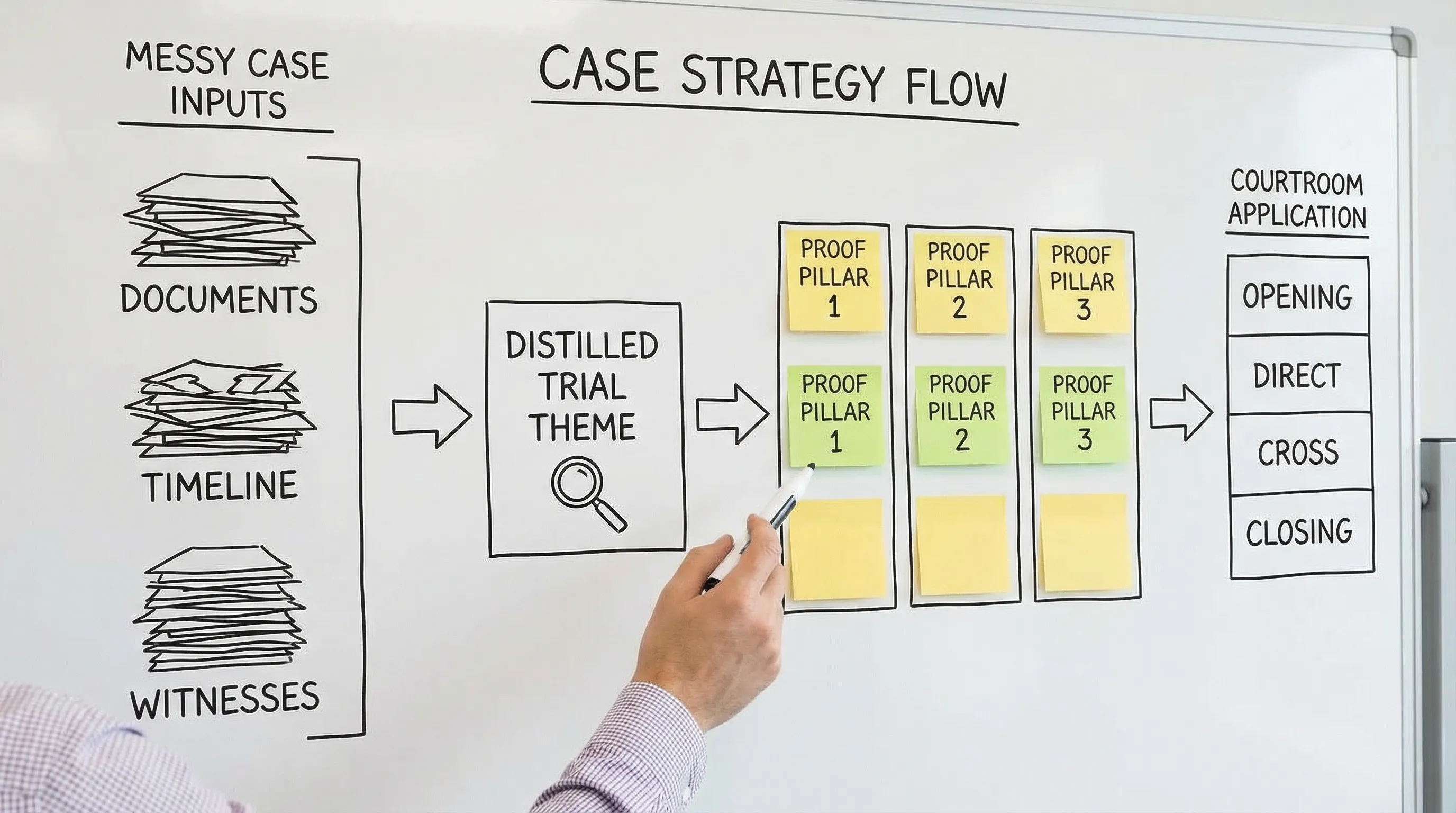
How to use your theme in the courtroom (without overdoing it)
Trial themes work because they create consistency. Use them as a routing rule:
In opening
State the theme early, then preview the pillars (not every fact). If your opening feels like a document dump, the theme is not doing its job.
On direct
Ask questions that reinforce the pillars. When a witness confirms a fact, tie it back to the theme’s plain-language idea (briefly).
On cross
Use the theme as your filter for what to attack. Cross should not be “everything that seems wrong.” It should be “what breaks their story.”
In closing
Bring the jury back to the hinge moment, then walk pillar by pillar through the proof that supports your theme.
Where themes go wrong (and how to fix them fast)
Most theme problems fall into three buckets:
- Too abstract: “This case is about safety.” Fix it by adding a choice and consequence.
- Too fact-heavy: “On May 12 at 3:42…” Fix it by moving details into pillars and exhibits.
- Too aggressive: “They didn’t care.” Fix it by using provable language (for example, “they didn’t follow their own rule”).
If you are unsure, read your theme to someone outside the case and ask what they think happened. If they cannot summarize it back, simplify.
Turning document chaos into a theme faster
Building trial themes is hard when your facts live across medical records, discovery PDFs, incident reports, and deposition transcripts. Tools can help you get to the hinge moments and proof pillars faster, as long as you still apply legal judgment.
If you want to reduce the time spent wrestling with raw documents, TrialBase AI is built for litigation support from intake to verdict. You can upload case materials and generate litigation-ready outputs like medical summaries, deposition outlines, and demand letters in minutes, then use those work products to pressure-test your theme against the record.