Trial Strategy in 30 Minutes: A Proof Plan You Can Reuse
.png)

Most “trial strategy” conversations start big (theme, story, jury appeal) and end up vague. In the real world, you need something you can build fast, reuse, and hand to a team member without losing the plot.
A proof plan is that tool. It is not a closing argument draft. It is a working grid that ties each legal element to admissible proof, the human who will deliver it, and the holes you still need to plug.
What a proof plan is (and what it is not)
A proof plan is a claim-by-claim map that answers one question: How will we prove each required element at trial, with what evidence, through which witness, and against what defense?
It is not:
- A memo full of case law.
- A timeline that never connects to elements.
- A theme statement without citations to testimony and exhibits.
If you can point to an element and say, “We do not have a witness or exhibit for that yet,” your proof plan is doing its job.
Trial strategy in 30 minutes: the build
You can get to a reusable first-pass proof plan in half an hour. The key is to timebox decisions and capture placeholders (you will refine later).
| Minutes | What you do | Output you should have |
|---|---|---|
| 0 to 5 | Choose the decision you must win (liability, causation, damages, or a key defense) and list the claims/defenses that will actually be tried | A short “scope list” of issues that matter |
| 5 to 10 | Write the elements for each claim/defense (use jury instructions or pattern instructions if available) | Element checklist you can’t hand-wave |
| 10 to 15 | For each element, write the best “case fact” in one sentence | One sentence per element, in plain English |
| 15 to 20 | Assign proof: primary witness + primary exhibit (or admission) per element | A minimum viable proof plan |
| 20 to 25 | Add the opponent’s best counter and your rebuttal proof | A plan that anticipates cross and defenses |
| 25 to 30 | Identify the top 3 gaps to close before depositions end | A short discovery and prep punch list |
A proof plan template you can reuse
Copy this structure into a doc or spreadsheet and reuse it across matters. It forces discipline, and it scales well when a team is dividing prep.
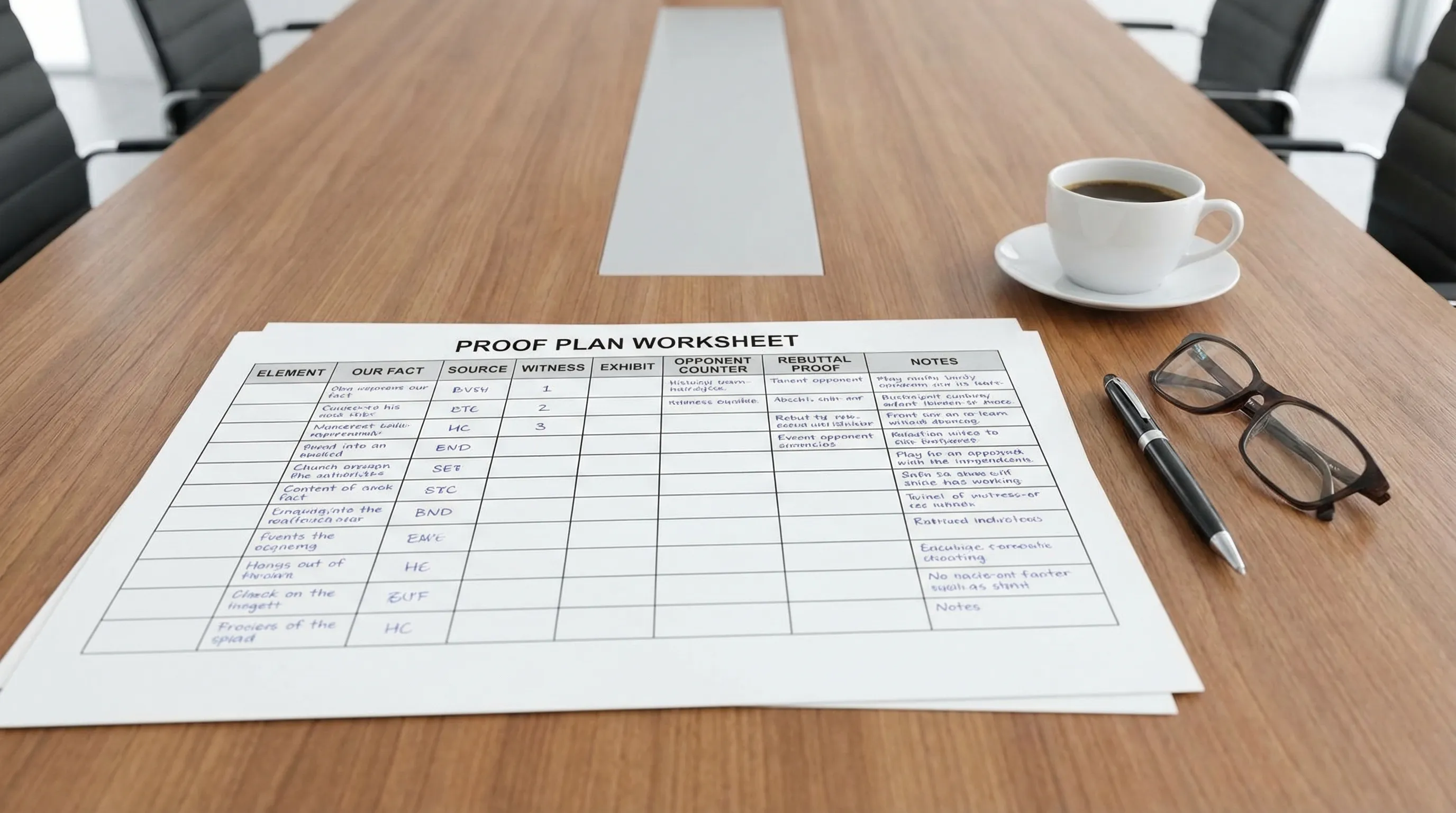
| Claim/Defense | Element to prove | Our best fact (1 sentence) | Proof source (cite) | Witness to deliver it | Exhibit/admission | Likely counter | Rebuttal proof | Status |
|---|---|---|---|---|---|---|---|---|
| (Fill in) | (Fill in) | (Fill in) | (Record cite, bates, depo page/line) | (Name) | (Exhibit #, request for admission, stip) | (Fill in) | (Fill in) | (Green/Yellow/Red) |
How to fill the columns quickly (without overthinking)
- Element to prove: Paste it in. Do not rewrite it creatively. Precision matters.
- Our best fact: One sentence, no adjectives. If it sounds like argument, rewrite it as a verifiable fact.
- Proof source: Use tight citations (Bates ranges, depo page and line, medical record date, photo filename). Your future self will thank you.
- Witness to deliver it: If the witness is “TBD,” mark it Yellow or Red. Trial is people, not binders.
- Likely counter: Write the other side’s strongest sentence, not a strawman.
The 10-minute stress test that makes this “trial strategy,” not paperwork
Once the grid is filled, do a quick stress test:
- Coverage test: Every element has at least one witness and one exhibit/admission.
- Admissibility sniff test: For each key exhibit, ask “What foundation do we need, and who lays it?”
- Cross-exposure test: For each witness, note one credibility risk or impeachment exhibit.
A useful mental model is a “playtest.” In strategy games, you do not wait until tournament day to see if the plan collapses. You run a few test hands, adjust, and iterate. If you want a fun reminder of that mindset, you can even playtest strategy with friends on a free platform like TableCommander and notice how quickly a plan improves once it is put under pressure.
Where TrialBase AI fits in this workflow
A proof plan is only as good as the raw material you feed it. When the record is large, the bottleneck is often turning documents into usable, citable building blocks.
TrialBase AI is designed for exactly that kind of compression: you upload your documents and generate litigation-ready outputs in minutes, including medical summaries, deposition outlines, demand letters, and trial materials. Practically, that can help you:
- Extract the “one sentence per element” facts faster from a messy record.
- Build deposition outlines that track directly to proof-plan gaps.
- Keep the team aligned in a unified workflow, so updates to the record translate into updated trial prep.
If you want to see the platform’s scope, start here: TrialBase AI.
Common proof-plan mistakes (and fast fixes)
These are the errors that quietly wreck trial strategy, even for experienced teams:
- You wrote a theme instead of proof: Fix by converting each theme sentence into a fact that can be supported by a cite.
- You ignored defenses until too late: Fix by giving each major defense its own row and assigning rebuttal proof now.
- Key elements rely on “we’ll get it in somehow”: Fix by adding a foundation note (who authenticates, who sponsors, hearsay exception if relevant).
- Damages are treated as a number, not an element-driven story: Fix by breaking damages into sub-facts (past, future, causation link, reasonableness if applicable) and mapping proof for each.
Keep the template, reuse the thinking
The point of doing this in 30 minutes is not perfection. It is to create a reusable structure that forces clarity early, exposes gaps while you can still fix them, and gives every later task (discovery, depositions, motions, exhibit lists) a single source of truth.
Run this proof plan at intake, refresh it after major depositions, and treat it as the backbone of your trial strategy, not an optional worksheet.