Trial Prep Checklist: From Motions in Limine to Exhibits
.png)

Trial prep has a way of feeling “done” right up until it isn’t. The fastest way to reduce last-minute risk is to run the same trial prep checklist every time, tie each item to an owner, and confirm it against your jurisdiction’s scheduling order and local rules.
Below is a practical checklist that covers the typical path from motions in limine to exhibits, plus the operational details that often cause avoidable stress in the final week.
Start with the non-negotiables (48 to 72 hours)
Before you debate strategy, lock the deadlines and the format requirements.
- Confirm the court’s scheduling order deadlines for pretrial filings, exhibit and witness exchanges, and jury materials.
- Pull the judge’s individual practices and courtroom tech rules (many courts publish these on their website).
- Build a single “trial binder index” outline now (even if the folders are empty today) so every file has a destination.
If you are in federal court, it helps to keep the baseline rules handy, for example FRCP 26 disclosures and FRCP 32 deposition use. Your local rules and the judge’s orders still control.
Motions in limine (MILs)
Motions in limine are not just legal writing, they are trial choreography. The goal is to prevent you from fighting in front of the jury.
What to draft and confirm
Write a tight list of evidentiary “no-go zones” and the authority that supports excluding them.
- Prior incidents, collateral source issues, insurance references, criminal history, immigration status (as applicable)
- Undisclosed witnesses or late-produced documents
- Expert scope limits (what the expert can and cannot say)
- Any “golden rule” or improper argument concerns
What to prepare for the hearing
Have short, judge-friendly backup ready.
- A one-page MIL roadmap with each request, the rule, and the precise relief
- Pinpoint citations to deposition testimony or discovery responses showing the issue will arise
- A proposed limiting instruction, if the judge prefers that over exclusion
Witnesses: availability, order, and impeachment
Witness logistics routinely break trial schedules, especially with experts and treating providers.
Confirm the witness plan
- Final witness list, including “may call” witnesses (if allowed) and any sequencing constraints
- Availability windows, travel, and remote appearance requirements
- Subpoenas issued, served, and calendared for follow-up
Build the examination materials
You do not want to be assembling these during openings.
- Direct and cross outlines that track your elements and themes
- Impeachment packets for key witnesses (prior depo pages, inconsistent statements, exhibits)
- A clean “witness folder” for each witness: bio, contact, expected testimony, demonstratives, and admits/denies
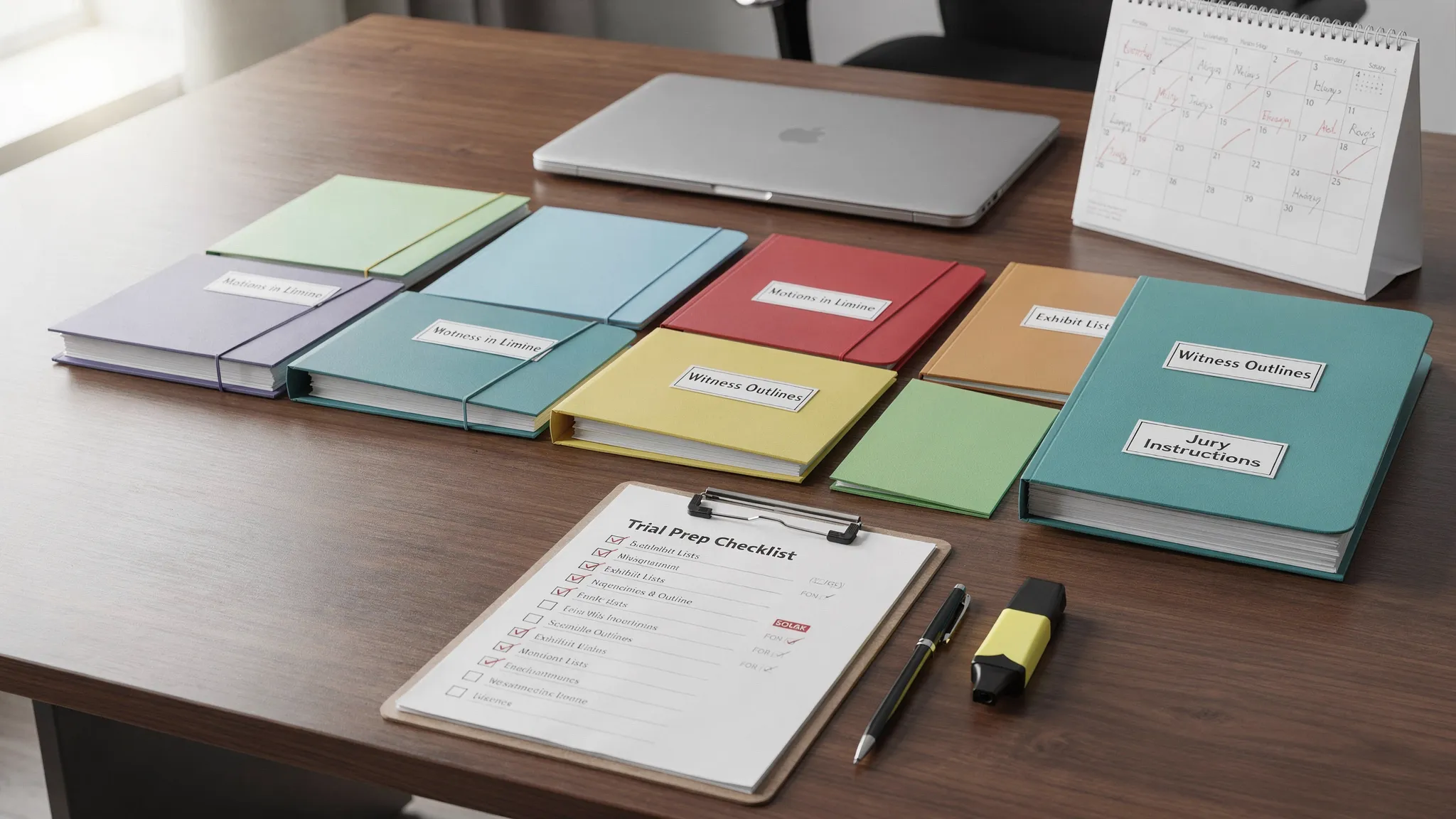
Exhibits: numbering, foundation, and objections
Exhibit chaos is one of the fastest ways to lose credibility in front of the court.
Assemble the master exhibit set
- Exhibit list in the required format (court-specific)
- Exhibit numbering scheme that matches your jurisdiction’s expectations
- Final, printable versions of each exhibit (with Bates ranges if used)
Pre-mark and pre-fight objections
Do the work early so trial time stays focused on the story.
- Foundation notes: who sponsors, what testimony is needed, and any authenticity stipulations
- Hearsay exceptions and business records predicates where relevant
- A running objections log (your objections and theirs) with short responses
Make sure your exhibit plan matches your theme
If an exhibit does not advance a claim element, damages, liability, or credibility, consider cutting it. Less paper often means more persuasion.
Jury instructions, verdict form, and trial brief
These documents are not administrative. They are how you translate your case into the decision the jury is allowed to make.
- Proposed jury instructions with citations and bracketed options resolved
- Verdict form that mirrors your theory of liability and damages without inviting ambiguity
- A short trial brief focused on disputed legal issues the judge will face during trial
Tip: pressure-test the verdict form with a colleague unfamiliar with the case. If they cannot explain how the jury gets from Question 1 to damages, revise.
Demonstratives and trial technology
Even strong cases lose momentum when screens do not work or demonstratives do not match the witness.
Technology checks to run
- Confirm courtroom presentation method (HDMI, document camera, in-court system, or your own setup)
- Test your exhibit decks offline (do not rely on Wi‑Fi)
- Prepare printed backups of critical demonstratives and key exhibits
Demonstratives to finalize
- Timelines, medical treatment summaries, wage loss calculations, scene diagrams (as applicable)
- An exhibit call-out plan (what you will display during each witness)
A simple ownership table (use this as your last-week control panel)
Use a single table to prevent “I thought you had that” problems.
| Trial prep item | Owner | Due date | Status check |
|---|---|---|---|
| Motions in limine (draft + exhibits) | Attorney | Per scheduling order | Filed + conformed copy saved |
| Witness list and subpoenas | Paralegal | Per scheduling order | Service confirmed |
| Direct/cross outlines (key witnesses) | Attorney | 3 to 5 days pretrial | Reviewed and synced |
| Master exhibit list + final PDFs | Legal ops / paralegal | Per scheduling order | Numbering verified |
| Objections and responses chart | Attorney | 2 to 3 days pretrial | Finalized for hearing |
| Jury instructions + verdict form | Attorney | Per scheduling order | Filed + editable version saved |
| Tech rehearsal | Trial team | 1 to 2 days pretrial | Full run completed |
The day-before and day-one checklist
Keep this short and ruthless.
- Print your “first 30 minutes” plan: what you will say, what you will show, who you will call first
- Confirm witness arrival times and where they should wait
- Make sure exhibit access is redundant (laptop + USB + printed core set)
- Prepare a short bench memo for any likely evidentiary disputes
Frequently Asked Questions
What is the most important part of a trial prep checklist? The part you actually run. A consistent checklist with clear ownership and deadlines prevents last-minute exhibit and witness problems that derail trial flow.
When should I start motions in limine? Start as soon as you can identify predictable evidentiary fights from depositions and discovery. Waiting until the deadline often produces rushed citations and weaker relief.
How do I keep exhibits organized for trial? Use a single master exhibit list, a stable numbering convention, and final PDFs in one shared location. Add foundation notes so any team member can admit the exhibit.
What should be in a witness folder? Contact info, expected testimony, direct and cross outline, key exhibits for that witness, and a small impeachment set (depo pages and prior statements).
Make trial prep faster (and more consistent) with TrialBase AI
If your team is manually turning document piles into deposition outlines, medical summaries, demand letters, and trial materials, the bottleneck is not effort, it is workflow.
TrialBase AI provides intelligent litigation support from intake to verdict, helping you transform uploaded documents into litigation-ready outputs in minutes so you can spend more time on strategy and less time assembling first drafts.
Explore TrialBase AI here: ai.trialbase.com