Trial Outline: A Practical Template for Story and Proof
.png)
A good trial outline does two jobs at once: it tells a coherent story a jury can follow, and it maps every story beat to admissible proof. If either side is missing, openings drift into argument without evidence, or the proof arrives as a confusing pile of facts.
Below is a practical, courtroom-ready trial outline template you can adapt to most civil cases (especially PI/med mal/employment) to keep “story” and “proof” locked together.
What a trial outline is (and what it is not)
A trial outline is a working roadmap that connects:
- Your case theme and narrative arc
- The elements you must prove (and defenses you must defeat)
- The witnesses, exhibits, and admissions that supply proof
- The order and purpose of each trial segment (opening, direct, cross, closing)
It is not a verbatim script. It is also not just a witness list. Think of it as a control panel that lets you see, at a glance, what you want the jury to believe and exactly where the record will support it.
The “Story and Proof” trial outline template
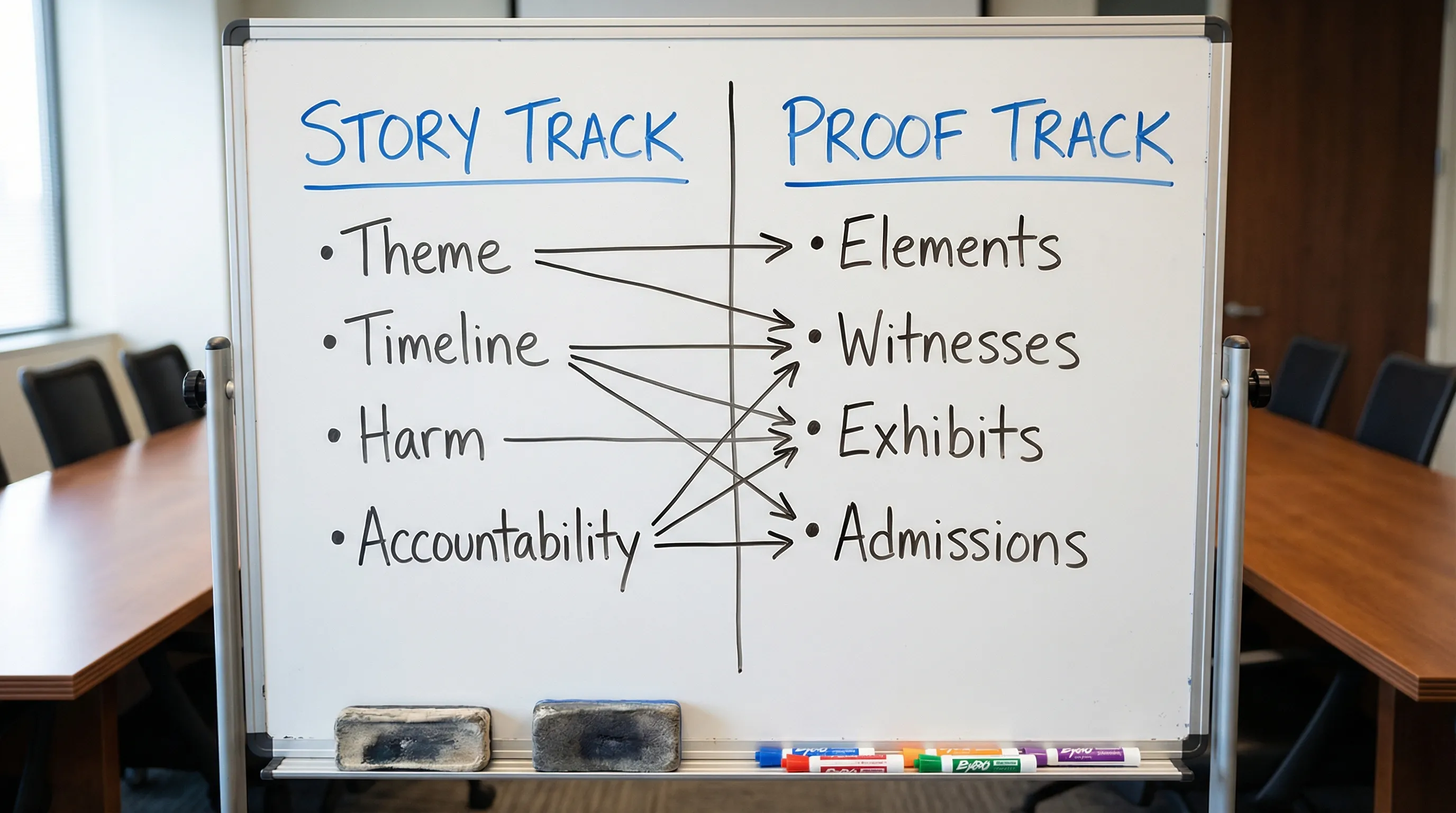
Use a two-track structure:
- Story track: what the jury should understand and feel at each step
- Proof track: the specific record support (witness + exhibit + element)
Core template (copy/paste)
Build your outline in sections like this.
1) Case theory in one paragraph
Write the case in plain English, no legalese. If you cannot say it simply, the jury will not retain it.
2) Theme and counter-theme
- Theme (your moral of the story): “Safety rules exist because shortcuts hurt people.”
- Counter-theme (what you must neutralize): “Accidents happen, and no one could prevent this.”
3) Elements checklist (with “proof slots”)
Create a list of the elements and add placeholders for the best proof you have for each. This prevents the classic failure mode: a compelling narrative that misses one required element.
4) Story beats mapped to proof (the working table)
This is the heart of the trial outline.
| Story beat (what the jury learns) | Element/issue | Best witness | Best exhibit/admission | Vulnerability to fix |
|---|---|---|---|---|
| Defendant chose speed over safety | Breach / standard of care | Safety manager / 30(b)(6) | Policy + training log + email | Foundation + hearsay path |
| That choice set the harm in motion | Causation | Treating physician / expert | Imaging + timeline chart | Alternative causes |
| Plaintiff’s life changed in concrete ways | Damages | Plaintiff + spouse + employer | Wage records + photos | Credibility / exaggeration |
Keep this table alive as discovery closes and motions in limine land. If an exhibit is likely excluded, you should see immediately which story beat is now under-supported.
How to draft the outline fast (without sacrificing accuracy)
Start with the verdict question
Write the exact question you want jurors to answer “yes” to. Then work backward:
- “What must they believe to answer yes?”
- “What will they need to see or hear to believe it?”
That backwards chain becomes your structure.
Build around a timeline, then layer elements
Jurors think in sequences. Lawyers think in elements. You need both.
Draft a clean timeline first (key moments only), then attach elements and proof to each moment. This prevents “element hopping,” where you prove duty, then jump to damages, then back to breach, and lose the room.
Add a “proof sufficiency” check before you finalize
For each story beat, ask:
- Do we have at least one clean witness path to get this in?
- Do we have a second route if the first is impeached or excluded?
- Do we know the foundation steps (authorship, business records, chain of custody)?
If the answer is no, you do not have a trial outline yet, you have a wish list.
Plug the outline into each trial phase
Opening statement
Use the outline to select 5 to 9 story beats only. More is not better. Your goal is a promise: “Here is what the evidence will show.”
Direct examinations
Turn each witness into a mini-proof delivery system:
- Their purpose in one sentence (what story beat they deliver)
- The two or three exhibits they authenticate or explain
- The single concession you must lock down
Cross examinations
Cross is where your counter-theme lives. For each opposing witness, pre-write:
- The point of cross (one point)
- The three best admissions (tight, leading, undeniable)
- The exhibit that forces agreement
Closing argument
Closing becomes easy when the outline is built well: you simply replay the story beats and “check off” proof.
Special note: when social media is part of the story
If identity, timelines, or online behavior matter, consider how content appears across devices and platforms so your demonstratives match jurors’ real-world experience. For example, you can sanity-check how profile images render in different layouts using a tool like Social Previewing before you lock a screenshot into a deck or board.
Frequently Asked Questions
What’s the difference between a trial outline and a witness outline? A trial outline covers the whole narrative and element-proof map across phases of trial. A witness outline is narrower: one person’s testimony, exhibits, and goals.
How long should a trial outline be? Long enough to prevent gaps, short enough to use in real time. Many teams keep a 1 to 3 page “spine” plus supporting witness/exhibit outlines.
Should the trial outline follow the order of witnesses or the order of events? Usually events first, then map witnesses to events. You can still present witnesses out of order, but your internal logic stays chronological.
When should I finalize my trial outline? You should draft early, then tighten after key depositions, expert disclosures, and motions in limine. Treat it as a living document until pretrial.
Turn your documents into a trial-ready outline faster
If your bottleneck is turning a record into usable work product, TrialBase AI is designed for litigation support from intake to verdict. You can upload case documents and generate items like medical summaries, deposition outlines, demand letters, and trial materials in minutes, then use the outputs to populate (and pressure-test) the story-and-proof structure above.
Explore how it fits your workflow at TrialBase AI.