Trial Litigation: Pretrial Tasks That Move the Needle
.png)
Trial litigation is rarely won on the courthouse steps. It is won in the weeks and months before trial, when you turn a messy fact pattern into a tight story, a provable damages model, and a clean evidentiary record.
Below are the pretrial tasks that consistently “move the needle”, meaning they create leverage for settlement, reduce trial risk, and make your team faster and sharper when the judge asks, “Counsel, where is that in the record?”
1) Lock a case theory that matches the elements (and the evidence you can actually get)
A strong theory is not a slogan. It is a map from legal elements to admissible proof.
What tends to move outcomes is doing this early, then revisiting it after key discovery events (initial disclosures, first record productions, core depositions).
Practical outputs that pay off:
- A one-page “elements to proof” chart (claim, element, supporting documents, supporting testimony, gaps).
- A live timeline/chronology that cites Bates numbers.
- A damages model you can explain in 60 seconds.
If you are in federal court, keep one eye on the structure discovery is built around, including the Rule 26(a) initial disclosure framework. The point is not academic compliance, it is making sure your theory stays anchored to what will be admissible.
2) Turn document chaos into a usable record (chronology + issues) before depositions
Depositions do not fix a disorganized record. They expose it.
Before your first “critical path” deposition, do the work that makes questioning surgical:
- Build a dated chronology with citations (Bates and page).
- Tag documents by issue (liability, causation, notice, damages, impeachment).
- Identify the 10 to 20 “must-use” documents for each key witness.
This is also where speed matters. If your intake includes medical records, police reports, adjuster notes, incident reports, or prior statements, converting them into a clean summary and timeline early tends to improve everything that follows (deposition outline quality, expert inputs, mediation posture).
Tools that analyze uploads and generate litigation-ready outputs can help here, but treat every AI-generated summary as a draft that must be verified against the source.
3) Design discovery around decision points, not habit
In trial litigation, discovery that moves the needle is discovery that answers “Can we win?” and “What is this case worth?” with confidence.
A useful way to keep discovery lean is to define decision points up front, for example:
- Is liability provable with independent evidence, or does it hinge on credibility?
- Is causation clean, or expert-dependent?
- Are there damages multipliers or reducers (pre-existing conditions, mitigation, apportionment, offsets)?
Then build targeted requests, subpoenas, and depositions around those decision points.
4) Win the expert battle before trial week (retention, record, and challenge strategy)
Expert issues often decide the ceiling of the case (and sometimes whether the case survives at all). Pretrial leverage increases when your expert plan is clear early.
Needle-moving expert tasks:
- Retain experts early enough to influence discovery (not just to write a report).
- Confirm the record supports every key opinion (and identify missing facts while you can still obtain them).
- Identify the opposing expert’s vulnerable assumptions and data gaps.
If your jurisdiction applies a Daubert-style reliability gatekeeping approach, your best time to plan is long before motion deadlines. The Federal Rule of Evidence 702 amendment materials are a helpful reference point for how courts analyze admissibility, even when you are not in federal court.
5) Treat depositions like trial: designations, clips, and impeachment packets
Many teams “take” depositions. Trial-ready teams “build” depositions.
Pretrial tasks that move the needle here:
- Create a one-page goal sheet per witness (what you must establish, what you must eliminate).
- Prepare impeachment packets tied to specific expected denials.
- After the depo, immediately flag page-line designations and counter-designations.
The biggest avoidable mistake is waiting until the pretrial order is due to start designations. By then, you are optimizing under time pressure instead of optimizing for impact.
6) Build your exhibit set early, then cut it down hard
Judges and juries reward clarity. A smaller, cleaner exhibit list typically performs better than a sprawling one.
Needle-moving pretrial exhibit work:
- Start with a “proof exhibits” set aligned to elements and damages.
- Add only what you will actually publish or use for impeachment.
- Pre-authenticate where possible (stipulations, custodian declarations where permitted).
- Run an admissibility check (relevance, hearsay purpose, foundation, prejudice).
A practical rule: if you cannot explain the purpose of an exhibit in one sentence, it is a candidate to cut.
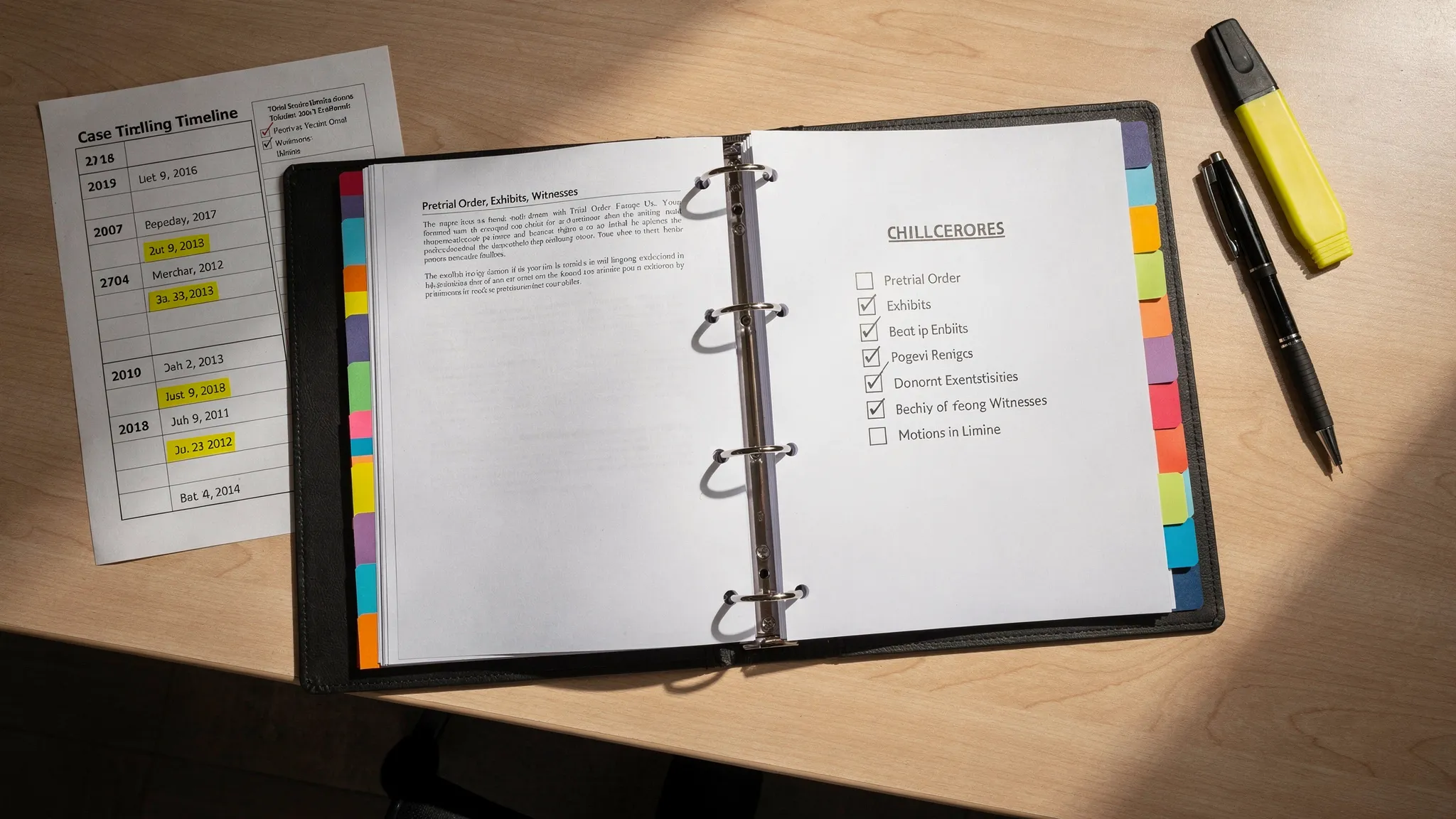
7) File motions that change leverage (not motions that fill space)
Not every motion is worth the time. The pretrial motions that tend to change outcomes are the ones that:
- Narrow claims/defenses or exclude entire categories of damages.
- Knock out unreliable expert opinions.
- Exclude high-risk evidence through motions in limine.
- Force clarity on what will and will not be tried.
If you are deciding where to invest, prioritize motions with a clear “if we win this, the case value shifts” effect.
8) Treat mediation and settlement posture as a deliverable, not an event
Settlement outcomes improve when your pretrial work produces a compelling, trial-ready package.
What “moves the needle” is not length, it is structure:
- Liability story supported by a clean chronology.
- Damages presentation that is easy to audit (medical summary, specials, wage loss, future care where applicable).
- A short “risk memo” that anticipates defenses and explains why they fail.
For plaintiff-side matters, this is where high-quality demand letters and medical summaries can materially change the negotiation dynamic. For defense, a well-supported valuation and exposure analysis can prevent late surprises.
A quick prioritization table (useful for staffing and calendar planning)
| Pretrial task | “Needle” impact | Best time to start | Common failure mode |
|---|---|---|---|
| Case theory tied to elements | Very high | Immediately after intake, revisit after key productions | Theory drifts from evidence actually obtainable |
| Chronology + issue tagging | Very high | Before core depositions | Timeline exists but lacks citations |
| Expert plan + record support | High | As soon as expert-dependent issues appear | Retain late, then backfill facts under deadline |
| Depo designations + impeachment | High | Right after each deposition | Scramble at pretrial order time |
| Exhibit set + admissibility check | Medium to high | Mid-discovery, refine continuously | Exhibit bloat, weak foundation |
| Motions in limine / Daubert strategy | High | After key depositions and expert reports | Filing everything, winning nothing |
| Mediation package (liability + damages) | High | 2 to 6 weeks before mediation | Demand/offer not anchored to a provable record |
Where TrialBase AI fits (without changing your workflow)
If your bottleneck is turning large document sets into usable litigation work product, TrialBase AI is designed for exactly that: upload documents and generate demand letters, medical summaries, deposition outlines, and other trial materials in minutes. The best use is to accelerate first drafts and organization, then have counsel confirm citations and tailor strategy.
When trial litigation is the context, speed matters, but precision matters more. The teams that consistently outperform are the ones that build a clean record, pick the motions that shift leverage, and arrive at the final pretrial conference already trial-ready.
If you want to see how that looks in practice, start at TrialBase AI and test it on a real case file (with your normal review standards).