Trial Document Checklist: What to Prep Before Pretrial
.png)
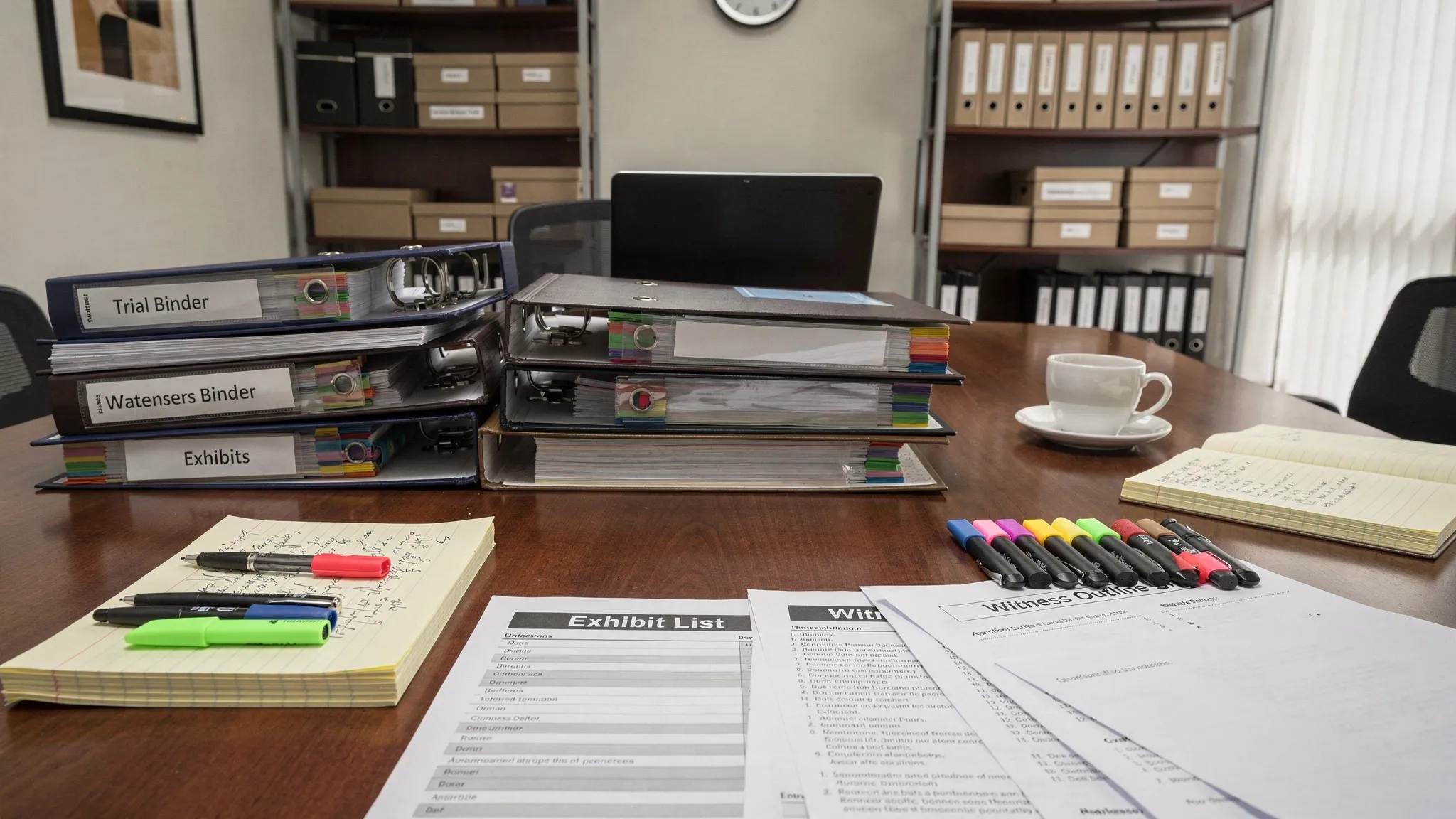
Pretrial is where strong cases are won or quietly weakened. The difference is rarely brilliance at counsel table, it is whether your trial documents are complete, consistent, and judge-ready before the final pretrial conference.
This trial document checklist focuses on what most litigators and trial teams need to prep before pretrial (and what commonly gets missed). Always confirm your court’s local rules, standing orders, and the judge’s pretrial order.
Start with the nonnegotiables: your court’s requirements
Before you perfect a binder, confirm the rules that control format and deadlines.
- The court’s local rules and the assigned judge’s standing orders
- The scheduling order and any amended trial setting orders
- The required contents of the joint pretrial statement or proposed pretrial order
- Exhibit labeling conventions, deposition designation procedures, and page limits
A practical reference point for federal cases is the Federal Rules of Civil Procedure (plus your district’s local rules), but the judge’s order controls the details.
Your “source of truth” file: the proposed pretrial order / joint pretrial statement
Most pretrial chaos comes from teams preparing documents in parallel without a single authoritative version of the case.
Typical sections you will want drafted, proofed, and internally aligned:
- Claims and defenses that will be tried (and what is out)
- Stipulated facts and disputed facts
- Witness lists (with time estimates, if required)
- Exhibit lists (with objections, if required)
- Deposition designations and counter-designations
- Damages theories and computations (in the form your court expects)
- Trial date logistics, tech needs, interpreter needs, and special issues
If your case has multiple parties, treat the pretrial order as a project management document: version control, an owner for each section, and a final reconciliation pass.
Trial document checklist (by category)
Use this as a working checklist, not a one-time printout. The goal is consistency across lists, briefs, and what you actually plan to put in front of the judge and jury.
1) Core case documents (clean, final, and consistent)
These are the items you will cite repeatedly at pretrial and trial.
- Operative complaint and all answers
- Any amended pleadings and relevant orders
- Key rulings on dispositive motions (summary judgment orders, dismissal orders)
- Important stipulations and prior agreements
- A current chronology of events that matches the evidence you intend to use
2) Discovery record and what you may need to use at trial
You do not need to bring “all discovery,” but you do need the parts that support exhibits, impeachment, and admissibility foundations.
- Verified interrogatory answers you may use (admissions, positions, damages)
- Requests for admission and responses (and a list of what is deemed admitted)
- Key document productions with Bates ranges you will rely on
- Authenticity stipulations (if any) and custodial declarations (if applicable)
3) Exhibit set (with a plan for admissibility)
Exhibits are where good cases get delayed. Your exhibit list should not be aspirational.
- Final exhibit list in the court-required format
- Exhibits labeled exactly as required (numbers, prefixes, stickers, electronic naming)
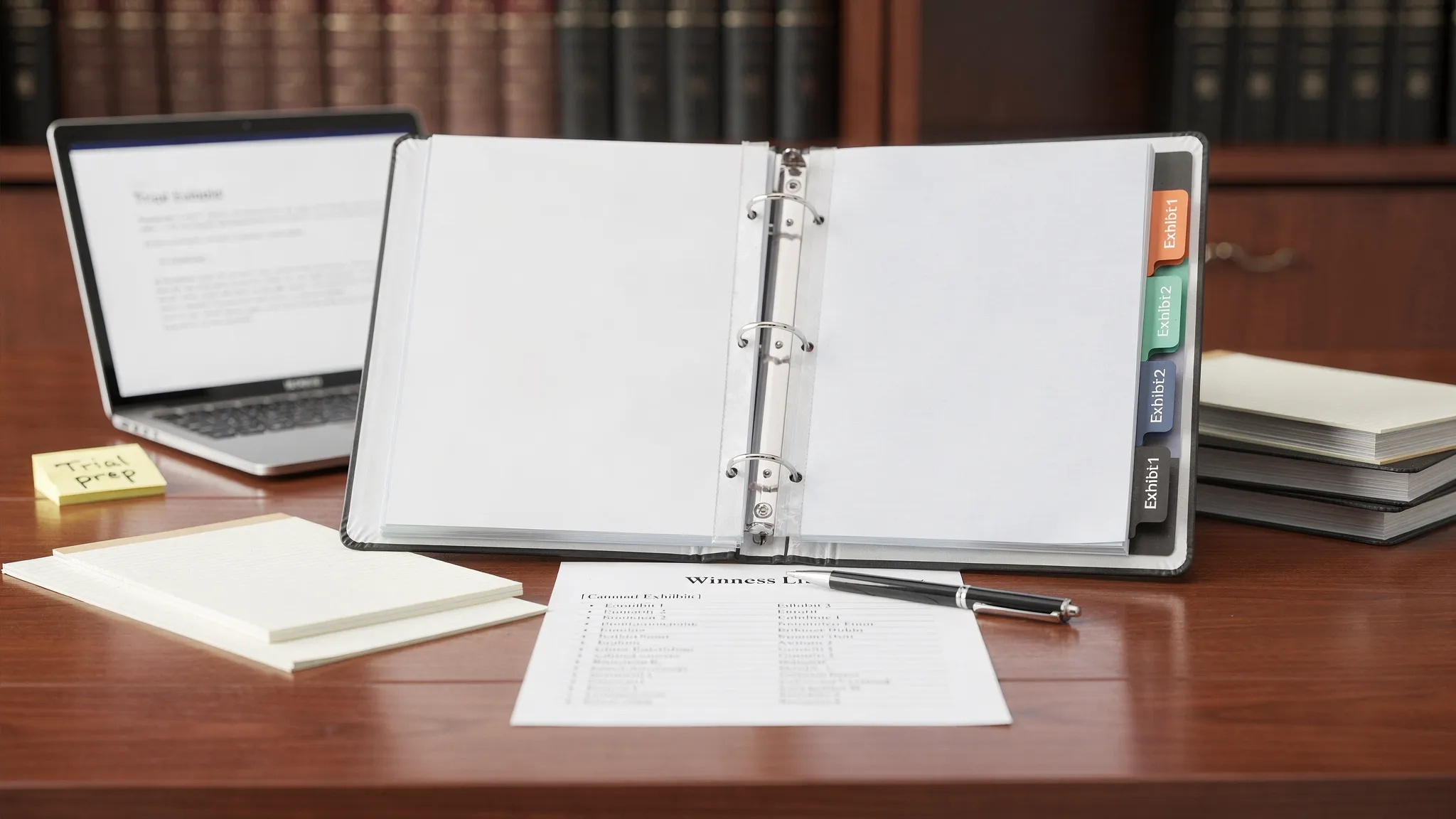
- An exhibit notebook or electronic folder structure that mirrors the exhibit list
- A short admissibility plan for each “important” exhibit (foundation witness, rule, purpose)
- Redacted versions where needed (privacy, insurance, collateral source, irrelevant prejudice)
4) Witness file (direct, cross, and logistics)
Pretrial is not the time to “figure out” witness sequencing or what each witness proves.
- Final witness list (including will-call, if permitted)
- Short witness summaries (what they prove, key exhibits they authenticate)
- Direct examination outlines for friendly witnesses
- Cross examination outlines and impeachment packets for adverse witnesses
- Subpoenas, service status, and appearance logistics
5) Deposition designations (and counter-designations)
If you have video depositions, treat designations like a mini trial.
- Designation charts with page:line citations
- Counter-designations and objections
- Rulings log (once the court rules), with “play list” timestamps if video will be shown
- Clean clips or organized segments consistent with the court’s playback requirements
6) Expert materials (tight and court-ready)
Expert issues often surface at pretrial because the paperwork was “technically produced” but not trial-usable.
- Expert reports and CVs
- Daubert or admissibility motions and responses (if applicable)
- Expert deposition excerpts you may use
- A simplified summary of opinions linked to the specific exhibits and facts you will prove
7) Motions in limine and other pretrial motions
These shape what the jury will actually hear.
- Motions in limine (filed and responses) with exhibits attached as required
- Trial briefs or legal memoranda (if the court requests them)
- Proposed limiting instructions (if you expect the court to admit evidence with limits)
8) Jury instructions and verdict form (drafted early, refined late)
Even in a bench trial, the equivalent is proposed findings and conclusions.
- Proposed jury instructions in the required format (and a source list)
- Objections to the other side’s proposed instructions
- Proposed verdict form or special interrogatories
- A short “elements checklist” mapping claims/defenses to witnesses and exhibits
9) Damages support that is simple enough to present
A pretrial conference is not the place for a damages theory that requires explanation.
- A clear damages chart (categories, amounts, sources)
- Medical specials documentation (bills, coding summaries, liens where relevant)
- Wage loss and earning capacity support (records, calculations, assumptions)
- Non-economic damages plan (theme, anchors, supporting testimony)
10) Trial presentation materials and technology plan
Courts increasingly expect you to have this figured out.
- Demonstratives (and disclosures if required)
- Exhibit presentation method (ELMO, trial presentation software, printed boards)
- Equipment check plan and backups
- A list of any items requiring advance approval (courtroom internet, screens, speakers)
A simple ownership map (so nothing slips)
A checklist works best when each trial document has an owner and a deadline.
| Trial document | Why it matters at pretrial | Typical owner |
|---|---|---|
| Joint pretrial statement / proposed pretrial order | Controls what will be tried and how | Lead counsel with paralegal support |
| Exhibit list + labeled exhibits | Prevents delays, supports admissibility | Paralegal or litigation support |
| Witness list + outlines | Clarifies proof and sequencing | Assigning attorney per witness |
| Deposition designations | Avoids last-minute objections and edits | Attorney who took/defended depo |
| Motions in limine | Defines what the jury can hear | Motion lead |
| Jury instructions + verdict form | Frames elements, preserves issues | Trial lead / research attorney |
| Damages summary | Makes the ask coherent and credible | Damages lead |
Quality control: the three consistency checks
Before you finalize, run these checks across your pretrial packet.
Exhibit list consistency check
Confirm exhibit numbers, file names, and Bates ranges match across:
- Exhibit list
- Witness outlines
- Deposition designations
- Motions in limine and trial brief citations
Claims-elements check
For each claim or defense you expect to try, confirm you have:
- A clean elements statement (jury instruction language helps)
- At least one witness and one exhibit (or a deposition excerpt) supporting each element
Objections and redactions check
Make sure you are not surprising yourself at trial with preventable issues.
- Privacy redactions finalized
- Duplicates removed
- Hearsay and foundation issues identified with a plan (stipulation, witness, or alternative exhibit)
Speeding up pretrial prep with AI (without losing control)
Pretrial work is document heavy: medical records, depositions, discovery responses, and exhibits that must line up. Tools can help, but the goal is not automation for its own sake, it is to produce trial-ready work product faster with fewer misses.
TrialBase AI is designed for litigation support from intake to verdict. If you are building pretrial materials under time pressure, it can help you turn uploaded case documents into practical outputs in minutes, such as:
- Medical summary creation
- Deposition outline generation
- Trial material preparation
- Unified workflow management and collaboration
If you want to reduce the time spent drafting and organizing core trial documents while keeping attorney judgment in the loop, you can explore TrialBase AI.
Final pretrial “day before” pack
If you do nothing else, make sure you can walk into pretrial with:
- A clean, final proposed pretrial order or joint pretrial statement
- Final witness and exhibit lists that match your internal folders
- Your top motions in limine and the exact relief requested
- Your jury instructions and verdict form draft (or bench trial equivalents)
- A one-page case theme and a one-page damages summary for internal alignment
That combination prevents most last-minute scrambling, and it makes every other trial document easier to finalize.