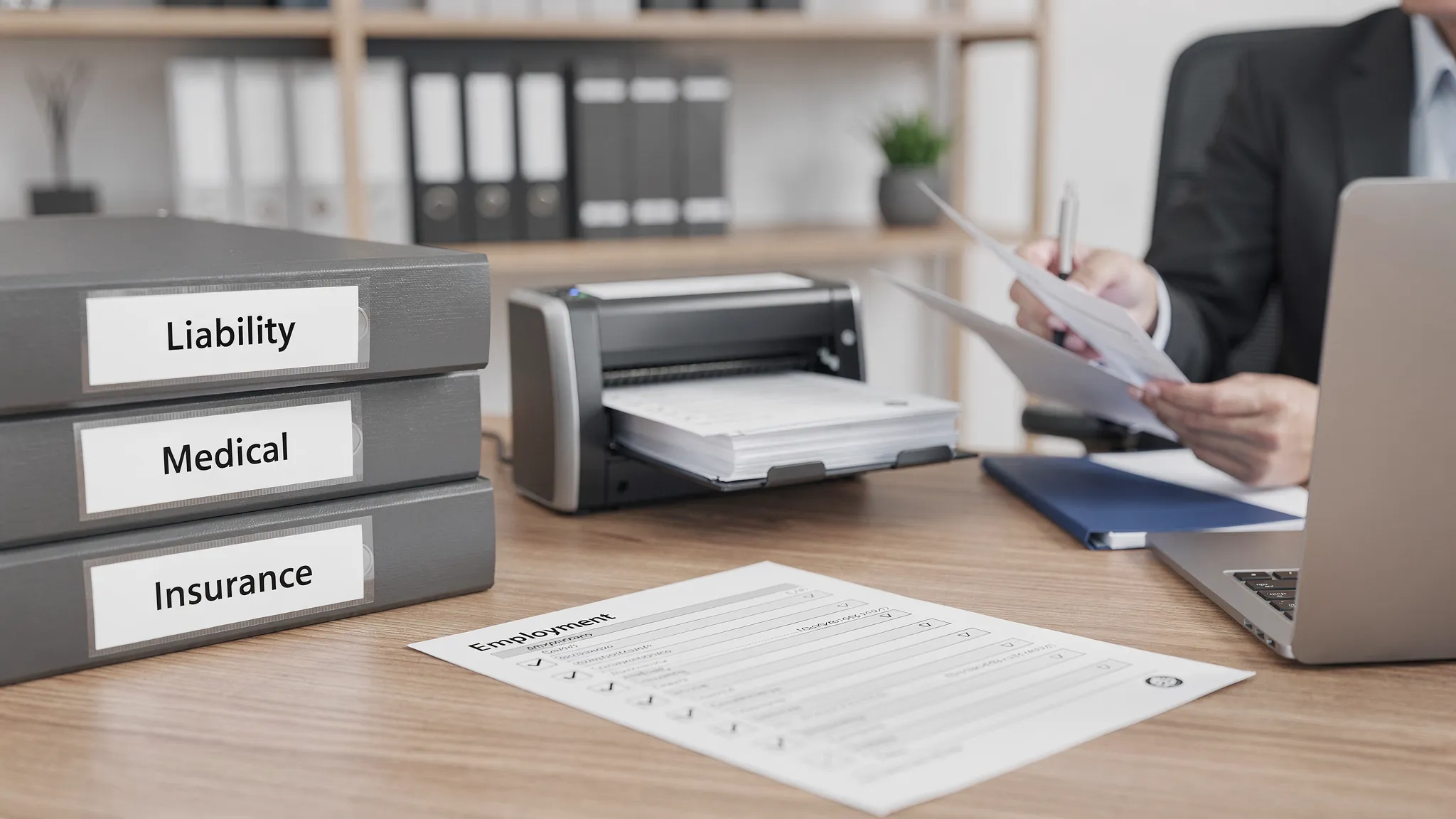
The Intelligent Lawyer Workflow: Where AI Helps Most
.png)

An “intelligent lawyer” is not the one who uses the most tools. It is the lawyer who builds a workflow where high-judgment work stays human, and high-volume work becomes faster, more consistent, and easier to verify.
AI is most valuable when it reduces time spent on repeatable drafting, document synthesis, and issue-spotting across large records, while you retain control over strategy, credibility, and advocacy.
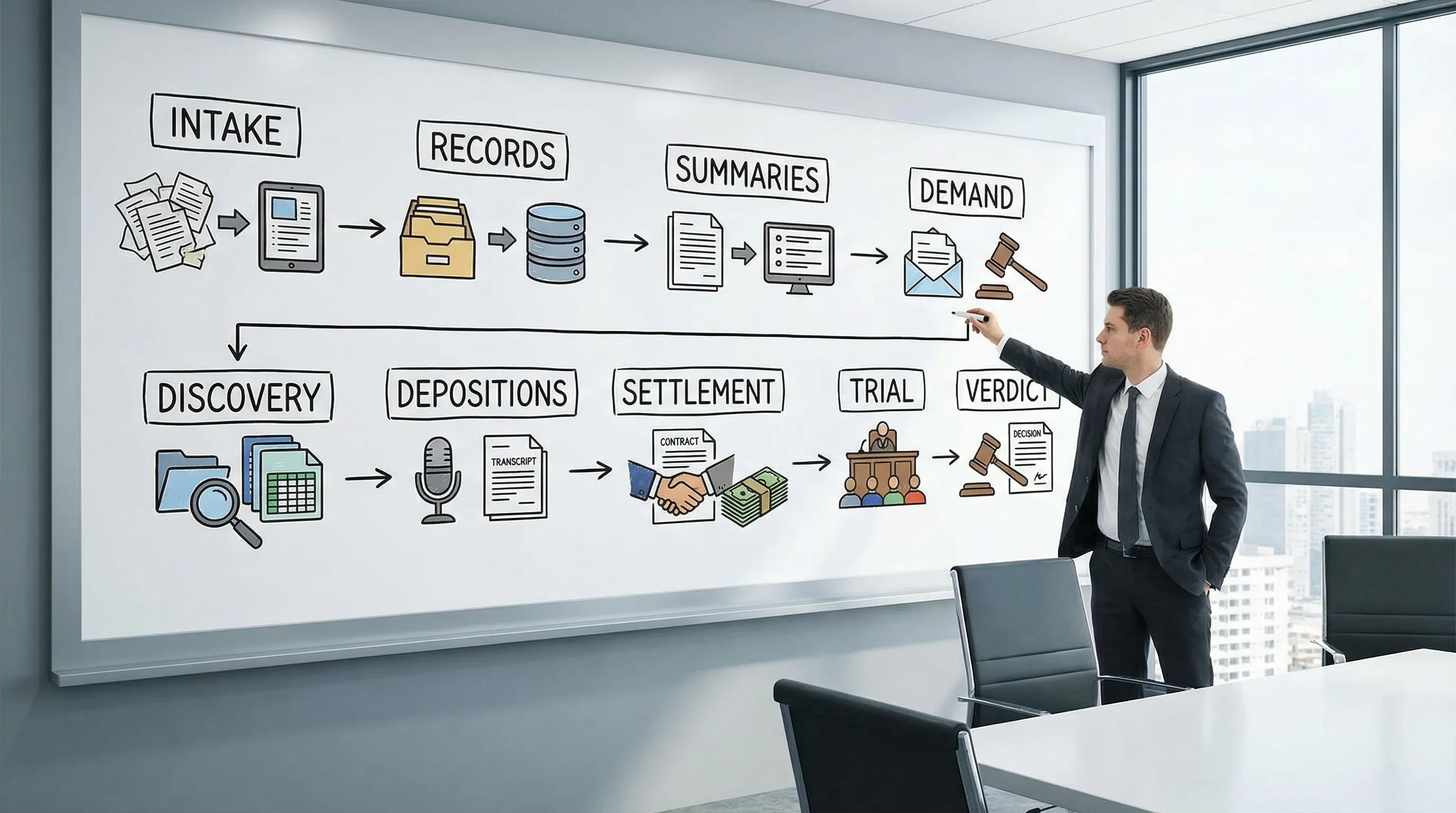
The intelligent lawyer workflow (from intake to verdict)
Most litigation teams run the same core cycle, even if the case type changes:
- Intake and case triage (what happened, damages, deadlines, viability)
- Record collection and organization (medical, billing, employment, photos, prior claims)
- Case theory formation (liability, causation, damages, story)
- Pre-suit package (demand letter plus supporting summaries)
- Discovery and depositions (requests, responses, depo plans)
- Settlement positioning (risks, leverage, negotiation narrative)
- Trial readiness (witness outlines, exhibit lists, themes)
The “AI helps most” opportunities cluster around the points where you are converting messy documents into structured litigation work product.
Where AI helps most (highest ROI tasks)
Intake: faster triage, cleaner issue lists
At intake, speed matters, but accuracy matters more. AI can help by extracting key facts from initial materials (incident descriptions, preliminary medical notes, insurance correspondence) and turning them into a structured case snapshot.
What this enables:
- Faster identification of missing documents (for example, EMS report, imaging, operative note)
- Earlier spotting of obvious defenses (comparative fault, gaps in treatment, prior injury)
- Cleaner handoff from intake staff to the attorney handling strategy
The intelligent lawyer approach here is to use AI for organization and prompts, not for deciding liability.
Medical records: summaries, chronologies, and “what matters” highlighting
Medical records are where time disappears, especially when the file spans multiple providers. AI performs well at:
- Converting records into medical summaries and chronologies
- Flagging date ranges, diagnoses, treatments, and objective findings
- Surfacing inconsistencies to double-check (symptom onset notes, prior injuries, missed follow-ups)
This is one of the clearest leverage points because the output is reviewable. You can validate dates, quotes, and key medical facts against the source record.
Demand packages: first drafts that follow your structure
Demand letters often follow a repeatable structure (liability, medical course, damages, specials, demand). AI can accelerate this stage by drafting a demand letter aligned to your facts and tone, and by keeping the supporting narrative consistent with the medical summary.
Where AI tends to deliver the most value:
- Turning a chronology into a coherent story
- Ensuring medical treatment, limitations, and prognosis are described consistently
- Producing a draft fast enough that you can spend time improving positioning (theme, credibility, valuation logic)
The intelligent lawyer workflow still requires you to confirm the numbers, confirm the citations to the record, and ensure the narrative matches what you can prove.
Discovery: synthesis, not guessing
Discovery is not just about volume, it is about precision. AI is useful when it helps you:
- Summarize what a production contains and what it does not contain
- Generate first-pass issue maps (what topics are supported, what needs follow-up)
- Draft requests and responses using your case theory and known facts
For standards and proportionality context, many litigators keep the Federal Rules of Civil Procedure close at hand, especially Rule 26, and use AI to accelerate drafting while keeping final decisions attorney-led.
Depositions: outlines that track documents and admissions
Deposition outlines are a classic “high-stakes, high-prep” deliverable. AI can help convert the case file into:
- A witness-specific outline (topics, sequencing, impeachment hooks)
- A document-driven questioning plan (what each exhibit is for, what admission you want)
- A clean checklist of “must cover” elements (foundation, timeline, prior statements)
This is not about letting AI “take the deposition.” It is about arriving with tighter organization and less time spent re-reading.
Settlement posture: risk summaries you can actually use
Settlement decisions are judgment-heavy, but the inputs are document-heavy. AI can support negotiations by producing:
- A balanced strengths and risks summary (liability, causation, damages)
- A dispute map (what you can stipulate to, what you need to fight about)
- A negotiation narrative that stays consistent with the record
The key is to treat these as positioning drafts and internal analysis, then pressure-test them like you would any associate’s memo.
A practical “trust framework” for AI in litigation
Courts, clients, and ethics rules are increasingly focused on competence and reliability. For example, the ABA Model Rules note that competence includes understanding relevant technology (see ABA Model Rule 1.1, Comment 8).
An intelligent lawyer workflow typically adds simple guardrails:
- Human-in-the-loop review: treat AI output as a draft that must be checked against the source.
- Source anchoring: require pinpoint references (page IDs, dates, exhibit labels) where feasible.
- Privilege and confidentiality controls: confirm what goes into the system, who can access it, and how data is handled.
- Consistency checks: verify that demand narratives, medical summaries, and depo outlines do not contradict each other.
- Documented process: keep an internal note of what was AI-assisted and what was attorney-edited.
For broader governance thinking, the NIST AI Risk Management Framework is a helpful reference point for teams formalizing evaluation and oversight.
What this looks like in practice with TrialBase AI
TrialBase AI is built around the exact conversion point where AI tends to deliver the most value: turning case documents into litigation-ready work product.
Within one unified workflow, teams can upload documents and generate outputs such as:
- Demand letters
- Medical summaries
- Deposition outlines
- Trial materials and case-ready drafting
Because the platform is designed for litigation support from intake to verdict, the intelligent lawyer workflow becomes simpler: fewer handoffs, fewer “version drift” problems, and a more consistent path from documents to deliverables.
A useful way to think about it is matching tasks to outputs and controls:
| Workflow stage | Where AI helps most | Typical output | What you still verify |
|---|---|---|---|
| Intake | Fact extraction and missing-doc spotting | Case snapshot | Viability, deadlines, conflicts, strategy |
| Records review | Synthesis across large files | Medical summary, chronology | Dates, diagnoses, quoted language, totals |
| Pre-suit | Structured drafting | Demand letter draft | Causation framing, damages math, attachments |
| Discovery | Organization and drafting acceleration | Draft requests, response language | Objections, representations, production accuracy |
| Depositions | Topic sequencing and exhibit integration | Deposition outline | Order, tone, admissions goals, impeachment accuracy |
| Trial readiness | Consolidation of themes and materials | Trial prep drafts | Trial strategy, evidentiary decisions |
The bottom line
The intelligent lawyer workflow is not “AI everywhere.” It is AI in the places where it reliably reduces time spent converting documents into drafts, summaries, and structured plans.
If you want AI to move the needle, focus first on medical record synthesis, demand package drafting, and deposition outline creation, then wrap those gains in a review process that protects accuracy, privilege, and your professional judgment.
To see how this workflow can look end-to-end, explore TrialBase AI and its litigation-ready outputs designed to move a case from intake to verdict faster, without sacrificing control.