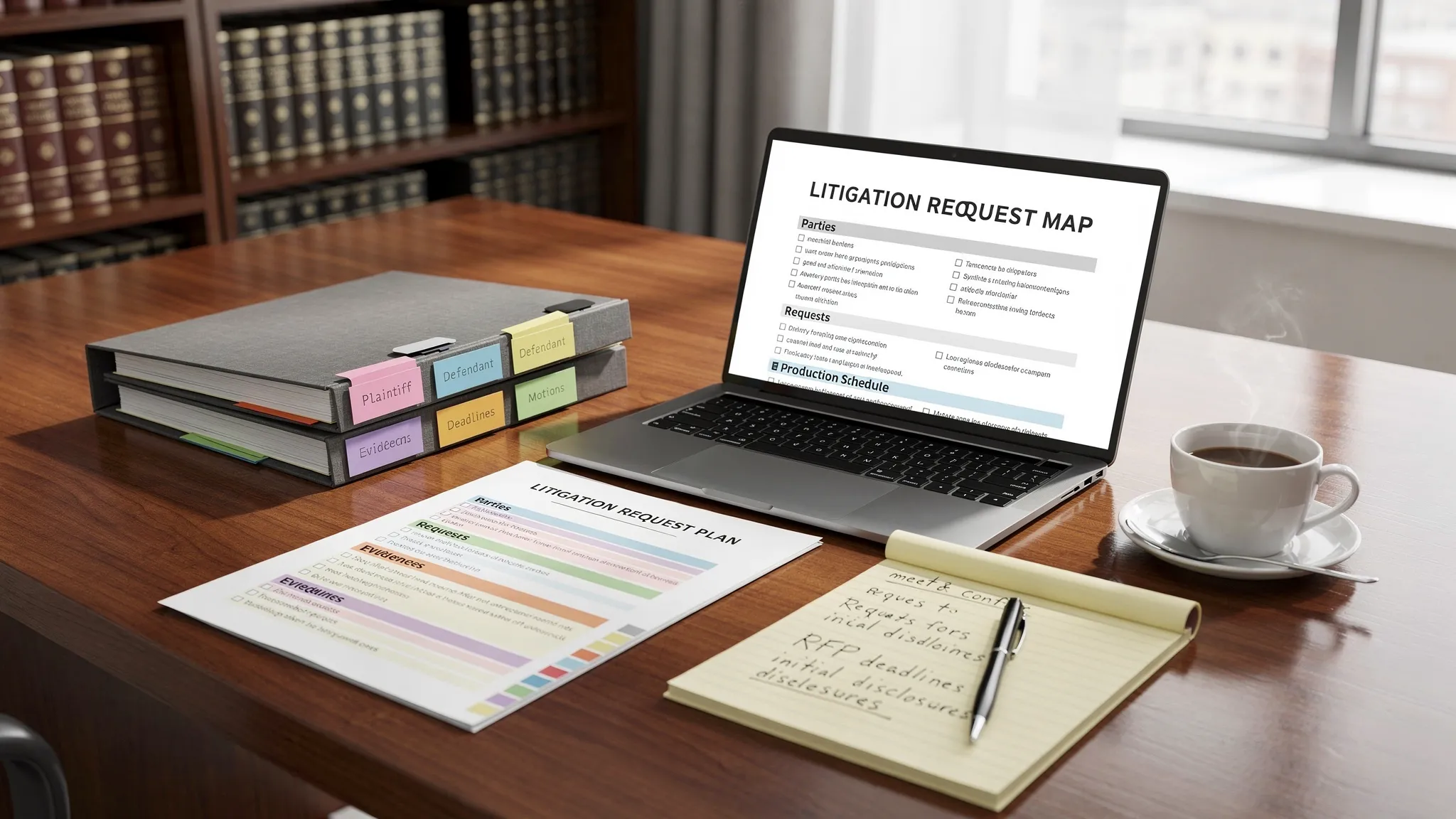
Medical Summaries for Law Firms: What to Include and Why
.png)

Medical records are often the heaviest part of a personal injury, medical malpractice, or premises case, in both volume and stakes. A strong medical summary turns scattered chart notes, imaging, and billing into a litigation-ready narrative that supports damages, withstands cross, and speeds up decision-making for settlement, depositions, and trial.
What a “medical summary” is (and what it is not)
For litigation, a medical summary is a source-cited, neutral synthesis of the relevant medical record that explains what happened, when it happened, what changed clinically, and what the care implies for damages and causation.
It is not just a document dump, a set of copied SOAP notes, or a timeline with no clinical interpretation. The best summaries are written so that a reader who has never seen the chart can still understand the injury course and the evidentiary hooks.
Medical summaries for law firms: what to include
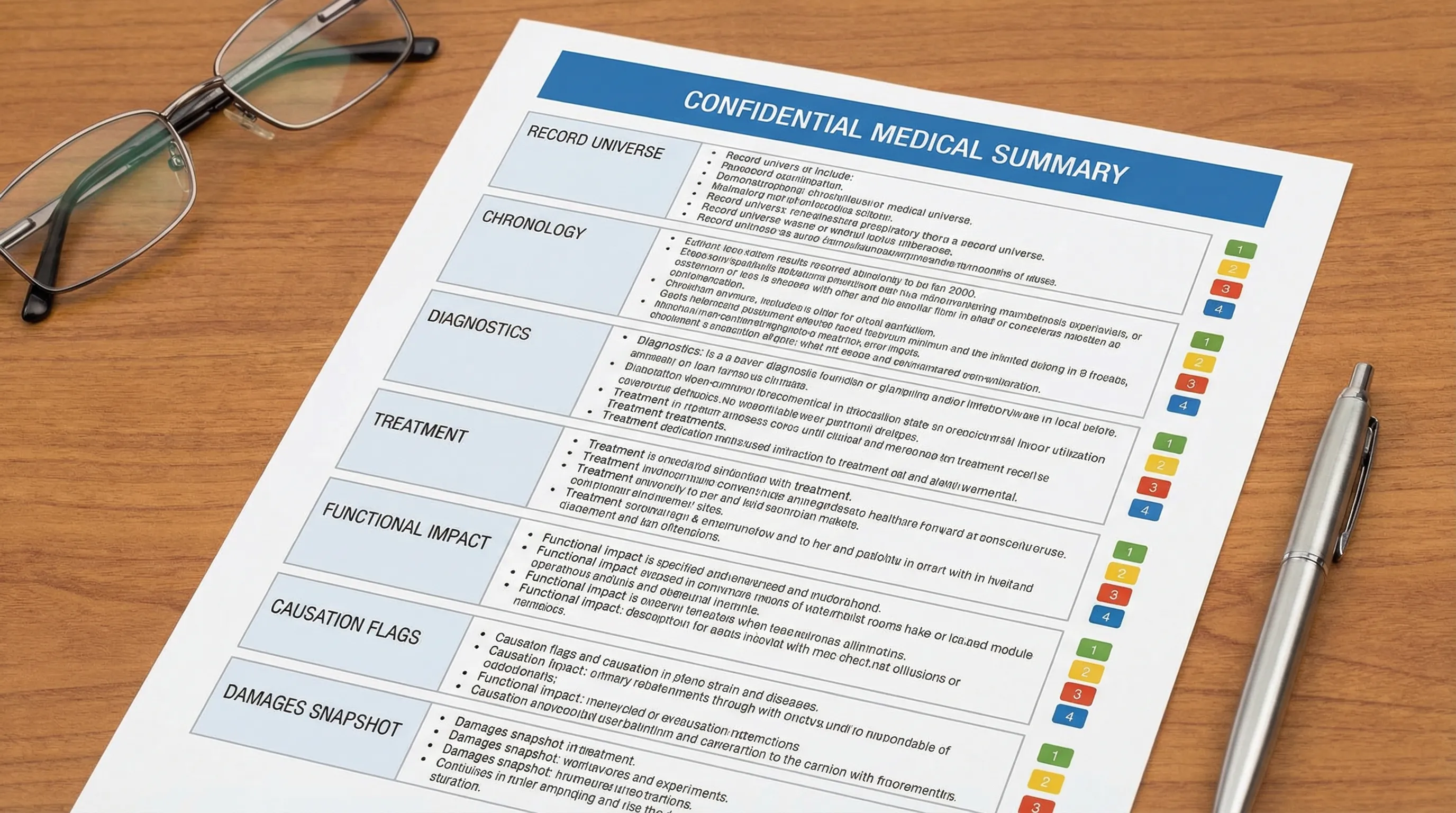
A useful approach is to build your summary in sections that map directly to how cases are evaluated: liability theory, causation, damages, and proof.
| Section to include | What it should contain | Why it matters in litigation |
|---|---|---|
| 1) Record universe + identifiers | Patient identifiers used in the file, date range covered, provider list, facilities, and what is missing or pending | Prevents surprises (missing EMS, imaging CDs, prior primary care), supports completeness attacks and rebuttals |
| 2) Accident/injury mechanism + initial complaints | How injury occurred (as documented), initial symptoms, triage notes, first provider visit details | Anchors causation to contemporaneous documentation, reduces hindsight bias |
| 3) Chronology of care (by episodes) | Visits grouped into episodes (ED, ortho, PT, pain management), key findings and decisions per episode | Makes the story readable, supports reasonableness/necessity of treatment |
| 4) Diagnostics and objective findings | Imaging results, labs, physical exam positives/negatives, red flags, changes over time | Objective support for injury severity, helps experts and adjusters evaluate |
| 5) Treatment, procedures, and medications | Conservative care, injections, surgery, compliance issues, medication changes, adverse events | Directly ties to damages and future care arguments |
| 6) Functional impact and restrictions | Work status notes, ADL limitations, restrictions, disability notes, PT functional measures | Converts “pain” into provable impairment and wage-loss implications |
| 7) Causation considerations and confounders | Pre-existing history in the record, prior similar complaints, degenerative findings, gaps in care, intervening events | Anticipates defense themes and helps frame your causation narrative credibly |
| 8) Damages snapshot (clinical plus financial) | High-level totals (billed/paid if known), liens (if known), major cost drivers, future treatment mentions in chart | Supports demand valuation and mediation prep, while keeping numbers traceable |
A note on citations and “pinpointing”
Every key statement should be traceable to the record. In practice, that means:
- Cite the source document (provider/facility) and date of service.
- Include a page reference or bates range when available.
- Quote sparingly, and only when the exact wording matters (for example, “no prior back pain,” “unable to work,” “positive straight leg raise”).
This citation discipline matters because medical summaries get used in multiple places: demands, mediation briefs, deposition prep, expert intake, and trial exhibit planning.
Why these elements matter (beyond “being thorough”)
A medical summary earns its keep when it answers the questions decision-makers actually ask.
For demand letters and settlement evaluation
Adjusters and defense counsel typically focus on: objective findings, reasonable treatment, functional limitations, and alternative explanations. If your summary is built around episodes, diagnostics, and functional impact (with citations), it becomes much easier to justify a number without sounding like advocacy.
For depositions
A good medical summary doubles as a roadmap for questioning:
- What did the patient report at the first visit?
- When did symptoms change or spread?
- What objective tests support the diagnosis?
- Were there gaps in care or inconsistent complaints?
- What did the provider recommend for future care?
When these items are already organized, your deposition outline becomes faster to draft and less likely to miss a key date.
For experts and trial themes
Experts value summaries that isolate the clinical “why,” not just “what.” If the summary highlights objective findings, the differential diagnosis logic, and the evolution of function, you reduce onboarding time and improve consistency across reports.
Common mistakes law firms make with medical summaries
Over-advocacy
Medical summaries should read like a clinical synthesis, not an opening statement. Overstated language invites credibility attacks. Let the records do the work, and use neutral phrasing.
Missing the “record universe” problem
If EMS, imaging, or prior history records are missing, a summary that sounds definitive can backfire later. A short “records included and missing” section protects you and helps your team chase gaps early.
Mixing clinical narrative and billing without clarity
Billing totals can be crucial for demands, but they should be clearly separated from clinical facts. If totals are preliminary, label them as such and keep a trace back to the source.
Ignoring pre-existing conditions and degenerative findings
Defense will raise them. Your summary should, at minimum, identify them, date them, and distinguish what is documented before and after the incident.
Inconsistent dates and duplicated records
Duplicates and conflicting versions (faxed notes, amended notes, partial printouts) are common. Date and page accuracy is not busywork, it is case integrity.
A practical workflow to produce better summaries faster
Most firms do best with a repeatable process that separates collection, organization, summarization, and attorney review.
Intake and organization
Start with a provider list and a records log. Confirm date ranges and ensure you have the “high-risk missing” categories early (EMS, imaging reports, operative notes, PT, prior similar body-part treatment).
Summarize by episodes, not by document
Episode-based structure mirrors the way care is delivered and evaluated. It also makes later updates easy when new records arrive.
Add a causation and defense-theme layer
Include a short section that flags chart language defense will use (for example, prior symptoms, noncompliance, inconsistent reports), with citations. This helps you prepare responses early rather than reacting late.
Use AI to draft, then review like a litigator
AI can accelerate first-pass organization and drafting, but the professional standard is still attorney-led quality control, especially on completeness, causation framing, and citation accuracy.
If you want a workflow that converts records into litigation outputs quickly, tools like TrialBase AI are designed for litigation support, including generating medical summaries and related case materials from uploaded documents. As with any system, the best results come from pairing automation with your team’s review and judgment.
A quick quality check before you send or file anything
A medical summary is ready to use when it is:
- Complete about what it includes (and explicit about what is missing)
- Easy to scan (episodes, headings, and dates are consistent)
- Supported by pinpoint citations
- Neutral in tone, strong in facts
- Clear on functional impact and future care mentions
When you build medical summaries for law firms with this structure, you reduce rework, strengthen demands, and walk into depositions and mediation with fewer surprises and better leverage.