Litigation Support: What It Is and When You Need It
.png)
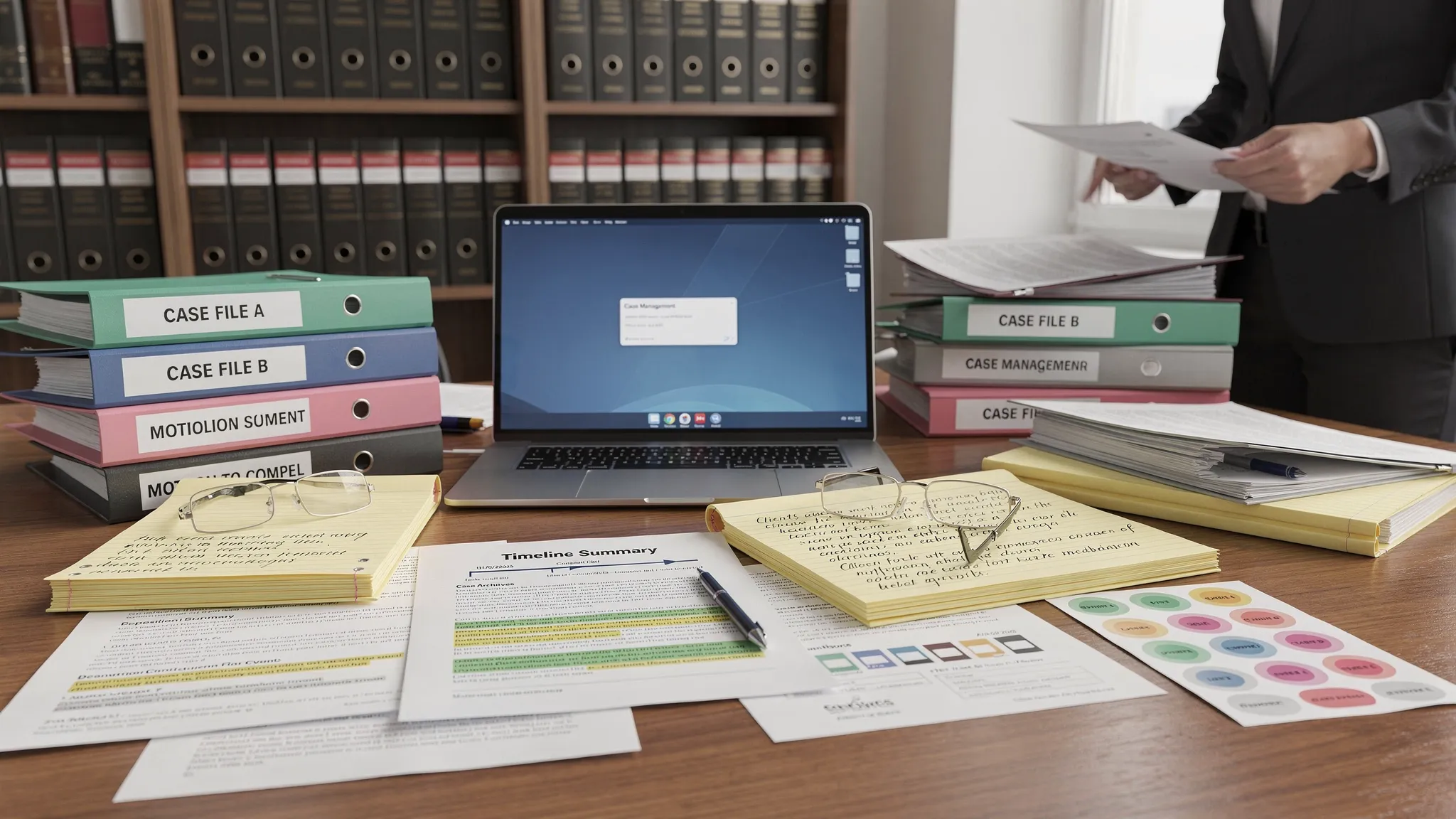
Litigation moves fast, and the work behind a strong case file is relentless: intake, record collection, issue spotting, discovery, deposition prep, motion practice, settlement packaging, and trial readiness. “Litigation support” is the umbrella term for the people, processes, and technology that keep that machine running so attorneys can focus on strategy, advocacy, and client outcomes.
This guide breaks down what litigation support is, what it typically includes, and the most common moments when you should consider adding it.
What litigation support is (and what it is not)
Litigation support refers to the operational and technical work that helps a legal team prepare, organize, analyze, and present case information throughout the lifecycle of a dispute. Depending on the firm and matter type, litigation support can be provided by:
- In-house litigation support staff (often aligned with eDiscovery, trial tech, and knowledge management)
- Paralegals and legal assistants (especially in smaller teams)
- Outside vendors and consultants (eDiscovery vendors, trial presentation specialists, document services)
- Technology platforms (document review tools, case management, AI-assisted analysis)
What litigation support is not: it is not the practice of law. It does not replace attorney judgment, legal analysis, or the duty to supervise nonlawyers and tools. Attorneys remain responsible for strategy, filings, and advocacy.
A practical way to think about it is this: litigation support turns “information” into “case-ready outputs.” That can mean a clean, searchable record set, a deposition binder that actually matches the chronology, or a settlement package that clearly tells the damages story.
What litigation support typically includes
Litigation support can be narrow (trial tech for a two-week jury trial) or broad (end-to-end support from intake to verdict). Common components include:
Document and data organization
Litigation generates documents from everywhere: client intake forms, medical records, employment files, phone extractions, emails, PDFs, photos, body cam video, and more. Support workflows often focus on:
- Collecting and tracking incoming records
- Converting formats (scans to searchable PDFs where appropriate)
- Naming conventions and metadata hygiene
- Building chronologies and issue tags
- Maintaining versions and audit trails
Discovery and eDiscovery support
Discovery is where volume and deadlines collide. Litigation support may assist with:
- Drafting and managing document requests and responses (with attorney oversight)
- Processing productions, deduplication, and load files
- Privilege workflow support
- Organizing productions and correspondence
For many teams, this work maps to established frameworks like the EDRM model (Electronic Discovery Reference Model), which outlines the lifecycle of electronic discovery from information governance through production and presentation.
Deposition and witness preparation materials
Depositions are won or lost in preparation. Support work often includes:
- Deposition exhibit preparation and indexing
- Chronology building (events, treatment timeline, communications timeline)
- Prior statement comparison (complaint, discovery responses, medical history)
- Deposition outlines and witness kits (prepared under attorney direction)
Damages documentation and summaries
In personal injury, employment, and commercial matters, damages are rarely “one number.” Litigation support helps assemble the story and the proof:
- Medical summaries and treatment timelines
- Wage loss and employment history organization
- Billing record tracking and lien/LOP documentation support
- Economic damages documentation packets
Trial preparation and presentation
When a case heads toward trial, litigation support often expands into:
- Exhibit lists and exhibit set management
- Trial notebooks and witness order planning support
- Technology in the courtroom (presentation software, hot seat support)
- Demonstratives coordination
When you need litigation support (the key inflection points)
Many firms wait until they “feel behind.” A better approach is to recognize the predictable moments when support creates leverage.
1) When the case turns on documents, not just testimony
If the outcome depends on medical records, internal emails, contracts, time records, safety policies, or regulatory documentation, litigation support becomes a force multiplier. These cases reward teams who can:
- Spot gaps early (missing time periods, missing providers, missing custodians)
- Build a defensible chronology
- Tie documents to elements (liability, causation, damages)
2) When volume spikes (or you expect it to)
Volume is not just “big cases.” It can come from:
- Multiple providers and years of treatment
- Multi-party accidents
- Corporate custodians and email threads
- Rolling productions and supplemental responses
If your team is using ad hoc folders and manual tracking, volume will eventually create avoidable risk: missed deadlines, inconsistent production handling, or deposition prep based on incomplete records.
3) When deadlines and rules leave little margin
Discovery obligations move on court schedules, not on your calendar. In federal cases, discovery planning and disclosures often implicate deadlines and obligations under the Federal Rules of Civil Procedure, including rules governing disclosures and discovery scope (for example, Rule 26) and requests for production (Rule 34).
Even in state court, local rules and standing orders can be unforgiving. Litigation support helps teams operationalize compliance: tracking what was requested, what was produced, what is outstanding, and what needs follow-up.
4) When you are preparing for depositions (especially “first key dep”)
The first major deposition is often where a case’s settlement value changes. You typically need litigation support if:
- There are multiple fact witnesses with overlapping timelines
- Medical causation or prior history will be contested
- You have to cross-reference testimony against records quickly
- Exhibits must be managed cleanly to avoid confusion on the record
Support at this stage is less about “printing binders” and more about building a usable structure: a chronology that matches the elements, a medical summary that flags contradictions, and exhibits that can be located instantly.
5) When settlement posture depends on a clear, credible damages narrative
Whether you represent plaintiffs or defendants, settlement discussions depend on how well you can explain damages. That often requires case-ready summaries (medical treatment, diagnosis, future care, impairment, specials, wage loss) that are accurate and easy to verify.
This is also where a strong demand package matters: adjusters and defense teams respond to clarity, not to volume.
6) When trial is a real possibility (not a bluff)
Cases settle late when both sides believe trial is real. Trial readiness requires disciplined exhibit control, witness prep materials, and rapid retrieval of impeachment points.
If your team is scrambling for “the final set” of exhibits, or if no one is assigned to manage versions and updates, you are already paying a tax in time and risk.
A simple phase-by-phase view (and what support looks like)
The same term, “litigation support,” can mean different things depending on where you are in the case. Here is a practical breakdown.
| Case phase | What tends to break first | What litigation support helps with | Outputs you should expect |
|---|---|---|---|
| Intake and early evaluation | Incomplete records and unclear theory | Record plan, initial chronology, issue tagging | Case timeline, early summaries, missing-records list |
| Pleadings and case strategy | Facts scattered across files | Centralized document set, searchable organization | Clean case file, key-doc set |
| Discovery | Tracking, consistency, volume | Production management, response support, defensible organization | Organized productions, request/response tracking |
| Depositions | Exhibit chaos and weak chronology | Deposition kits, outlines, cross-reference tools | Deposition outline, exhibit index, witness prep materials |
| Motions | Pinpoint cites and record control | Supporting record compilation, cite-ready excerpts | Motion support packets, exhibit sets |
| Settlement | Unclear damages story | Demand package support, damages summaries | Demand letters, medical summaries, settlement-focused packets |
| Trial | Version control and retrieval speed | Exhibit management, trial presentation support | Trial materials, exhibit lists, presentation readiness |
In-house vs outsourced vs AI-assisted litigation support
Most firms use a mix. The right balance depends on case volume, staffing, and the sensitivity of your matters.
In-house support
Best when you have consistent volume and want tight integration with attorney workflow.
Potential tradeoffs:
- Hiring and training takes time
- Coverage gaps appear during trials, vacations, and spikes
Outsourced vendors
Best for specialized needs (large eDiscovery processing, trial presentation specialists, data forensics).
Potential tradeoffs:
- Cost can escalate quickly
- Knowledge transfer and context-building can be slow
AI-assisted support
Best when your bottleneck is transforming large document sets into usable work product (summaries, chronologies, outlines) and you want speed without rebuilding headcount.
Potential tradeoffs:
- Requires careful supervision and verification
- You must evaluate security, confidentiality, and reliability
On the ethics and supervision point, many firms look to guidance embedded in the ABA Model Rules of Professional Conduct regarding competence and the supervision of nonlawyers and service providers (often discussed in connection with Model Rules 1.1 and 5.3).
How to choose litigation support (a practical checklist)
A good litigation support function is not just “help.” It is a system. When evaluating an internal hire, a vendor, or a platform, prioritize the capabilities that reduce risk and rework.
Operational fit
- Can it match your matter types (PI, med mal, employment, commercial, insurance defense)?
- Can it support your preferred workflow (chronology-first, issue-first, deposition-first)?
- Does it handle the formats you actually receive (scans, native files, mixed productions)?
Quality and verification
- Are outputs traceable back to source documents?
- Can you quickly validate statements, dates, and medical facts?
- Does the workflow reduce hallucinations and citation errors?
Security and confidentiality
- Clear data handling and retention policies
- Access controls for teams
- Confidentiality alignment with your professional obligations and client agreements
Speed and scalability
- Can you turn around deposition prep and summaries in days, not weeks?
- Can you handle multiple matters without collapsing under volume?
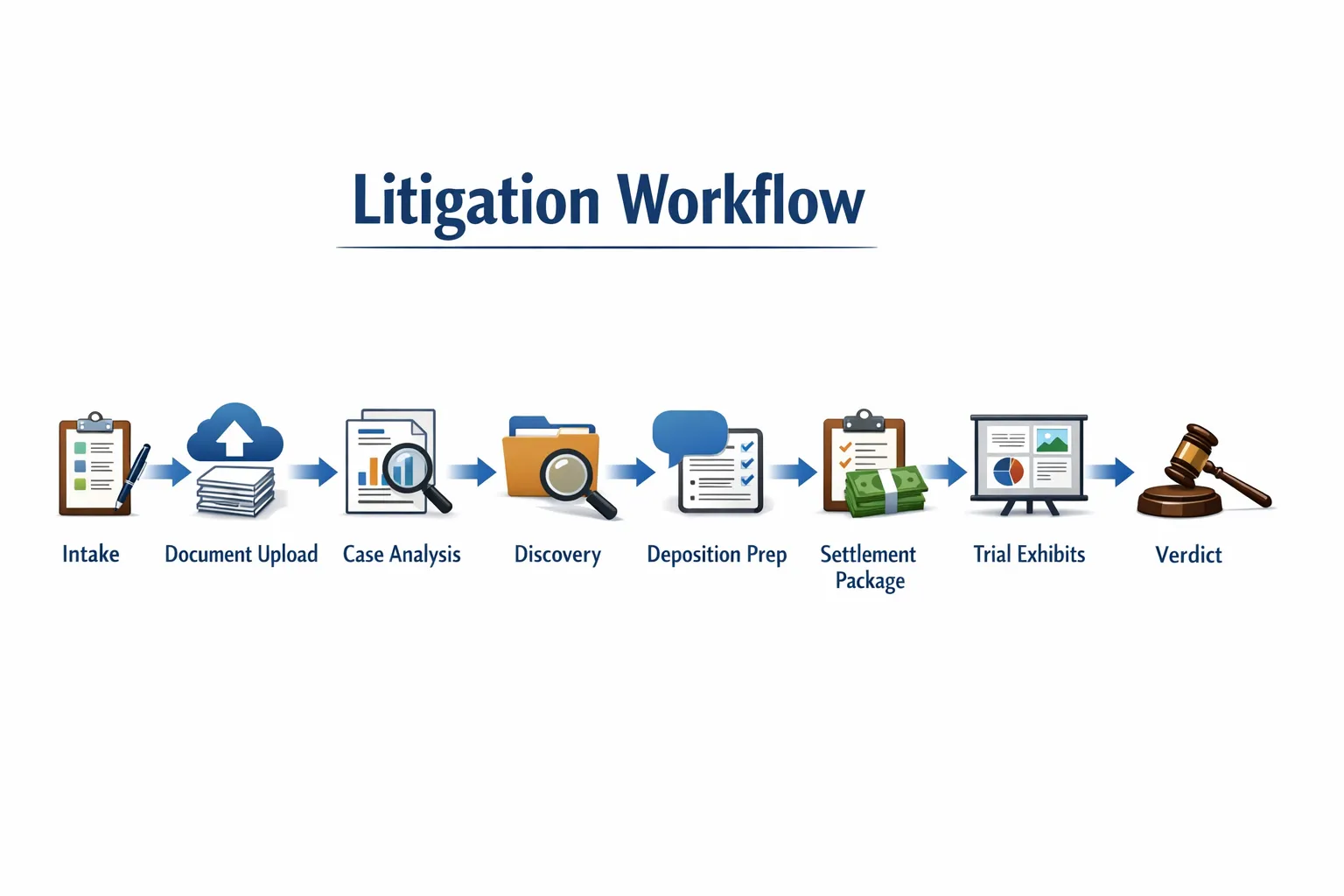
Where TrialBase AI fits (and how teams typically use it)
If your definition of litigation support includes converting documents into litigation-ready work product quickly, AI-assisted platforms can cover a large portion of the workload that traditionally consumed paralegal and attorney hours.
TrialBase AI is positioned as intelligent litigation support from intake to verdict. Based on the platform description, legal teams can upload documents and generate outputs such as:
- Demand letters
- Medical summaries
- Deposition outlines
- Trial materials
It also emphasizes AI-driven document analysis, unified workflow management, team collaboration, discovery simplification, and settlement-focused insights.
The practical use case is straightforward: instead of manually reading, sorting, and rewriting the same record set into multiple formats (summary, outline, demand narrative), you start with the documents and generate structured drafts faster, then have attorneys review, verify, and tailor them to the theory of the case.
If you want to see how that workflow could look in your practice, you can explore TrialBase AI and evaluate it against the checklist above (traceability, collaboration, speed, and security).
A realistic rule of thumb
You likely need litigation support when case complexity exceeds your team’s ability to keep the record “court-ready” at all times.
That can happen in small matters (one critical deposition with messy medical history) or in high-dollar litigation (multiple custodians, rolling productions, and competing experts). The earlier you build support into your process, the less you pay later in emergency labor, preventable mistakes, and missed leverage in depositions and settlement.