Litigation Support Services: What They Do and When to Hire
.png)

Litigation moves fast, and the work behind the scenes is often what determines whether a case settles well, survives dispositive motions, or lands cleanly at trial. Litigation support services exist to absorb the operational and technical load of case preparation so attorneys can spend more time on strategy, client counseling, and advocacy.
What are litigation support services?
Litigation support services are specialized services (provided by people, software, or both) that help legal teams collect, organize, analyze, summarize, and present case information across the litigation lifecycle. They are commonly used in civil litigation, personal injury, employment, commercial disputes, and any matter with high document volume or tight deadlines.
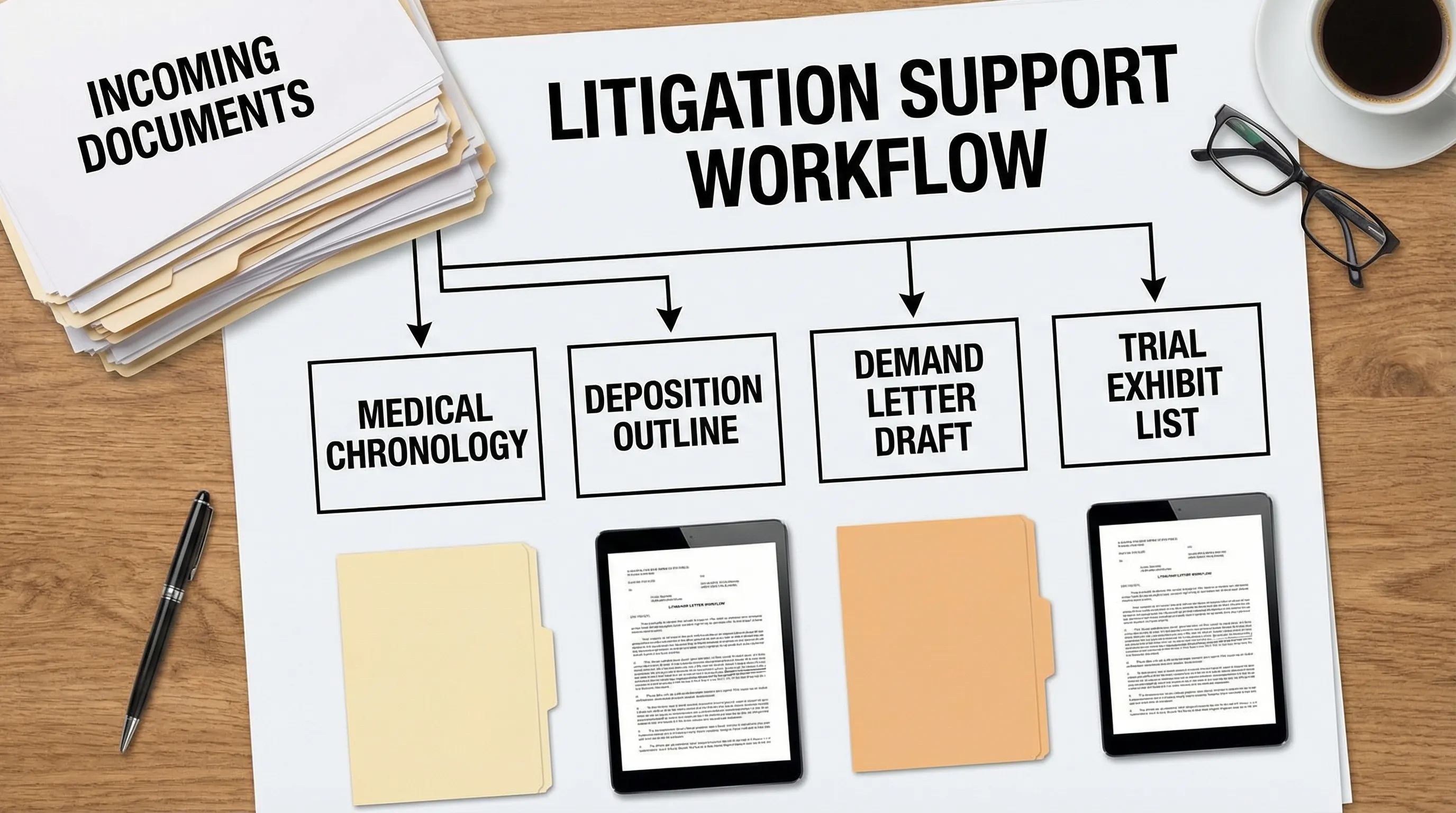
Think of litigation support as the bridge between raw material (emails, PDFs, medical records, discovery responses, transcripts) and litigation-ready work product (chronologies, issue lists, deposition outlines, trial exhibit lists, and settlement packages).
What litigation support services typically do
Exact deliverables vary by provider, but most litigation support work falls into a few repeatable categories.
Discovery and document workflow support
Discovery is where many teams get overwhelmed, especially in cases involving lots of ESI (electronically stored information). Litigation support can help you:
- Collect and organize productions from clients and opposing counsel
- Create searchable repositories and keep file naming consistent
- Track requests, responses, and deadlines aligned to governing procedure rules (for example, the Federal Rules of Civil Procedure)
- Identify gaps, duplicates, and high-priority document sets
Medical record and damages summarization
In personal injury and medical-related matters, litigation support often includes:
- Medical chronologies and treatment timelines
- Provider-by-provider summaries and record indexing
- Bills and specials tracking support for demand and settlement packages
Because medical records frequently contain sensitive health information, vendors and platforms should be prepared to support HIPAA-aligned handling where applicable (see the HHS HIPAA Privacy Rule overview).
Deposition and testimony preparation
Support teams can streamline deposition prep by turning the record into usable tools:
- Deposition outlines based on pleadings, discovery, and key documents
- Topic lists, impeachment materials, and exhibit bundles
- Transcript organization and issue tagging after the depo
Drafting support for litigation-ready documents
Some litigation support services help generate first drafts or structured templates, such as:
- Demand letters and settlement packages
- Case summaries for mediation
- Trial exhibit lists and witness folders
Important: drafting support should fit your jurisdiction and firm standards. Attorneys remain responsible for legal judgment, accuracy, and final review.
Case analytics and settlement support
Many teams also use litigation support to clarify the “shape” of a case:
- Chronologies and dispute timelines
- Liability and damages themes
- Settlement-focused insights (what moves the case value, what creates risk, what documentation is missing)
When to hire litigation support services
Some firms wait until the case is “too big” to handle. In practice, the best time to hire support is when it prevents rework and deadline pressure.
Hire early if intake is document-heavy
If the first week of a new matter already involves a large PDF stack, multiple medical providers, or a long incident history, early support can quickly produce a usable case map (timeline, parties, issues, missing records). That makes your first client updates and early settlement positioning far easier.
Hire during discovery if volume or deadlines spike
If your team is spending nights renaming files, searching PDFs, or trying to reconcile discovery responses, you are in the danger zone. Litigation support is often most valuable when:
- Productions are frequent and messy
- Multiple custodians, providers, or business units are involved
- Your team needs to locate “the one document” quickly for motions or meet-and-confer
Hire before key events (depositions, mediation, trial)
A practical rule is to bring support in 2 to 4 weeks before any high-stakes event that requires clean organization and fast retrieval. The goal is to avoid building deposition prep materials or exhibit sets the night before.
Hire when quality control becomes a risk
Even strong teams make mistakes under volume. If you notice inconsistent summaries, version confusion, or uncertainty about what has been reviewed, litigation support can introduce repeatable processes and reduce preventable errors.
Common engagement models (and how to choose)
Litigation support is not one thing. It is typically delivered in three models: in-house staff, outsourced vendors, and software platforms.
| Model | Best for | Tradeoffs to consider |
|---|---|---|
| In-house litigation support | Ongoing caseload, standardized firm workflow | Hiring, training, capacity limits during peaks |
| Outsourced vendor or consultant | Short-term surges, specialized tasks (forensics, complex review) | Turnaround time, coordination overhead, cost variability |
| AI-powered platform | Rapid summarization and drafting from uploaded documents | Requires careful attorney review, security diligence, process fit |
A practical checklist for selecting a provider
Ask questions that map to your real pain points:
- Security and confidentiality expectations (access controls, auditability, retention)
- Ability to work within your deadlines and preferred format (Word, PDF, binder-style, cloud workspace)
- Quality controls (how errors are caught, how updates are handled)
- Clear scope and pricing (per project, per hour, per document set)
Where TrialBase AI fits
If your bottleneck is turning documents into usable litigation work product quickly, an AI platform can be a strong option. TrialBase AI is designed for “intake to verdict” workflow support: you upload documents and generate litigation-ready outputs like demand letters, medical summaries, deposition outlines, and other trial materials in minutes.
Because every case is different, the highest-value approach is often: use automation for speed and structure, then apply attorney judgment for final refinement and strategy.
Frequently Asked Questions
Are litigation support services only for big firms? No. Solo and small firms often benefit the most because they have less internal capacity for document organization, summarization, and deadline-heavy prep.
Do litigation support services replace paralegals or attorneys? They should not replace legal judgment. The best support complements your team by handling organization, first-pass drafting, and structured outputs that lawyers can review and finalize.
Is AI litigation support safe for confidential documents? It can be, but you should evaluate each platform’s security controls, permissions, retention practices, and your own ethical duties. When in doubt, ask for documentation and use least-privilege access.
When is the latest I should bring in litigation support? Before depositions, mediation, or trial prep becomes reactive. If you are already working late to find exhibits or summarize records, you are likely past the optimal time.
What deliverables should I request first? Start with the deliverable that unlocks multiple next steps, often a case chronology, a medical summary (for PI), or an organized discovery repository.
Streamline your next case from intake to verdict
If you want faster turnaround from documents to litigation-ready work product, explore TrialBase AI. Upload your materials, generate demand letters, medical summaries, deposition outlines, and more, then review and refine with your team for a stronger, cleaner case workflow.