Litigation Research: Build a Repeatable Source List
.png)

When deadlines compress and fact patterns sprawl, litigation research often breaks down in the same predictable way: you start from scratch, chase the same sources, and still worry you missed something controlling. A repeatable source list fixes that. It gives you a vetted, jurisdiction-aware set of places to look first, every time, so your research is faster, more defensible, and easier to delegate.
What a “repeatable source list” is (and isn’t)
A repeatable source list is a curated set of research sources you trust, organized by jurisdiction, practice area, and task (motion briefing, damages, medical causation, impeachment, settlement posture). It also includes a lightweight process for keeping that list current.
It is not a “top 50 legal websites” bookmark dump. If the list is not tied to specific litigation tasks and jurisdictions, it will not hold up under pressure.
The core buckets every litigator’s source list should include
You can tailor endlessly, but most high-performing litigation teams cover the same buckets.
1) Primary law (binding and persuasive)
Start with the sources that produce citeable authority.
- Federal and state statutes and codes (official or authoritative versions)
- Case law (federal and state)
- Rules (civil procedure, evidence, appellate)
- Local rules and standing orders
Good starting points:
- Cornell Legal Information Institute (LII) (fast access to federal rules, U.S. Code, and more)
- PACER (federal dockets and filings)
- Your state judiciary site and appellate court sites (for slip opinions, rules, and court notices)
2) Dockets and filings (what courts are actually doing)
Briefs, orders, and dockets reveal how judges apply the law in practice. This is where you find winning framing, not just citations.
- Federal dockets via PACER
- State e-filing portals (varies by state)
- Published court orders and motion calendars where available
3) Secondary sources (to learn, confirm, and structure)
Secondary sources do not replace primary authority, but they speed up issue spotting and give you a roadmap.
- Treatises and practice guides
- Pattern jury instructions
- Bar association materials and CLE papers (use cautiously, confirm everything)
4) Agency guidance and technical standards (when relevant)
For products, safety, employment, benefits, and regulated industries, agency publications can be crucial.
- OSHA guidance and standards
- CDC guidance (useful in exposure and public health contexts)
- FDA safety communications and labeling history (product and medical device matters)
5) Medical and damages references (personal injury and med-mal)
You need sources that support summary language, not just “medical facts.” These often help for demand letters, mediation briefs, and expert deposition prep.
- Hospital records and treating physician notes (case documents)
- Peer-reviewed literature databases (check methodology and date)
- Public health guidance (CDC, NIH) where appropriate
6) Judge, venue, and practice intelligence
This is the most under-systematized category, especially for teams that rotate venues.
- Local rules and judge standing orders
- Court forms and procedural checklists
- Prior orders in similar cases (from dockets)
Build your list around tasks, not just “sources”
A source list becomes truly reusable when it is mapped to the tasks you repeatedly perform.
Examples of task-based groupings:
- Motion to dismiss: pleading standards, key circuit/state cases, local rule on page limits, judge’s formatting preferences
- Summary judgment: evidentiary burdens, admissibility standards, record citation rules, exemplar statement of facts structure
- Deposition prep: prior testimony (if any), impeachment sources, medical literature for causation angles
- Demand package and settlement: damages ranges, verdict/settlement research (if you have access), medical chronology support
A practical template: the “source card”
To keep your list usable, standardize how each source is recorded. A good “source card” has:
- Name and link
- What it’s for (one sentence)
- Jurisdiction/coverage (for example, “9th Cir + CA state”)
- Update cadence (monthly, quarterly, as needed)
- Access notes (login required, fees, internal credentials)
- Citation notes (how you cite or verify it)
This is the difference between “I think we use that site” and “a junior can run this research pass correctly.”
A starter table you can copy into your firm wiki
Use this as scaffolding, then customize by jurisdiction and practice area.
| Bucket | Source type | What you pull from it | Quality check before relying |
|---|---|---|---|
| Primary law | Statutes, rules, opinions | Controlling authority and standards | Confirm jurisdiction, date, and subsequent history |
| Dockets | Complaints, briefs, orders | Winning arguments, judge tendencies | Verify it is the same court and procedural posture |
| Secondary | Treatises, practice guides | Issue checklists, frameworks | Back-check every key proposition in primary law |
| Agency | Guidance, regulations | Technical standards, official positions | Confirm it is current and not superseded |
| Medical/damages | Records, literature | Chronology support, causation context | Check publication date, methodology, and fit to facts |
| Local practice | Local rules, standing orders | Filing requirements, formatting | Confirm last updated date on the court site |
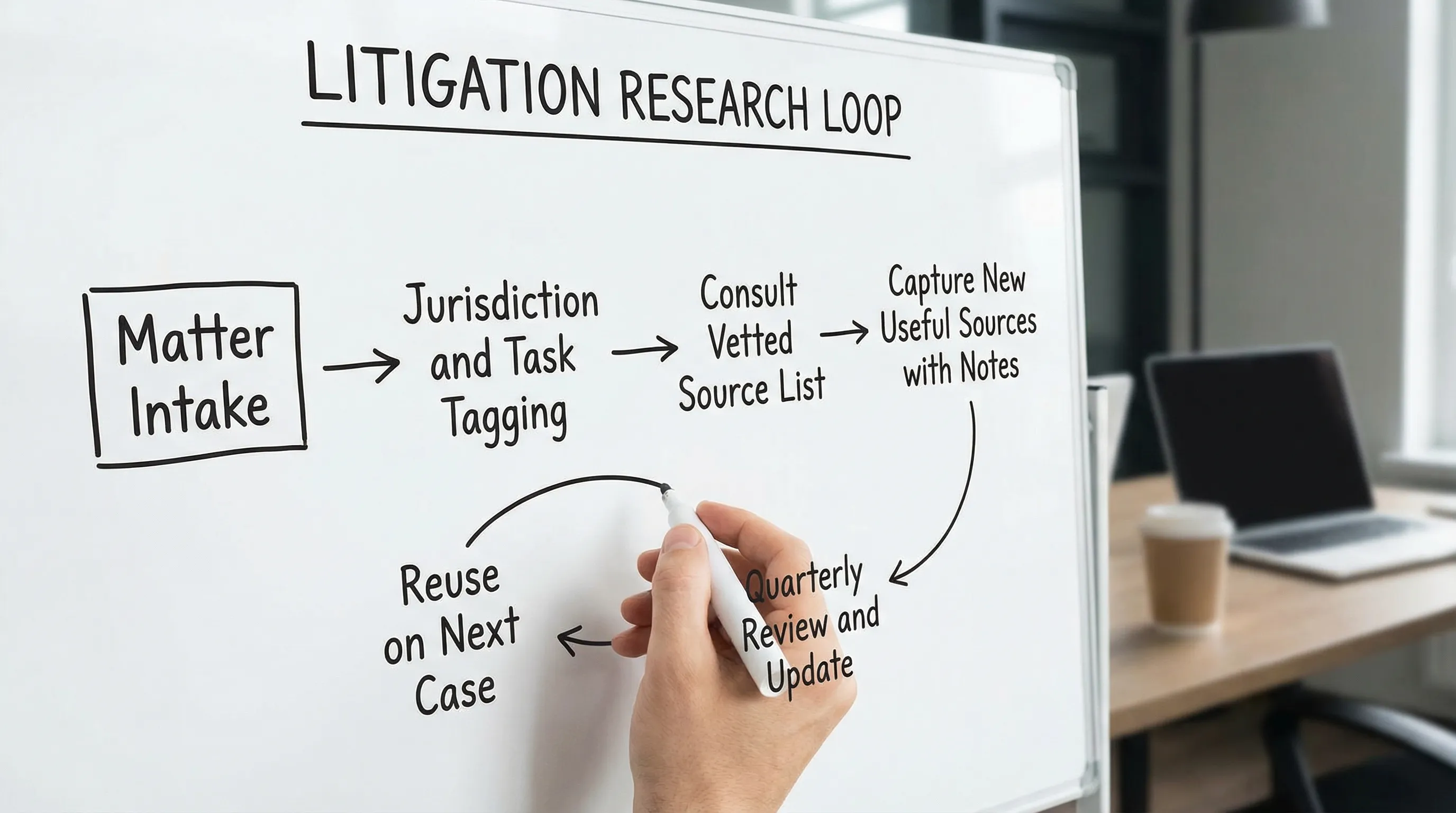
Make it repeatable: a simple maintenance workflow
A source list stays valuable only if it stays current.
- Assign ownership: one person (or role) is responsible for updates per jurisdiction or practice group.
- Set an update cadence: quarterly is often enough for most sources, with ad hoc updates when a major rule change hits.
- Run a “dead link and drift” audit: remove broken links, replace outdated guidance, and note superseded standards.
- Version it: keep a short changelog so your team knows what changed and why.
Common mistakes that make source lists fail
Most source lists fail for predictable reasons.
- They are not jurisdiction-specific, so teams waste time sorting what applies.
- They mix “nice to read” with “safe to cite,” without labeling.
- They ignore dockets and local practice materials, which is where many litigation outcomes are decided.
- They are not maintained, so people stop trusting them.
Where AI fits (without replacing legal judgment)
AI can speed up the parts of litigation research that are expensive but repetitive, like turning a document pile into an organized theory of the case, a medical timeline, or deposition themes. It does not remove the need to verify controlling authority and apply it to your facts.
If your research process starts with “understand the record,” tools like TrialBase AI can help by transforming uploaded case documents into litigation-ready work product (for example, medical summaries, demand letters, and deposition outlines) so your team can spend more time validating authority and strategy.
Frequently Asked Questions
What should be in a litigation research source list? Include primary law sources, docket access, key secondary references, agency guidance where relevant, and local rules/standing orders for your target courts.
How do I keep a source list from becoming outdated? Assign an owner, set a quarterly review, and keep a short changelog. Remove dead links and flag superseded guidance immediately.
Do I need different lists for different case types? Yes. Start with a shared backbone (primary law, dockets, local rules), then create add-ons for practice areas like PI, employment, or products.
Is it okay to rely on secondary sources for citations? Secondary sources are great for structure and issue spotting, but you should confirm and cite primary authority whenever possible.
Turn your sources into faster case prep
A repeatable source list saves time, but the real leverage comes when your team pairs it with a fast, consistent way to digest the record. If you want to reduce the time from intake to actionable work product, explore TrialBase AI to generate litigation-ready drafts and summaries from your documents in minutes, then apply your vetted research sources to finalize a court-ready strategy.