Litigation Liability: Early Case Signals That Change Value
.png)

Case value rarely changes because of a single dramatic moment. More often, it shifts because someone spots, or misses, an early signal that changes how a judge, jury, carrier, or mediator will view litigation liability and damages.
Below are the intake-stage indicators that most reliably move value, plus a practical way to capture them in the first week without drowning in documents.
What “early case signals” really are
Early signals are facts, documents, or gaps that predict how the case will resolve, before you have complete discovery. They usually fall into three buckets:
- Merits (duty, breach, causation, defenses)
- Damages (medical proof, wage loss proof, duration, alternative causes)
- Collectability and friction (coverage, liens, venue risk, credibility problems, litigation cost)
The key is not to “decide the case” at intake. It is to identify what will predictably change your negotiating leverage and the cost to get to an outcome.
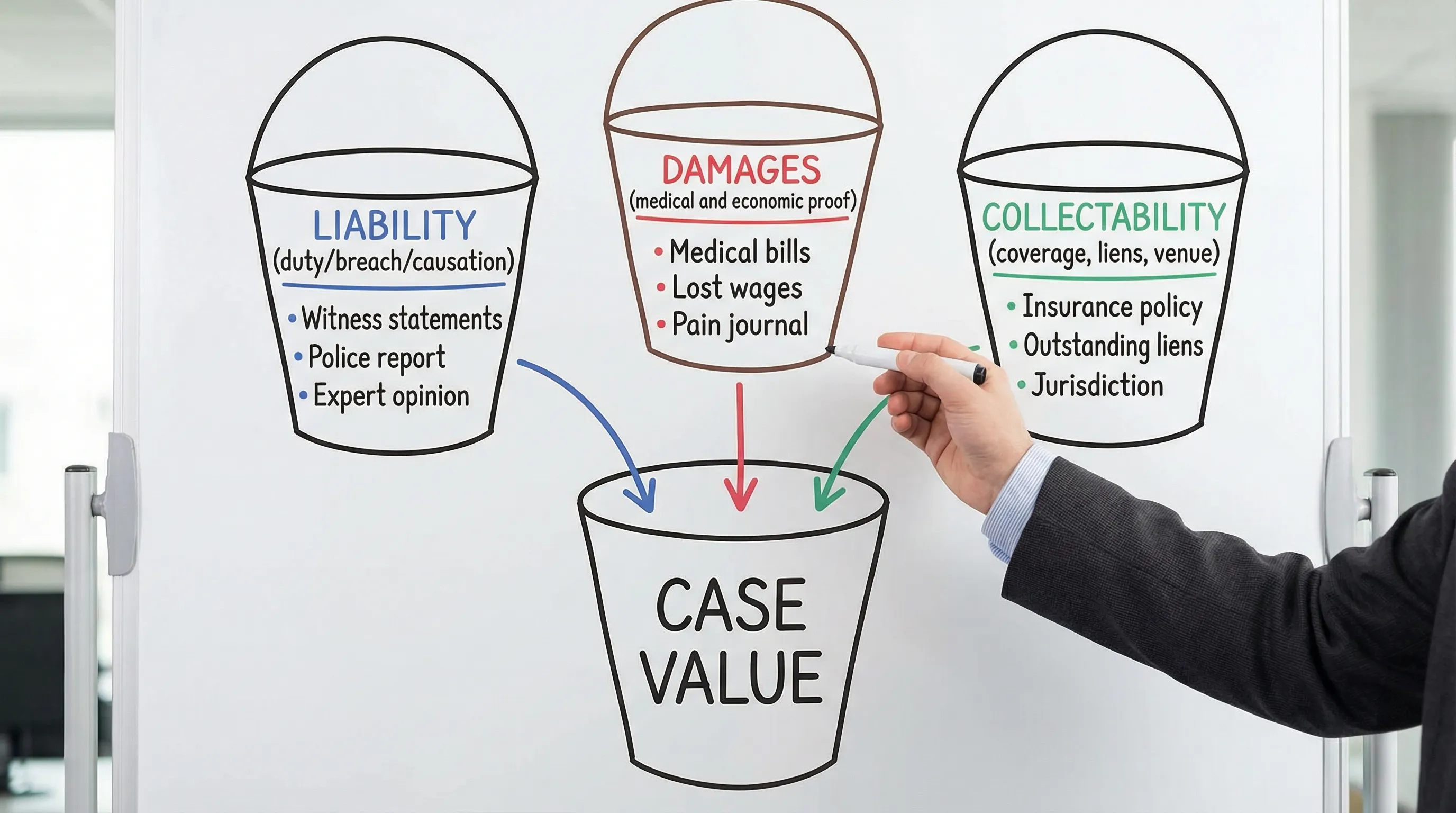
Litigation liability: early signals that move case value
1) Clean duty and a simple story (or the opposite)
Cases with straightforward duty and a timeline a juror can repeat in one sentence often outperform “technically strong” cases that feel messy. Early value changes when you can articulate:
- Who owed what duty
- The specific act or omission
- A tight, chronological narrative
If the facts require multiple conditional statements to explain, the defense will price in confusion and uncertainty.
2) Causation strength shows up in the first medical records you pull
Early medical records do more than prove treatment, they quietly answer causation and credibility questions. Value usually moves when the chart contains:
- Consistent mechanism of injury documented early
- Temporal proximity between incident and first complaint
- Objective findings (when applicable) aligned with claimed symptoms
- Prior similar complaints that suggest alternative causation
A single urgent care note that contradicts the later narrative can materially change valuation and deposition strategy.
3) Comparative fault is either defensible or it is a multiplier against you
Comparative fault is not just “a percentage.” It changes how a mediator, juror, or adjuster reads everything else. Early signals include:
- Admissions in incident reports, recorded statements, or intake notes
- Rules or policies that cut against your client (training manuals, posted warnings)
- The presence of a plausible “common sense” defense theme
If comparative fault will be argued, you want to know how it will be argued within days, not months.
4) Documentation density: are damages provable on paper
The market value of a claim tracks what you can actually prove.
Early signs your damages will underperform include missing baseline records, self-directed gaps in care, or no corroboration for wage loss. Early signs of strength include consistent follow-up, clear work restrictions, and a paper trail that matches the narrative.
5) Venue and judge tendencies (risk pricing is real)
Venue is one of the fastest ways case value changes because it affects perceived jury risk, motion practice outcomes, and litigation cost.
Even before you have formal analytics, intake signals include:
- Removal issues and forum options
- Local practice patterns (scheduling, discovery disputes, continuances)
- Typical verdict ranges and how “pain and suffering” is treated
If you cannot explain why venue helps or hurts you, someone else in the room will.
6) Coverage clarity and policy limits (collectability changes “value” overnight)
A strong liability case with uncertain coverage can be worth less, in practical terms, than a moderate case with clear limits and prompt tender.
Early value-moving signals:
- Correct defendant identification and insured status
- Reservation of rights letters and coverage defenses
n- Umbrella policies, additional insured endorsements, or missing declarations pages
This is also where liens and subrogation can quietly compress settlement value.
7) Credibility indicators, especially “small” inconsistencies
Credibility is not just about truthfulness, it is about predictability under cross.
Early credibility signals include:
- Timeline inconsistencies between intake, medical notes, and reports
- Overstated limitations that conflict with documented activity
- Prior claims history that will be discoverable
A case can be “good,” yet still discount heavily if the client is a fragile witness.
8) The cost-to-prove ratio (including experts)
Case value is net of what it costs to win.
Ask early:
- Do you need accident reconstruction, biomech, vocational, or future care experts
- Are the records in a format that will be expensive to organize and authenticate
- Will the defense force motion practice on admissibility or causation
When proof requires multiple experts to reach the same conclusion, the defense will often bet you cannot justify the spend.
Quick valuation table: what to look for in the first week
| Early signal | What you check at intake | Typical value impact |
|---|---|---|
| Liability clarity | One-sentence theory, clean timeline | Increases settlement confidence |
| Causation support | First notes align with mechanism and timing | Reduces “alternative cause” discount |
| Comparative fault theme | Admissions, policy violations, warnings | Often compresses range materially |
| Damages proof | Consistent care, work notes, bills, baseline records | Converts “claim” into “provable loss” |
| Venue risk | Forum options, local verdict expectations | Shifts risk premium up or down |
| Coverage and limits | Correct insured, limits known, tender path | Determines collectability ceiling |
| Credibility | Consistency across documents | Impacts deposition and mediation leverage |
| Cost-to-prove | Expert needs, record complexity | Changes net value and case selection |
A practical “first 10 days” workflow to catch signals early
You do not need full discovery to surface most of the above. You need a disciplined first-pass review.
A simple approach:
- Day 1 to 2: Build a master chronology (incident, treatment, employment, prior issues).
- Day 3 to 5: Flag contradictions and missing anchors (first complaint, diagnostic imaging, wage records, prior claims).
- Day 6 to 10: Draft the first negotiation-ready narrative (liability theory, causation argument, damages proof list), then identify what discovery must accomplish.
This is exactly where AI-assisted litigation workflows can help, if used carefully. For example, TrialBase AI is designed to turn uploaded documents into litigation-ready outputs like medical summaries, demand letters, and deposition outlines in minutes, which can shorten the time between intake and an informed valuation. As with any tool, attorneys should validate outputs against source records and ensure confidentiality and privilege protections align with firm policy.
Special note for IP matters
In IP disputes, early signals often include proof of ownership/registration, evidence of access or use, and documentation that supports damages theories (lost profits, reasonable royalty). If your matter involves identifying unauthorized uses at scale and moving quickly from detection to enforcement, a specialized partner like Third Chair for IP monitoring and enforcement can be relevant to the early case-value equation.
Frequently Asked Questions
What is litigation liability in the context of case valuation? Litigation liability is the likelihood and scope of legal responsibility (plus defenses) that drives whether you can win on the merits and on what terms.
Which documents change case value the fastest? Early medical records, incident reports, photos/video, recorded statements, employment and wage records, and insurance declarations pages tend to move value quickly.
How early can you accurately value a case? You can rarely “price it precisely” at intake, but you can often set a realistic range once you confirm liability theory, causation strength, damages proof, and coverage.
What are the biggest red flags for overvalued claims? Causation gaps, inconsistent histories, unclear coverage, heavy comparative fault themes, and damages that lack documentation.
Can AI replace attorney judgment in early valuation? No. AI can speed up document review and drafting, but valuation still requires legal analysis, local venue knowledge, and strategic judgment.
Turn early signals into litigation-ready work product
If your team is spending days assembling chronologies, medical summaries, and first-pass demand narratives, you are not alone. TrialBase AI helps legal professionals move from intake documents to case-ready outputs faster, so you can spot the liability and damages signals that truly change value and act on them.
Explore TrialBase AI at ai.trialbase.com.