Litigation Company vs In-House: What to Outsource Safely
.png)

Outsourcing has become a normal part of modern litigation, but it still raises the same question for every firm: what can you safely delegate without risking quality, confidentiality, or ethics?
A “litigation company” (for example, a vendor that provides demand letters, record summaries, trial graphics, discovery support, or managed document review) can remove bottlenecks fast. The tradeoff is that the lawyer remains responsible for the work product and for protecting client information. In most jurisdictions, the core rule of thumb is simple: you can outsource tasks, but you cannot outsource professional judgment or supervision.
Below is a practical breakdown of what to keep in-house, what is typically safe to outsource, and how to put guardrails in place.
Start with the ethics baseline: supervision and confidentiality
Two ABA Model Rules are the easiest way to frame “safe outsourcing” in litigation:
- Rule 5.3 (Responsibilities Regarding Nonlawyer Assistance): lawyers must make reasonable efforts to ensure vendors’ conduct is compatible with the lawyer’s obligations.
- Rule 1.6 (Confidentiality of Information): lawyers must take reasonable steps to protect client information.
You can read them directly via the ABA Model Rules of Professional Conduct.
In practice, that means you should assume:
- You can delegate execution (drafting, summarizing, organizing, formatting).
- You must retain control over direction (strategy, legal positions, settlement authority).
- You must verify quality before anything goes to a client, carrier, opposing counsel, or the court.
Litigation company vs in-house: what to outsource safely
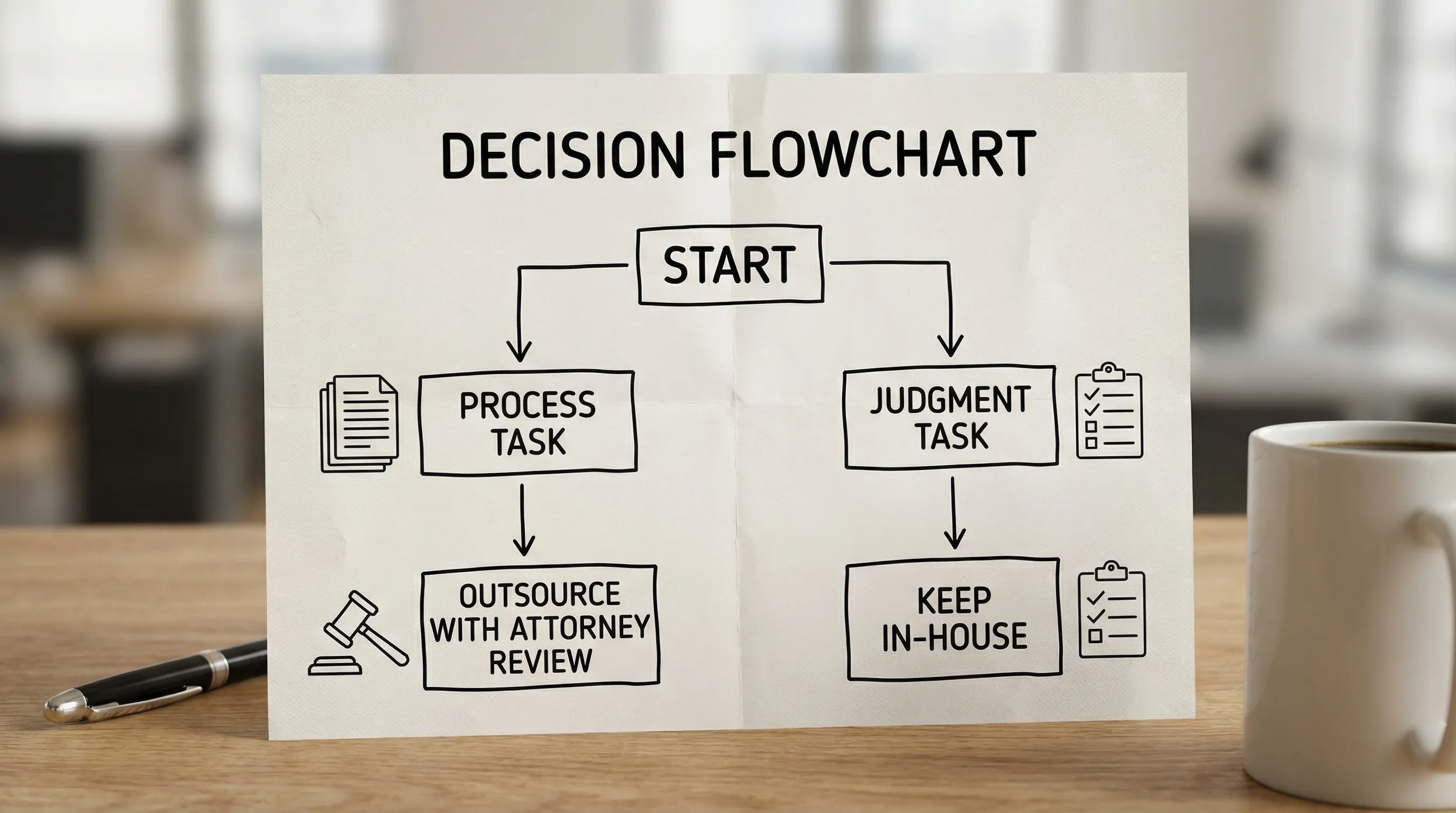
Many litigation tasks are “process-heavy” rather than “judgment-heavy.” Those are usually the best candidates for outsourcing, especially when the outputs are standardized and the vendor workflow is repeatable.
Here’s a decision-oriented view.
| Task / deliverable | Often safe to outsource? | Why it’s usually safe (with review) | Common guardrail |
|---|---|---|---|
| Medical record summaries and chronologies | Yes | Largely extraction, organization, timeline building | Attorney checks for missing records, causation flags, and key dates |
| Demand letter first drafts | Yes | Structured narrative plus damages presentation can be templated | Attorney validates liability theory, specials, and settlement posture |
| Deposition outlines (issue-based) | Yes | Outline structure can be generated from pleadings and records | Attorney adds case theme, impeachment goals, and sequencing |
| Discovery organization (tagging, indexing, bates mapping) | Yes | Administrative and QC driven | Confirm privilege workflow and redaction standards |
| Trial exhibit lists and witness binders (assembly) | Yes | Compilation and formatting heavy | Attorney confirms admissibility plan and foundational requirements |
| Legal research memos on black-letter law | Sometimes | Useful for speed, but jurisdiction nuances matter | Attorney verifies authorities, updates, and local rules |
| Negotiation strategy and settlement authority | No | Requires legal judgment and client direction | Keep in-house |
| Final filings, signed verification, sworn discovery responses | No (final) | High-risk representations to court and parties | Draft support can be outsourced, final review and signature stays in-house |
The pattern is consistent: outsource the build, keep the call.
What to keep in-house (or treat as high-risk)
Even if a vendor is excellent, some areas are risky because errors are hard to detect and consequences are high.
1) Anything that creates binding positions
Examples include:
- Final pleading allegations and causes of action
- Final discovery responses, objections, and verifications
- Statements that could be treated as admissions
- Communications that set settlement anchors without attorney sign-off
You can still outsource drafting support, but treat the attorney review as non-negotiable.
2) Privilege calls and privilege logs
Privilege is extremely context-specific, and mistakes can waive protection. Outsourcing can work if the lawyer provides clear criteria and performs spot checks, but for many teams it is best handled in-house or with very tight oversight.
3) Case theme, venue strategy, and witness sequencing
These require a holistic view of liability, credibility, jury dynamics, and judge-specific practice. Vendors can help with materials, but the strategic architecture should remain internal.
“Outsourcing” does not always mean “sending it out”
A key middle ground is using internal tools that produce outsourcing-like outputs, without handing the work to an outside shop. This is where AI litigation support platforms are increasingly being used.
For example, TrialBase AI is designed to turn uploaded case documents into litigation-ready outputs in minutes, including:
- Demand letters
- Medical summaries
- Deposition outlines
- Trial materials and case-ready drafting support
Because the workflow stays inside your firm’s control (and within a unified workspace), many teams use this approach to reduce vendor dependency while keeping attorney supervision tight.
You can explore the platform here: TrialBase AI.
A practical “safe outsourcing” checklist for any litigation company
Before you delegate work externally (or adopt any tool that processes case documents), pressure-test the workflow.
Scope and supervision
- Define what the vendor is doing in writing (inputs, outputs, deadlines, format).
- Specify what the lawyer will review (for example, all demand letters before sending).
- Decide your QC method (spot checks are not enough for high-stakes deliverables).
Confidentiality and data handling
- Confirm whether the vendor can reuse data for training or analytics (many firms require “no”).
- Ensure you have a clear retention and deletion policy.
- Limit access on a need-to-know basis (especially for sensitive medical and employment records).
Quality controls that actually catch errors
- Require citations to source documents for key facts (dates, diagnoses, treatment, wage loss).
- Standardize templates (demand structure, med-chron headings, depo outline sections).
- Build a “red flag” checklist (missing EMS, gaps in treatment, prior similar injuries, inconsistent dates).
If you do just one thing, do this: force every outsourced draft to be traceable back to the record. That’s where mistakes surface.
Frequently Asked Questions
Is it ethical to outsource litigation work to a litigation company? Yes, in many situations, as long as the lawyer supervises the work, protects confidentiality, and ensures the output meets professional standards (see ABA Model Rules 5.3 and 1.6).
What litigation tasks are the safest to outsource first? High-volume, process-driven tasks like medical record summaries, document organization, and first drafts of demand letters or deposition outlines, assuming attorney review before use.
Can I outsource drafting a demand letter if I’m the attorney of record? Typically yes, but you should treat it as a draft. The attorney should verify liability theory, damages support, attachments, and settlement posture before it goes out.
What should never be outsourced in litigation? Settlement authority, legal strategy, final signed filings, and other work requiring professional judgment that is hard to supervise or where errors create major legal exposure.
Streamline outsourcing decisions with litigation-ready outputs
If your goal is to reduce turnaround time without sacrificing control, consider an approach that keeps review and workflow inside the firm. TrialBase AI helps legal professionals upload documents and generate demand letters, medical summaries, deposition outlines, and more in minutes.
Learn more at TrialBase AI.