Liability Trial: Proving Fault With a Clean Evidence Map
.png)

In a liability trial, the side with the clearest story often wins, but only if every claim is anchored to admissible proof. Juries do not decide “who feels right.” They decide whether you proved each element, with credible witnesses and exhibits, in a sequence they can follow.
A clean evidence map is the fastest way to get there. It is a one page (or one screen) blueprint that ties (1) the legal elements, (2) your best facts, (3) the exact supporting documents, and (4) the witness who will authenticate and explain them.
What “proving fault” really means at a liability trial
Most liability cases (auto, premises, product, professional negligence) come down to a familiar set of issues:
- Duty: What standard of care applied?
- Breach: What specific act or omission violated that standard?
- Causation: How did the breach cause the harm?
- Damages: What losses followed?
The trick is not reciting the elements. The trick is ensuring each element has:
- A clean exhibit path (you know what document proves what)
- A clean witness path (you know who lays the foundation)
- A clean time path (the jury can track the timeline without effort)
If your team is arguing about “where that photo is,” “which version of the report is final,” or “who is sponsoring the record,” your proof is leaking.
The clean evidence map: the one deliverable that controls the whole trial build
A clean evidence map is not a document dump. It is a curated matrix that answers three questions for every point you intend to prove:
- What is the point? (element or sub element)
- What is the best proof? (exhibit, demonstrative, admission)
- How does it get admitted and understood? (foundation witness, rule, and a short explanation)
Evidence map template (use this as your default)
| Issue to prove (element) | Key fact (one sentence) | Best exhibit(s) | Sponsoring witness | Admissibility notes | How you will use it at trial |
|---|---|---|---|---|---|
| Duty | Applicable standard of care exists | Policy, statute, manual, contract | Corporate rep, expert | Authentication, relevance | Establish baseline rule before breach |
| Breach | Defendant deviated from standard | Incident report, video, photos, emails | Eyewitness, custodian, investigating officer | Foundation, hearsay strategy | Show what happened and what should have happened |
| Causation | Breach caused the injury event | Timeline, scene evidence, biomech/engineering analysis | Expert + fact witnesses | Expert foundation (Daubert/FRE 702), fit | Connect event mechanics to injury mechanism |
| Damages | Injury and losses are real and measurable | Medical records, bills, wage records | Treaters, records custodian, economist | Medical records exception, business records | Quantify harm, reinforce credibility |
Keep the map short. If one row becomes a paragraph, split it into two rows.

Building the map in 60 to 90 minutes (before you “prep” anything)
Step 1: Define your theory of fault in one paragraph
Write a plain English theory you could read in opening. Example structure:
- The defendant owed a duty because …
- They breached it when …
- That breach caused the incident because …
- The plaintiff suffered measurable harm shown by …
If your theory needs five parentheticals and three caveats, your map will sprawl.
Step 2: Break each element into “jury sized” sub issues
Instead of mapping “breach,” map the two to four facts that make breach obvious. For example (premises):
- Notice (actual or constructive)
- Failure to fix or warn
- Unreasonable risk (not open and obvious, if relevant)
This makes your witness and exhibit plan more precise.
Step 3: Assign a single best exhibit per sub issue
A common mistake is listing every document that “relates.” Pick the exhibit you would keep if the judge limited you to one. Add backups only if they add a different function (for example, video proves breach, maintenance log proves notice).
Step 4: Identify the foundation path now, not the night before
For every exhibit, decide who gets it in and how:
- Authentication: who can testify it is what you say it is (FRE 901)
- Hearsay plan: admission, exception, non hearsay purpose, or redaction (FRE 801 to 803)
- Relevance and prejudice: why it matters and why it is fair (FRE 401 to 403)
Citing the rules in your map is not busywork. It forces you to confront weak foundation early.
Step 5: Add a “conflict marker” for defense themes
A clean evidence map is also a rebuttal tool. Add one column (or a tag) that answers: “What will the defense say about this?”
Examples:
- “Poor photo quality” (add authentication + angle explanation)
- “Pre existing condition” (add prior baseline records + treater testimony)
- “Speculation” (tighten expert basis and connect to admissible facts)
The fastest way to lose clarity: timeline drift
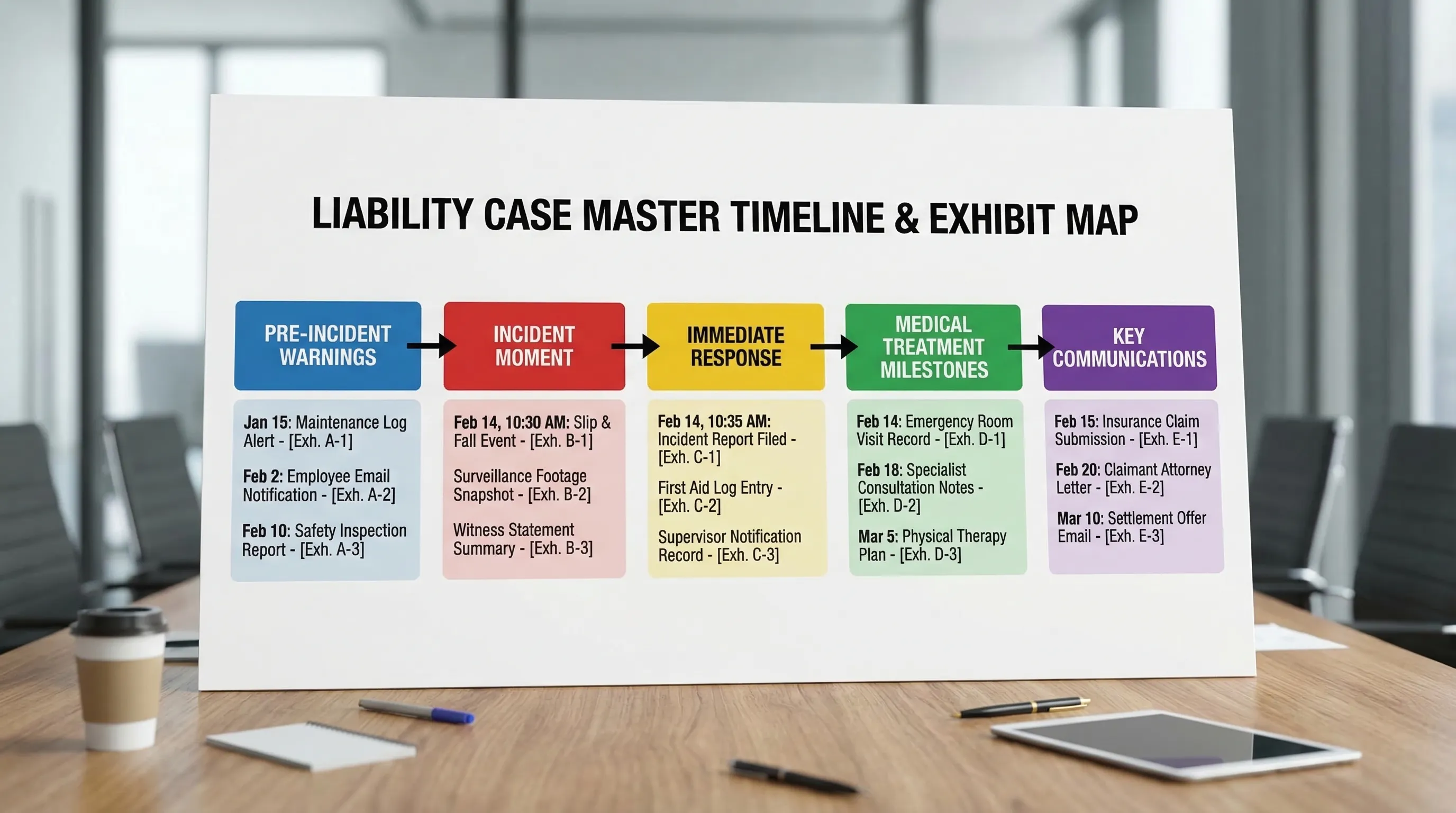
Timeline drift happens when different parts of the case use different “versions” of time.
Fix it by choosing one master timeline (even if it is simple) and forcing every witness and exhibit to align to it.
Turning the map into trial ready work product (without reinventing the wheel)
Once you have the map, most “trial prep” becomes assembly, not improvisation:
- Deposition outlines: each outline section corresponds to one row of the evidence map.
- Exhibit list and objections chart: generated directly from the exhibit column and admissibility notes.
- Medical summary: damages rows become the structure, with dates and providers anchored to the master timeline.
- Opening and closing: written in the order of the map, so argument mirrors proof.
This is where AI can be genuinely useful, if it is pointed at the right structure. Platforms like TrialBase AI are built for litigation workflows where you upload documents and quickly generate case ready outputs (for example, demand letters, medical summaries, and deposition outlines). The practical win is not “AI wrote words,” it is that your team can iterate faster while keeping everything tied to the same evidence map.
Practical safeguards: keep your evidence map clean under pressure
Use naming conventions that match courtroom reality
Pick a convention you can say out loud in court without confusion (for example, “PX 12, EMS Run Sheet” rather than “final_final_2.pdf”). Consistency reduces mistakes during witness examination.
Record provenance for critical documents
For anything that will be attacked (maintenance logs, prior claims, social media captures), note:
- Source and date obtained
- Who handled it
- Whether you need a custodian declaration or live custodian
Keep your review environment stable
If you run internal tooling for document review, e-discovery, or large file sync, performance and uptime matter. Some firms use reliable VPS hosting like PetroSky to keep project infrastructure responsive, especially when handling heavy workloads. (As always, evaluate confidentiality and compliance requirements for your jurisdiction and data types.)
Frequently Asked Questions
What is an evidence map for a liability trial? An evidence map is a structured matrix that ties each liability element (and key sub issues) to the best supporting exhibits, the sponsoring witness, and the admissibility plan.
How detailed should an evidence map be? Detailed enough that someone else can pick it up and run direct examination and exhibit admission, but short enough to scan quickly. Aim for one strong exhibit per point, with limited backups.
How do I connect causation proof to admissible evidence? Start with a master timeline, then tie expert opinions to specific admissible facts (records, measurements, observations) and ensure the expert foundation meets the applicable standards (for example, FRE 702 in federal court).
Can AI help with trial prep without creating risk? Yes, when you use AI to summarize, draft, and organize based on your curated documents and your evidence map structure, and you still apply attorney review for accuracy, privilege, and admissibility strategy.
CTA: Build your clean evidence map, then automate the outputs
If your case file is already thick, your best next move is not “more notes.” It is a clean evidence map that aligns every element of fault to a short, admissible proof path. Once that structure is set, generating deposition outlines, medical summaries, and demand letters becomes faster and more consistent.
To streamline that workflow, explore TrialBase AI at ai.trialbase.com and use your mapped issues to produce litigation ready materials in minutes (with attorney review).