Legal IT Company Guide: Security Questions to Ask in 2026
.png)

Vendor security reviews used to be a box to check. In 2026, they are part of client service. Law firms and legal departments are adopting cloud case platforms, AI drafting tools, and litigation-support automation that can touch highly sensitive data, including medical records, financials, trade secrets, and privileged communications.
If you are evaluating a legal IT company (or an AI litigation platform), the goal is not to “get to yes” quickly. It is to understand exactly how your data is protected, where it goes, who can access it, and what happens when something goes wrong.
Below is a practical, time-efficient set of security questions you can ask in 2026, plus what acceptable evidence looks like.
What changed in 2026 (and why your old checklist is not enough)
Three shifts are driving tougher security due diligence:
- AI supply chains are longer. Even if your vendor looks simple, it may rely on multiple subprocessors (cloud hosting, OCR, transcription, LLM providers, logging, analytics).
- Client expectations are higher. Corporate clients increasingly expect documented controls, not just “we encrypt data.”
- Ransomware and data exfiltration are now paired. You need both resilience (recovery) and confidentiality (exfiltration prevention and detection).
The security evidence to request (before the meeting)
Ask the vendor to share these items up front. A serious provider will have a standard package.
- A recent SOC 2 Type II report (or ISO 27001 certificate) and the scope (which systems are covered)
- A summary of the latest penetration test and remediation status (executive summary is fine)
- A subprocessor list (names, purpose, location, and what data they handle)
- A data retention and deletion policy that matches how your firm actually operates
- A sample incident response playbook and breach notification timelines
If the vendor cannot share any evidence due to policy, that is not automatically disqualifying, but you should expect a credible alternative such as a bridge letter, an independent assessment, or supervised review.
Security questions to ask your legal IT company (with “good” vs “red flag” answers)
The table below is designed for procurement calls. It helps you keep the conversation specific.
| Security area | Questions to ask (2026-ready) | What “good” looks like | Red flags |
|---|---|---|---|
| Security program | “Do you have SOC 2 Type II or ISO 27001, and is it scoped to the product we will use?” | Current, relevant scope, clear exceptions | “We are working on it,” unclear scope |
| Encryption | “Is data encrypted in transit and at rest, and how are keys managed?” | Modern TLS, strong at-rest encryption, controlled key management | Vague answers, shared keys, unclear ownership |
| Access control | “Do you support SSO (SAML/OIDC), MFA, and role-based access controls?” | SSO + MFA, least privilege roles, admin controls | Shared accounts, MFA optional for admins |
| Auditability | “What audit logs do we get, and how long are they retained?” | Exportable logs, admin actions tracked, retention options | No admin audit logs, short fixed retention |
| Segregation | “Is our data logically isolated from other customers?” | Tenant isolation with clear architecture explanation | “We think so,” or no isolation story |
| Backups and recovery | “What are your RPO and RTO targets, and are backups immutable?” | Clear targets, tested restores, ransomware-aware approach | “We do backups” with no restore testing |
| Incident response | “What is your breach notification timeline, and do you run tabletop exercises?” | Defined SLA, rehearsed response, clear roles | No timeline, ad hoc response |
| Vulnerability mgmt | “How do you handle vulnerability scanning, patching SLAs, and dependency risks?” | Regular scans, defined SLAs, dependency monitoring | No SLAs, reactive patching |
| Data retention | “Can we control retention, legal holds, and deletion verification?” | Configurable retention, deletion confirmation | Fixed retention that conflicts with policy |
| AI data use | “Is our data used to train models, improve prompts, or fine-tune anything?” | Default: no training on customer data, explicit opt-in | Training by default, unclear opt-out |
| AI supply chain | “Which model providers do you use, and what data do they receive?” | Clear list, minimization, contractual controls | “We cannot say,” or broad sharing |
| Confidentiality | “How do you prevent employees or contractors from accessing customer content?” | Least privilege, approvals, monitoring, strong internal controls | Broad internal access, informal approvals |
| Data residency | “Where is data stored and processed, including support and subprocessors?” | Transparent locations and transfer mechanisms | Unknown locations, shifting answers |
AI-specific security questions you should not skip
AI features can be safe, but only if the data path is explicit. Ask these questions even if the vendor says, “We do not train on your data.”
1) What is stored from prompts, uploads, and outputs?
You want clarity on:
- Whether prompts and generated outputs are logged
- How long logs are retained
- Who can access logs (support, engineers, contractors)
A good answer is specific, includes retention periods, and describes access controls.
2) Can we keep our matter data out of third-party model providers?
Some platforms can process data through external LLM APIs, others can offer stricter isolation patterns. Your job is not to demand a particular architecture, it is to understand:
- Which third parties receive content
- Whether data is minimized or transformed before it leaves the platform
- What contractual restrictions exist with those third parties
3) How do you reduce accidental disclosure in generated work product?
Security includes preventing the wrong content from appearing in the wrong place. Ask about safeguards around:
- Matter and document separation
- Citations or traceability back to source documents
- Guardrails to reduce cross-matter leakage
Cross-border work and data residency (especially if you operate internationally)
Many firms handle matters involving foreign entities, overseas witnesses, or international clients. If you open offices, form entities abroad, or support clients expanding internationally, data handling questions get stricter.
Ask your vendor to identify:
- Countries where data is stored and processed
- Whether support access occurs across borders
- How cross-border transfers are handled contractually
If your practice supports clients establishing operations in the UAE, for example, coordinate legal, IT, and corporate setup stakeholders so security and compliance are aligned. Corporate services advisors such as Alldren can be part of that broader planning on the entity and compliance side, while your legal IT company must still prove where litigation data lives and who can access it.
Contract terms that make your security review real
Technical controls matter, but contracts determine what happens when expectations are not met. In 2026, your baseline should cover:
- Security addendum and DPA (including subprocessors and notification obligations)
- Breach notification window that matches your client obligations
- Right to audit or review (often satisfied via SOC 2, pen test summaries, and questionnaires)
- Data deletion and return at termination, including verification
- Support access controls (how access is approved, logged, and time-bound)
Keep this section practical: align contract language to your firm’s actual incident response and client reporting duties.
Applying this to AI litigation support tools
Platforms that turn uploads into litigation-ready outputs (medical summaries, demand letters, deposition outlines, and trial materials) can save substantial time, but the security bar should be higher, not lower, because the inputs and outputs are often privileged and case-critical.
If you are evaluating an AI litigation support platform such as TrialBase AI, use the questions above to map:
- Exactly what documents you upload
- Who can access them (your team and the vendor)
- How outputs are stored, shared, and retained
- Whether any part of the workflow sends content to third parties
A good vendor will answer directly, provide evidence, and help you document the decision for your firm and for client security questionnaires.
A fast way to run the review (without slowing adoption)
To keep your process moving while staying defensible:
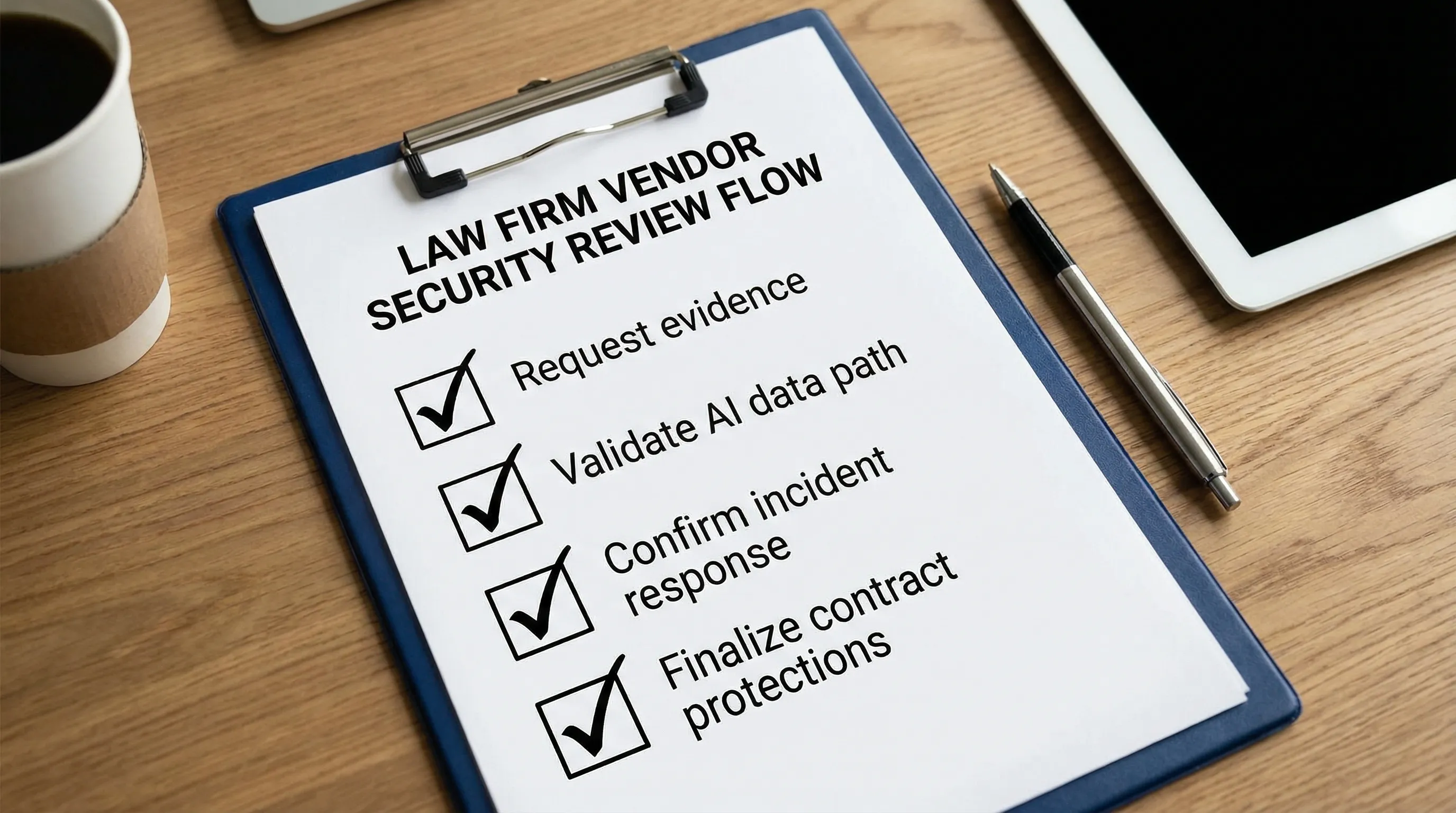
- Do a 30-minute “data path walkthrough” with the vendor (upload, processing, storage, sharing, deletion).
- Pilot with non-production or sanitized documents, then repeat with a realistic matter set once controls are confirmed.
- Require security evidence before procurement approval, not after implementation.
In 2026, the best legal IT companies make security easy to verify. Your job is to insist on clarity, evidence, and contract terms that match the reality of modern AI-enabled workflows.