Legal Intakes: Reduce Missed Details With a Simple Script
.png)

Missed details in legal intakes rarely come from “carelessness.” They come from predictable pressure: a client who is stressed, a caller who talks in circles, interruptions at the front desk, and different staff members asking different questions each time.
A simple, repeatable script solves most of this. It creates consistency, surfaces red flags early, and makes it easy to hand off the file to the next person without losing context.
Why legal intakes miss details (and what that costs you)
Most intake errors fall into a few patterns:
- Unstructured storytelling: You get a timeline, but not dates, locations, or who was present.
- No “close the loop” step: Names, treatment dates, employer info, and insurance details are recorded but not confirmed.
- Hidden complexity: Prior injuries, secondary impacts, additional defendants, and liens often appear only after records arrive.
- Document drift: The firm has “some photos” and “a few bills,” but no one knows what’s missing until demand time.
Even in strong cases, missing one intake detail can create avoidable rework later (extra calls, delayed record requests, and last-minute fact hunting). In the worst cases, it can create conflicts issues, deadline risk, or an incomplete damages picture.
A good script is also a diligence tool. Professional responsibility rules vary by jurisdiction, but the ABA Model Rules emphasize competence and diligence in representation (see Model Rule 1.1 and Model Rule 1.3). A consistent intake process helps you meet those obligations.
The 10-minute legal intake script (simple, not robotic)
Think of the script as three phases: Triage, Story, then Verification. Your goal is not to “get everything.” Your goal is to reliably capture the details that prevent delays and surprises.
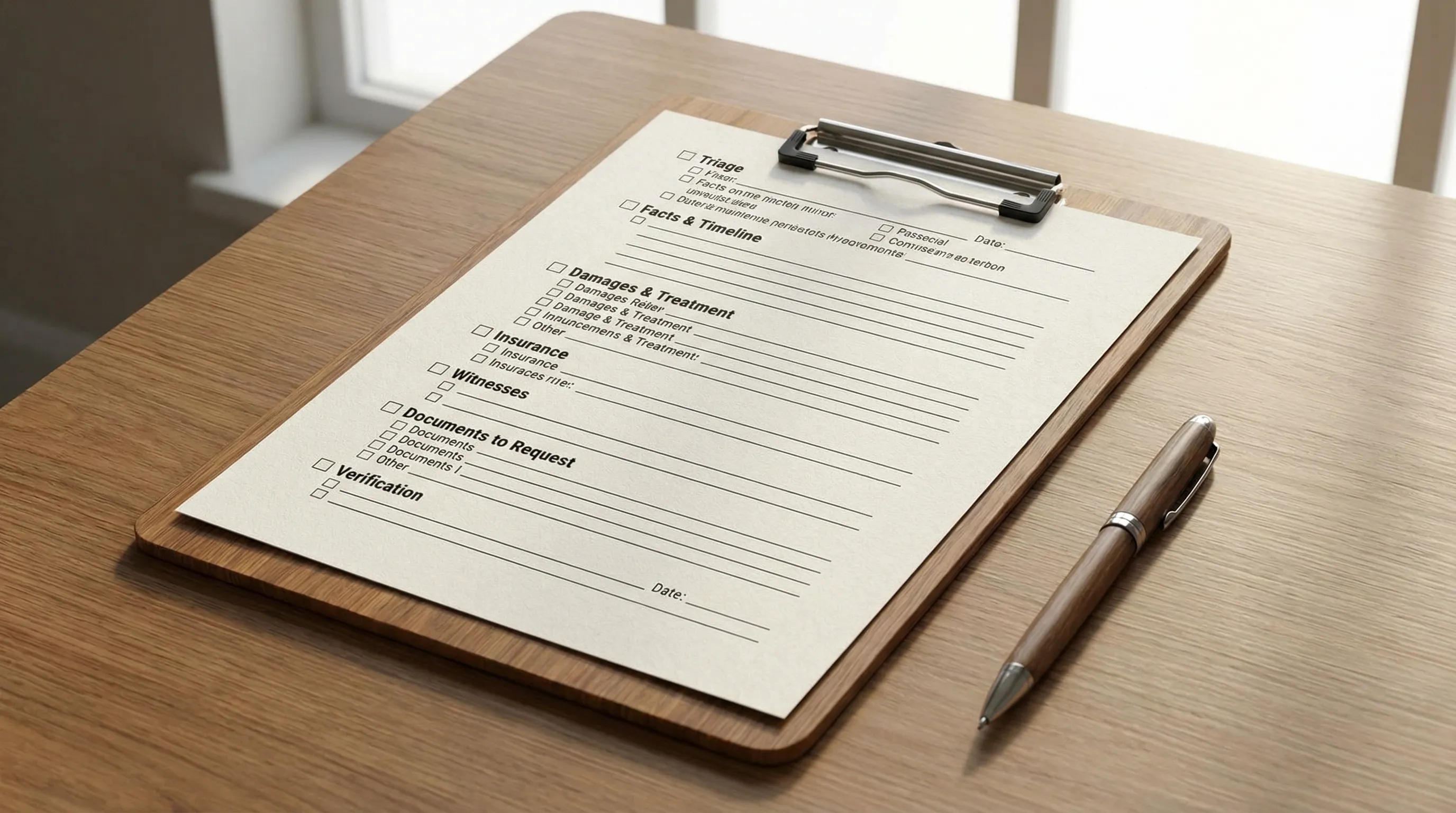
Intake script map (use as your one-page guide)
| Section | Purpose | Ask it like this (example wording) |
|---|---|---|
| Triage | Confirm you can and should proceed now | “Are you safe right now?” “Any upcoming deadlines or court dates?” |
| Contact + identifiers | Prevent errors and duplicate files | “What’s your legal name as it appears on your ID?” “Spell your email for me.” |
| Incident basics | Lock in the anchor facts | “Date and time?” “Exact location?” “Who was involved?” |
| Injuries + treatment | Build damages and records plan | “Where do you hurt today?” “Where have you treated, and when was the first visit?” |
| Insurance + coverage | Identify adjusters and coverage paths | “What insurance is involved?” “Do you have a claim number or adjuster name?” |
| Work + wage impact | Preserve loss documentation early | “Did you miss work?” “Are you using PTO, or unpaid time?” |
| Evidence + witnesses | Prevent evidence loss | “Any photos, video, or witnesses?” “Who has them right now?” |
| Prior issues + related events | Surface defenses and alternative causation | “Any prior injuries to the same body parts?” |
| Verification | Reduce mistakes immediately | “I’m going to read back the key details. Stop me if anything is off.” |
Copy/paste script (use verbatim if you want)
1) Triage
Are you safe and able to talk for 10 to 15 minutes? If not, schedule a callback and capture the best contact method.
Is there any urgent deadline you know of? (Upcoming hearing, statute concern, notice requirement, looming medical procedure, insurance statement request.)
Have you already signed with another attorney for this matter? (If yes, route internally per your policy.)
2) Contact and identity (accuracy first)
What is your full legal name?
Date of birth?
Best phone number and email? Then: Can you spell your email for me?
Preferred contact method and time window?
Where are you located (city and state)?
How did you hear about the firm?
3) Incident anchor facts (make it concrete)
What happened, in one sentence? Then: Let’s lock in the basics.
Date and approximate time?
Exact location (address or nearest intersection)?
Who was involved? (People, businesses, drivers, property owners, employers.)
Was a report made? (Police report, incident report, HR report.) If yes: Do you have a report number or agency name?
4) Injuries and treatment (timeline, not just diagnoses)
What body parts were affected?
When did you first feel symptoms? Immediately, later that day, or days later?
Where have you treated? Capture facility names and approximate dates.
Any imaging (X-ray, CT, MRI) or surgery recommended?
Are you still treating? Next appointment date?
5) Insurance and communications
Which insurance companies are involved?
Do you have a claim number or adjuster contact?
Have you given a recorded statement or signed any authorizations?
6) Work and out-of-pocket losses
Did you miss work or have restrictions?
Any out-of-pocket expenses so far? (Medications, co-pays, transportation, equipment.)
7) Evidence and witnesses
Any photos, video, or dashcam footage?
Any witnesses? Names and best contact info.
Anything posted on social media about the incident? (You’re not advising here, just capturing risk.)
8) Prior injuries and related history (ask neutrally)
Before this incident, did you ever have problems with the same body parts?
Any prior claims or injuries in the last few years?
9) Verification (the step most teams skip)
Let me read back what I captured to make sure it’s right. Read back: date/time, location, parties, main injuries, first treatment site/date, insurance/claim number, and best contact.
What did I miss that you think matters most? Then pause.
“Never miss” intake details (a short checklist)
If you only standardize one thing, standardize these:
- Full legal name, DOB, and best contact info (verified)
- Incident date, location, and all involved parties
- First treatment provider and approximate first treatment date
- Insurance company, claim number, adjuster contact (if known)
- Any report created (police, incident, HR) and where
- Photos/video/witnesses and who currently has them
- Prior injury to same body part (yes/no + brief explanation)
- Client’s top priority (treatment help, lost wages, vehicle, accountability)
A simple “trigger” method to catch gaps while you’re still on the phone
When you hear certain phrases, you should auto-follow with one clarifying question.
| If the client says… | Follow-up to avoid gaps |
|---|---|
| “I went to the hospital.” | “Which hospital, and what date did you go?” |
| “The adjuster keeps calling.” | “What company, and do you have a claim number?” |
| “I can’t work.” | “Since what date, and has a doctor given restrictions?” |
| “There’s video.” | “Who has it right now, and can we request it today?” |
These follow-ups keep the intake short while preventing the most common missing pieces.
After the intake: turn documents into litigation-ready work product faster
A strong script helps you capture the right facts and collect the right documents. The next bottleneck is turning those documents into usable work product.
That’s where a litigation support platform like TrialBase AI can help: you can upload case documents and generate litigation-focused outputs such as demand letters, medical summaries, and deposition outlines in minutes. Instead of starting from a blank page each time, your team starts from a structured draft and can spend their time refining strategy and accuracy.
Frequently Asked Questions
How long should legal intakes take? Most intakes can be completed in 10 to 20 minutes if you follow a script (triage, anchor facts, treatment timeline, verification) and schedule deeper follow-up only when needed.
What’s the biggest mistake in legal intakes? Skipping verification. Reading back key facts (date, location, parties, injuries, first treatment, insurance) prevents small errors that create major delays later.
Should intake be open-ended or checklist-based? Use both. Start with one open-ended question (“What happened, in one sentence?”), then move to a checklist to lock in dates, locations, parties, and treatment.
How do I handle a client who is emotional or disorganized? Keep them on rails kindly: confirm safety, ask for the incident date and location first, then build a simple timeline with “before, during, after” prompts.
Can AI help with intake follow-through? Yes, especially after intake. Once you have core facts and documents, AI tools can draft demand letters, summarize medical records, and generate deposition outlines faster, so staff can focus on review and case strategy.
Want fewer intake gaps and faster case prep?
Use the script above to standardize legal intakes across your team, then streamline the next step by turning your documents into case-ready materials.
Explore TrialBase AI to upload documents and generate demand letters, medical summaries, deposition outlines, and other litigation support outputs in minutes.