Legal Discovery Checklist for Faster Case Prep
.png)

Discovery is where cases are won slowly or lost quickly. When requests go out late, holds are incomplete, or productions are inconsistent, teams spend weeks redoing work that should have been settled at the start. A tight legal discovery checklist is less about bureaucracy and more about creating a repeatable system that gets you to the same place faster: usable evidence, clean issues, and a case file that is ready for deposition, mediation, and trial.
This checklist is for litigators and litigation teams who want faster case prep without cutting corners. It focuses on practical steps, clear ownership, and the common failure points that create avoidable delay.
What “faster case prep” actually means in discovery
Speed in discovery is usually about reducing rework, not just reviewing faster. The biggest time drains tend to come from unclear scope, incomplete custodian lists, inconsistent tracking and naming, privilege surprises, and weak linkage between discovery and downstream work product (depositions, motions, and damages materials).
A good checklist does three things:
- Compresses decision time by forcing early calls on scope, custodians, and format.
- Protects the record by documenting reasonableness, proportionality, and preservation.
- Turns evidence into outputs (summaries, timelines, depo prep) sooner.
Phase 1: First-week discovery setup (before you draft requests)
Early setup is where most “fast” teams separate from everyone else. In federal court, early planning maps closely to proportionality and case management concepts in Rule 26.
Start with alignment. Your discovery plan should reflect your case theory, damages model, and the decisions you actually need to make. If the team cannot articulate the few facts that will decide the case, discovery becomes a document-collecting exercise instead of case prep.
Then lock down preservation. Many “later” problems are really preservation failures that surface late and trigger motion practice, forensic collection, or credibility issues.
Key first-week actions
- Confirm parties, affiliates, and likely third-party sources.
- Identify custodians and data sources (email, chat, shared drives, mobile, core systems).
- Issue and track legal holds, including acknowledgments and updates.
- Create a draft ESI protocol outline (format, metadata, dedupe, natives, search terms, clawback).
- Draft or request a protective order early if sensitive categories are likely.
If you litigate in federal court, planning around the meet-and-confer expectations of Rule 26(f) is a useful structure.
Phase 2: Drafting and serving requests that shorten the case
“Faster” requests are not necessarily fewer requests. They are requests that map to case decisions and can be answered, negotiated, and enforced.
A practical approach is to draft in blocks:
- Foundation and authenticity (so exhibits are usable later)
- Liability and causation
- Damages and mitigation
- Policies, procedures, insurance, indemnity (when relevant)
- ESI and communications (often the highest-yield category)
Also specify what you actually need in production terms. If you want native spreadsheets, say so. If you need particular metadata, identify it. If key communications live in a specific system (Teams, Slack, text messaging, a claims platform), name the system.
Proportionality matters in both outcomes and speed. Overbroad ESI requests often cost time twice, once in objections and negotiation, then again in enforcement.
Phase 3: ESI collection, review, privilege, and production (where time disappears)
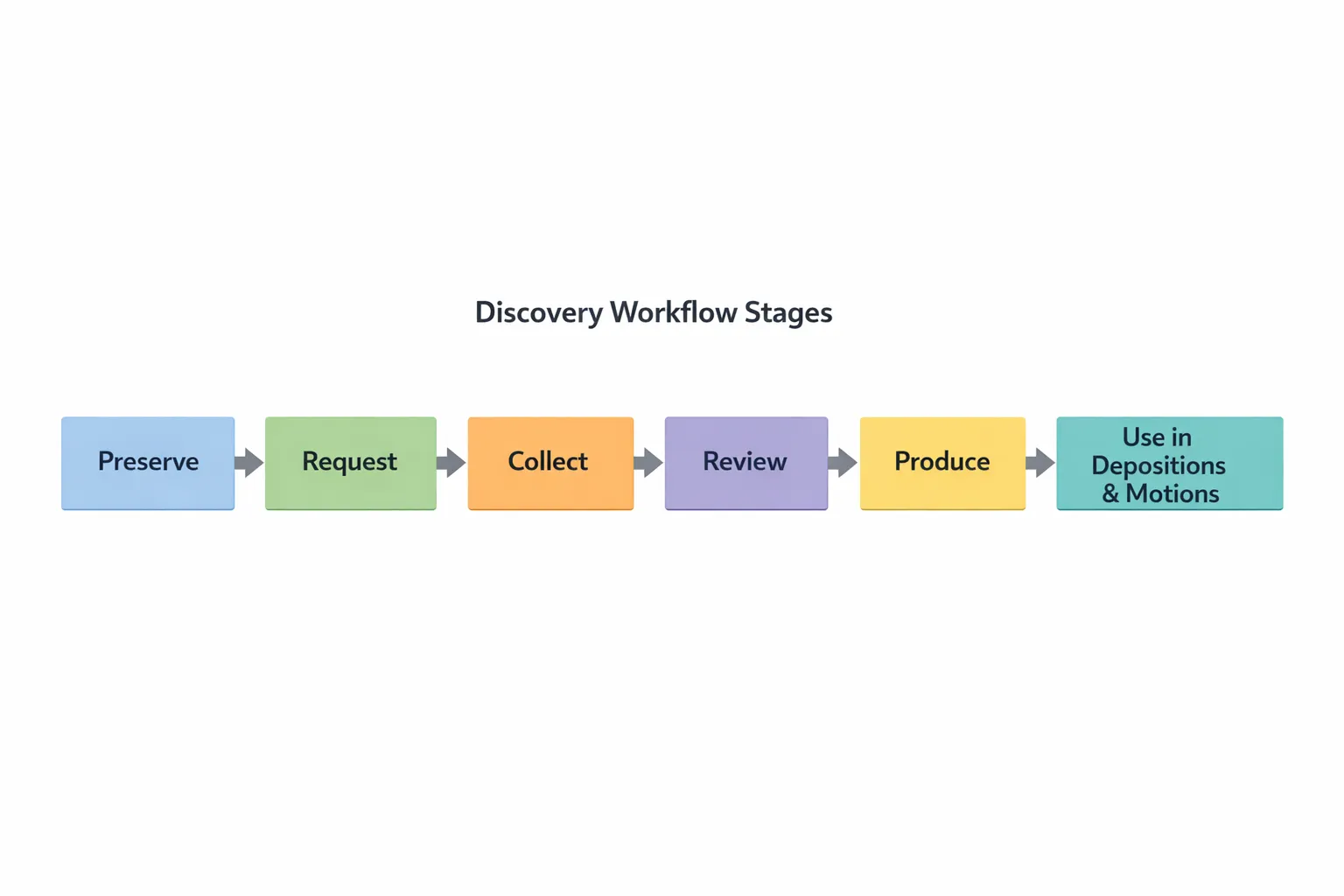
Most discovery schedules slip between “we served requests” and “we produced usable evidence.” Treat ESI as a pipeline with checkpoints.
Collection and production format checkpoints
Your internal record (even if you use a vendor) should be able to answer: what sources were preserved, what was collected, when, by whom, and what was excluded and why.
Align early on:
- Bates numbering and load file conventions
- TIFF/PDF/native expectations (and which categories must be native)
- Deduplication rules and family preservation (email plus attachments)
- Redaction handling and redaction logs
For a widely cited framework on defensible e-discovery practices, many teams reference The Sedona Conference.
Privilege and clawback planning
Privilege review moves faster when you decide early:
- Who makes privilege calls and how escalations work
- What will be logged (fields and level of detail)
- Whether a clawback agreement will be used (often addressed under FRE 502)
Without a plan, teams commonly do two full privilege passes because the data needed for the log was not captured consistently.
Phase 4: Medical and damages discovery (make it litigation-ready early)
In personal injury, med mal, employment, and many commercial cases, the time sink is not just collecting records. It is turning them into a usable damages story.
A faster workflow treats damages as a parallel track:
- Send authorizations and subpoenas early and track follow-ups.
- Normalize incoming records (provider, date range, completeness).
- Build a running chronology and issues list as records arrive.
If you wait to summarize until discovery closes, deposition prep and mediation briefing become an emergency review project.
Phase 5: Using discovery to accelerate depositions and motions
Discovery is only “done” when it feeds the next deliverable. The fastest teams convert new information into deposition plans and motion themes continuously.
As productions arrive, update:
- A custodian or witness topic map
- A short document-hits memo by witness
- A focused deposition exhibit shortlist
When you need to compel, judges respond best to clean records: what you asked for, what you got, what you did to resolve it, and what is still missing (see Rule 37).
Legal discovery checklist for faster case prep (copy and use)
The table below is designed to be pasted into your case plan. Add columns for dates and internal owner names if you want it to run like a tracker.
| Discovery stage | Checklist item | Output you want | Why it speeds case prep |
|---|---|---|---|
| Case intake | Define top issues, defenses, and damages drivers | 1-page case theory + issues list | Prevents over-collection and rework |
| Preservation | Identify custodians and systems, issue legal holds, track acknowledgments | Custodian list + hold log | Reduces spoliation risk and late “surprise” sources |
| ESI planning | Draft ESI protocol terms (format, metadata, native categories, dedupe, clawback) | ESI protocol draft | Avoids production disputes and redo productions |
| Initial disclosures (if applicable) | Confirm documents and witnesses you must disclose | Disclosure-ready file | Prevents omissions that trigger later scrambling |
| Written discovery | Draft targeted RFPs, interrogatories, RFAs tied to elements and defenses | Requests mapped to issues | Cuts irrelevant review and supports early enforcement |
| Meet and confer | Log disputes, proposals, and agreements in writing | Dispute tracker + confirmation email | Saves time later when memories differ |
| Collection | Document collection method and scope | Collection memo + source list | Supports defensibility and reduces forensic “do-overs” |
| Review | Set tagging standards, issue coding, and QC sampling | Review protocol | Prevents inconsistent tagging that slows depo and motion work |
| Privilege | Decide privilege workflow and logging fields early | Draft privilege log template | Prevents rebuilding logs from scratch |
| Production | Standardize Bates, load files, redactions, and slip sheets | Production checklist + index | Speeds use of exhibits and deposition prep |
| Third-party discovery | Identify third parties, subpoenas, and follow-ups | Subpoena tracker | Avoids last-minute record gaps |
| Depositions | Build witness-by-witness outline tied to produced evidence | Deposition outlines + exhibit list | Reduces prep time and increases effectiveness |
| Motion practice | Keep a clean record for compel/sanctions, update dispute tracker | Motion-ready timeline | Makes enforcement faster and more persuasive |
| Settlement and trial prep | Maintain exhibit list, key document set, and damages support | Mediation/trial-ready binder | Avoids end-stage rush and missed exhibits |
Common bottlenecks (and how to prevent them)
Most delays come from a few predictable problems.
Unclear ownership slows everything down. Discovery moves faster when one person owns the tracker and deadlines, even if multiple lawyers own substance.
Inconsistent naming conventions also quietly waste hours later. Standardize how you name productions, key exhibits, and witness folders from day one.
Waiting to synthesize is another repeat offender. If medical records, incident materials, or financials are not summarized as they come in, depositions and mediation prep require emergency review.
Finally, format fights are among the most avoidable disputes in discovery. You eliminate most of them by pushing ESI protocol discussions earlier and confirming agreements in writing.
Where AI can help shorten discovery without sacrificing quality
AI does not replace legal judgment in discovery, but it can reduce the time between “we received documents” and “we can use them.” In practice, that means accelerating the conversion of raw materials into litigation outputs.
For example, once records or documents are collected, teams often need medical summaries that highlight chronology and gaps, deposition outlines built around the record, and demand letters or settlement packages grounded in organized facts and damages support.
TrialBase AI is positioned for that part of the workflow. It is designed to turn uploaded case documents into litigation-ready outputs in minutes, including demand letters, medical summaries, deposition outlines, and trial materials, while supporting a unified, collaborative workspace.
Make your discovery outputs usable sooner
If your team is spending more time hunting through documents than using them, consider tightening the handoff from “documents received” to “litigation deliverable created.” TrialBase AI helps legal professionals upload documents and generate litigation-ready materials like demand letters, medical summaries, deposition outlines, and trial prep outputs in minutes.
Explore TrialBase AI here: TrialBase AI