Legal Developments: A Monthly Brief Template for Firms
.png)

Most firms want to stay on top of legal developments, but the real challenge is turning “interesting updates” into something that actually changes strategy, improves templates, and supports client conversations.
A monthly legal developments brief solves that problem when it is consistent, opinionated (in the good way), and written for action.
Below is a lightweight template you can reuse every month, plus a simple workflow to keep it from becoming a “nice idea” that no one maintains.
What a monthly legal developments brief is (and is not)
A monthly brief is an internal, practice-facing memo that answers three questions:
- What changed?
- Who does it matter to (practice group, client types, venues)?
- What should we do next (templates, playbooks, discovery posture, settlement narrative, intake flags)?
It is not a law review note. It is not a case dump. It is not a compilation of headlines.
Suggested cadence and ownership
Monthly works because it is frequent enough to be current, but not so frequent that it becomes a daily news feed. If your firm has fast-moving regulatory exposure, keep a “mid-month alert” option for true emergencies.
Ownership matters more than format. Pick one “brief owner” per practice group (rotating is fine), and give them a defined timebox (for example, 60 to 90 minutes to draft, 15 minutes for review).
Recommended sources (pick a small set and stick to them)
Choose sources that match your practice mix and jurisdictions. A short, consistent source list beats an exhaustive one.
- U.S. Supreme Court opinions for merits decisions and key dissents
- SCOTUSblog for accessible case context and updates
- Federal Register for federal agency rules, proposed rules, and notices
- U.S. Courts for federal judiciary updates and resources
- Your key state appellate court sites (set bookmarks and alerts by jurisdiction)
The monthly brief template (copy/paste)
Use this as a one to two page internal memo. The goal is skimmable, searchable, and easy to forward.
| Section | What to include | Target length |
|---|---|---|
| 1) Executive summary | 3 to 5 bullets on the month’s most important changes and why they matter | 6 to 10 lines |
| 2) Top developments by practice area | Group updates by practice (PI, employment, commercial, med-mal, etc.) | 4 to 10 short entries |
| 3) Cases to know | For each case: holding, procedural posture, venue, practical takeaway, quote-ready line | 3 to 6 cases |
| 4) Regulatory and rule updates | New rules, proposed rules, guidance, effective dates, compliance posture | 2 to 6 items |
| 5) Litigation “so what” | What this changes in pleadings, discovery, expert strategy, damages framing, mediation posture | 5 to 12 lines |
| 6) Templates and playbooks to update | Demand letters, depo outlines, intake checklists, discovery requests, trial themes | 3 to 8 actions |
| 7) Client talking points | Short client-friendly phrasing (no jargon), plus who should receive it | 3 to 6 bullets |
| 8) Watchlist | Items to track next month (pending appeals, rulemaking, splits) | 3 to 8 items |
“Case to know” entry format (tight and reusable)
Use the same mini-structure every time so attorneys can skim quickly:
Case name, citation (court, date).
Holding (1 sentence): What the court decided.
Why it matters (2 to 3 sentences): The practical impact on motions, proof, venue strategy, or damages.
Action (1 sentence): What to change now (or what to monitor).
Quote-ready line (optional): A clean sentence you can reuse in internal emails or a client alert.
A workflow that makes the template sustainable
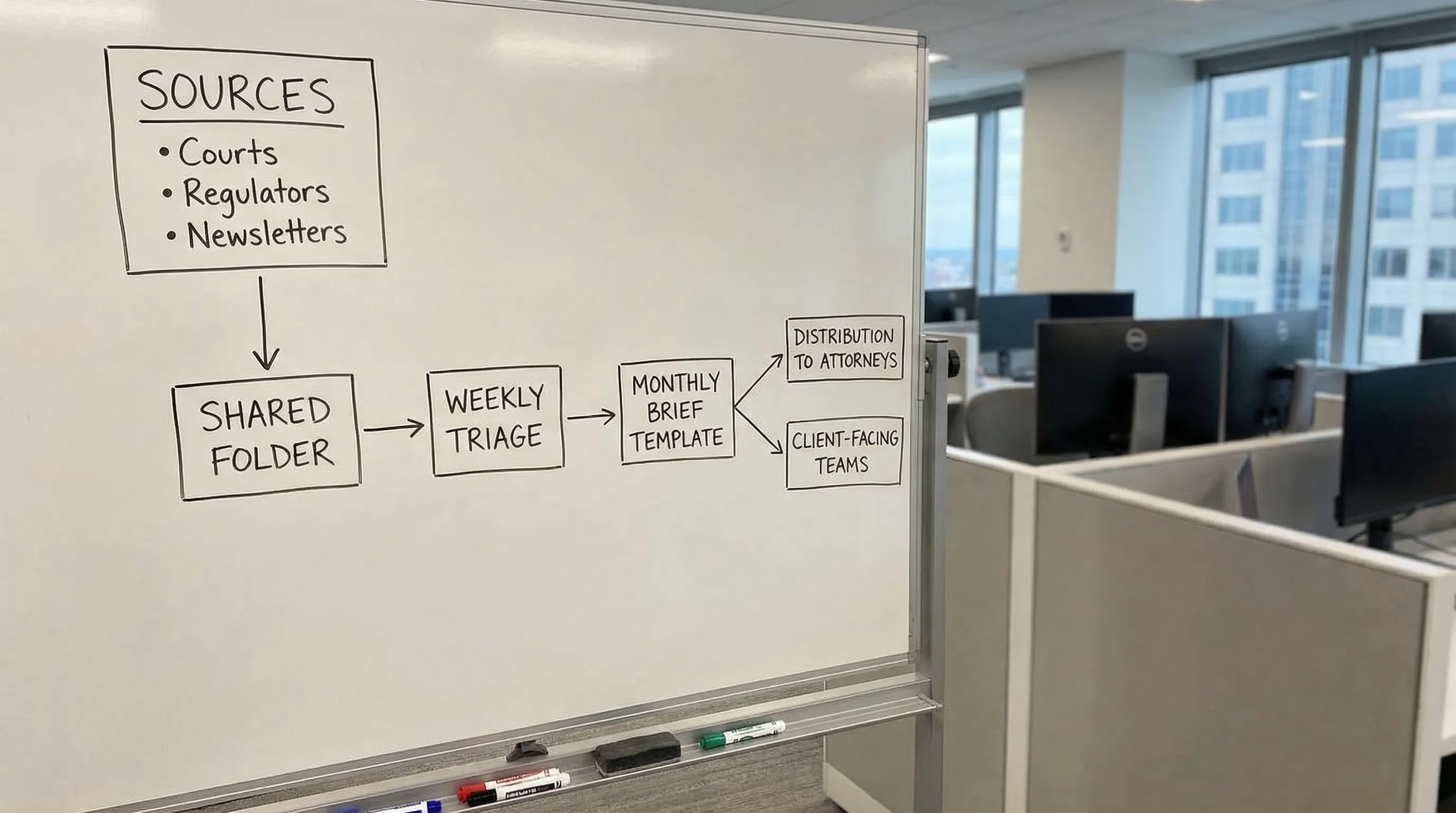
Most briefs fail because collection is messy and drafting starts from scratch every month. A simple pipeline fixes that.
- Collect: Keep a shared inbox or folder where attorneys drop links, PDFs, and orders during the month.
- Triage weekly: Spend 10 minutes each week tagging items as “FYI,” “practice-impacting,” or “client-impacting.” If it is only interesting, it does not make the brief.
- Draft from the template: End-of-month drafting should feel like assembling pre-tagged pieces, not researching from zero.
- Distribute and store: Email it, but also store it in a searchable place by month and practice area.
Where AI helps (without turning the brief into “auto-generated noise”)
AI is most useful when it compresses reading time and standardizes outputs. For a monthly legal developments brief, that typically means:
- Converting long opinions, orders, and rulemaking PDFs into short, structured summaries aligned to your template.
- Extracting holdings, procedural posture, key dates, and practical takeaways in a consistent format.
- Producing client-ready talking points from an internal analysis (with attorney review).
If your team already uses TrialBase AI, you can apply that same “upload documents, get litigation-ready outputs” workflow to legal updates: upload the source material, generate a clean summary for internal use, and then adapt it into the “so what,” template updates, and client talking points sections. Always keep attorney review in the loop.
Quality control checklist (fast, but important)
A monthly brief earns trust when it is accurate and clearly scoped.
- Cite primary sources whenever possible (opinions, orders, rules).
- Separate what is binding from what is persuasive.
- Flag open questions (splits, pending en banc, cert petitions).
- Avoid absolute language when the law is still developing.
- End each major item with a concrete action or a clear “monitor only.”
Make it firm-specific: the one question to ask every month
Before you send the brief, ask: “What will we do differently next week because of this?”
If the answer is “nothing,” cut the item or move it to the watchlist. If the answer is “update our demand letter language,” “change depo sequencing,” or “add an intake red flag,” it belongs in the brief.
Used consistently, this template turns legal developments into a repeatable internal product: easier for attorneys to consume, easier for teams to maintain, and much more likely to influence outcomes.