Legal Deposition Basics: Roles, Rules, and Goals
.png)

Depositions are one of the most powerful tools in civil litigation because they turn “what someone says happened” into sworn testimony that can shape settlement value, motion strategy, and trial presentation. They are also one of the easiest places to lose time and leverage if you treat them like an informal interview instead of a governed procedure with specific roles, rules, and outcomes.
This guide covers legal deposition basics in practical terms: who does what, what the core procedural rules typically require, and how to stay focused on deposition goals from notice to transcript.
What a deposition is (and what it is not)
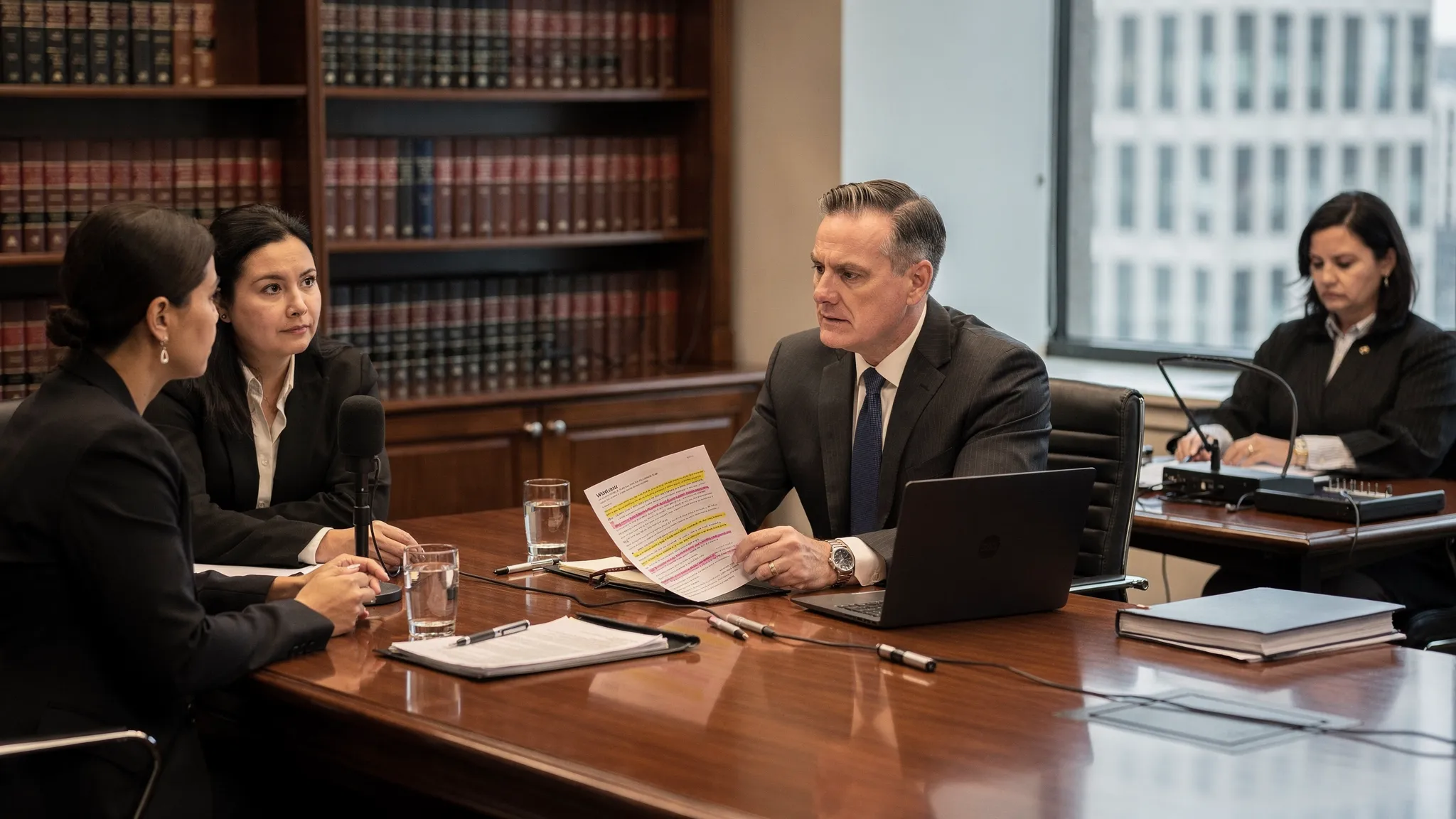
A deposition is sworn, out-of-court testimony taken before a case is tried. It is usually recorded by a court reporter (stenographic transcript) and often by video. In most civil cases, depositions are a discovery device governed by rules of civil procedure (federal or state).
A deposition is not:
- A closing argument. You are building a record, not winning the room.
- A trial cross-exam. You are often gathering information and testing positions, not performing.
- An informal conversation. The witness is under oath, and the record is the product.
For federal cases, the baseline framework is in the Federal Rules of Civil Procedure, especially Rule 30 (Depositions by Oral Examination) and Rule 32 (Using Depositions in Court Proceedings). State rules vary, sometimes significantly, so always confirm local requirements.
Roles in a deposition (who is in the room, and why)
A deposition runs smoothly when everyone understands their lane and the record reflects clean roles.
| Role | Core function | Common pitfalls to watch |
|---|---|---|
| Deponent (witness) | Gives sworn testimony based on personal knowledge (or corporate knowledge in some cases) | Guessing, volunteering, adopting counsel’s framing, unclear “I don’t know” |
| Examining attorney | Elicits testimony, establishes exhibits, builds impeachment-ready statements | Overlong questions, argument in questions, unclear time markers and document references |
| Defending attorney | Protects privileges, enforces limits, preserves objections | Speaking objections, coaching, excessive interruptions |
| Court reporter | Administers oath (in many jurisdictions) and creates the transcript | Parties talking over each other, unclear exhibit labeling |
| Videographer (optional) | Creates video record for playback and impeachment | Poor audio, missing on-the-record stipulations, unclear exhibit handling |
| Interpreter (as needed) | Ensures accurate language access | Failure to establish interpreter qualifications and ground rules |
| Corporate representative (sometimes) | Observes on behalf of a party, may help counsel track issues | “Off the record” coaching attempts, reactions that distract the witness |
Special case: Rule 30(b)(6) depositions
In federal court and many states, organizations can be deposed through a designated representative on specific topics (often called “30(b)(6)” depositions). These depositions raise unique preparation and record issues because:
- The testimony is on behalf of the entity, not just personal recollection.
- The organization has a duty to prepare the designee to testify on noticed topics.
- Topic scope fights are common, and proportionality and reasonable particularity matter.
Core rules you should plan around (typical deposition mechanics)
Procedural details differ by jurisdiction, but many depositions share a common structure. Planning around these mechanics reduces disputes and keeps your record usable.
Notice, subpoena, and attendance
- Party witness depositions are typically set by notice under the applicable rule.
- Non-party witness depositions usually require a subpoena, plus witness fees and mileage where required.
- Disputes often center on timing, location, remote format, document requests, and protective orders.
Oath and the “record”
The witness testifies under oath. Everything said on the record can matter later, including objections, colloquy, and exhibit references.
Best practice is to build a clean transcript:
- One person speaks at a time.
- Counsel state appearances clearly.
- Exhibits are marked consistently and described precisely.
Time limits and session structure
Many jurisdictions impose presumptive time limits (for example, federal Rule 30(d)(1) sets a one-day, seven-hour limit unless otherwise stipulated or ordered). Even when there is no strict cap, courts expect reasonable pacing.
Objections and instructions not to answer
A common misconception is that deposition objections work like trial objections. In many systems, most objections are preserved by stating them briefly and the witness answers anyway, unless the objection implicates a protected category.
| Objection type (common categories) | What it is trying to accomplish | Typical handling (jurisdiction-dependent) |
|---|---|---|
| Form | Flags issues like ambiguity, compound questions, lack of foundation | Usually stated briefly, witness answers |
| Relevance | Preserves position that the line is outside discoverable scope | Often preserved, witness still answers |
| Privilege / work product | Protects confidential attorney-client communications or protected material | May support an instruction not to answer |
| Asked and answered / cumulative | Prevents harassment or needless repetition | Usually preserved, witness often answers |
| Mischaracterizes testimony | Prevents unfair paraphrasing from becoming “adopted” | Often followed by clarifying testimony |
Because local rules and judicial preferences vary, it is important to align your objection practice with what your court expects. Speaking objections and coaching can backfire, both substantively and in front of the judge.
Breaks, off-the-record time, and communications
Depositions often involve breaks for practical reasons. Still, many courts scrutinize witness-attorney communications during breaks, especially when a question is pending.
A clean approach is to:
- Put rules for breaks on the record at the start.
- Avoid mid-question conferences.
- Preserve privilege carefully without creating avoidable disputes.
Exhibits, authentication, and foundation
Even if you do not plan to use the exhibit at trial, deposition exhibits are a strategic opportunity to:
- Lock down what the witness recognizes.
- Establish timelines and authorship.
- Confirm what was known and when.
The more precise your exhibit handling (titles, Bates ranges, dates, who created it, who received it), the more usable your record becomes.
Transcript review and errata
Many jurisdictions allow the witness to review the transcript and make changes on an errata sheet within a time window. Errata can become a mini-battle over substantive changes.
Practically:
- Use the transcript review period as a timeline for follow-up discovery.
- Track any substantive edits for impeachment and motion practice.
Goals of a deposition (what “winning” looks like)
A deposition’s value is measured by what it enables later. Before you draft an outline, pick the job the deposition must do.
Discovery and case theory testing
Depositions surface facts you cannot reliably get from paper discovery:
- What the witness actually knows (and does not know).
- How they explain “bad documents.”
- The story they will tell a jury.
They also reveal what needs follow-up: additional custodians, missing records, unknown witnesses, and alternative causation theories.
Locking testimony for later use
A strong deposition record creates clear, quotable commitments:
- “I did X on Y date.”
- “No one told me Z.”
- “These are the only two reasons.”
Those statements support summary judgment, motions in limine, settlement negotiations, and trial impeachment.
Preserving testimony you might not get at trial
Depositions may preserve testimony when a witness is unavailable later. The rules on admissibility are technical (and jurisdiction-specific), but planning with Rule 32 (or your state equivalent) in mind helps you ask questions that will later “play.”
Valuation and settlement leverage
Depositions are often the first time decision-makers see how a witness performs under pressure. Credibility, consistency, and clarity can change a case’s settlement posture quickly.
How to prepare for a deposition without wasting time
Preparation is where most deposition outcomes are decided. The goal is not to “know everything,” but to know what you need to prove or disprove and what admissions you need on the record.
Build a tight case map: claims, elements, and proof
Start with the legal elements and defenses, then map each to witnesses and documents. Your outline should be driven by burdens of proof, not curiosity.
A practical way to do this is to maintain a one-page deposition objective sheet that states:
- Top issues you must cover.
- Exhibits required to authenticate or confront.
- The specific admissions you want.
Organize documents around events, not folders
Witnesses remember sequences. Jurors do too. Chronologies reduce rambling answers and help you anchor questions.
If you are in a medically intensive case (personal injury, med-mal, toxic exposure), chronologies matter even more because timelines drive causation, treatment reasonableness, and damages.
Plan your exhibit workflow
Before the deposition, decide:
- Which exhibits are “must use” versus “nice to have.”
- How you will introduce each exhibit (identify, authenticate, confirm receipt, confirm understanding).
- How you will reference page and line on the record.
Prepare your witness (when it is your witness)
Witness preparation is a nuanced topic and heavily governed by ethics rules, local practice, and privilege considerations. In general, a well-prepared witness:
- Understands the process and the stakes.
- Understands the importance of listening, pausing, and answering only what is asked.
- Can explain documents accurately without speculating.
Conducting the deposition: techniques that create a usable record
A clean deposition record is not about being aggressive, it is about being precise.
Ask questions that can be quoted
Prefer questions that produce complete, standalone answers. “Yes/no” is sometimes ideal, but only when you have established context and definitions.
Useful building blocks include:
- Define terms early.
- Confirm time periods.
- Separate knowledge from belief.
- Confirm who else was present.
Control pace without sounding combative
You can control pace by controlling question length. Long questions invite long answers and objections.
When a witness rambles, bring them back with:
- “My question was…”
- “Do you know, yes or no?”
- “If you do not know, please say you do not know.”
Handle objections strategically
If you anticipate form objections, tighten your phrasing. If you anticipate privilege disputes, structure the topic to avoid protected communications while still getting facts (who, what, when, where).
When defending, preserve privilege and the record. Avoid speeches. Judges read transcripts.
Remote depositions and modern realities
Remote depositions are now routine in many jurisdictions. They introduce practical risks:
- Witness coaching off camera.
- Exhibit confusion.
- Audio dropouts and incomplete records.
Mitigations often include on-the-record ground rules, screen-sharing protocols, and clear handling of breaks and communications.

When industry knowledge matters (and a niche example)
Some depositions hinge on understanding regulated operational systems, not just who signed a contract. If your case touches industries like online gambling, payments, or fraud prevention, it can help to understand what “normal” platform operations look like: KYC, AML checks, payment flows, and back-office controls.
For a concrete reference point on how a modern iGaming operator’s tooling can be structured, you can look at an iGaming platform compliance stack and note the kinds of controls and records that may exist (for example, identity verification, payment logs, fraud rules). That context can inform smarter document requests and more precise deposition questions when those systems are at issue.
Using AI responsibly to prepare deposition materials
Many legal teams now use AI to accelerate preparation work, especially when the case file includes large medical records, lengthy discovery, or prior testimony.
In deposition practice, AI can be especially useful for:
- Creating timelines and issue-focused summaries.
- Identifying contradictions across documents.
- Drafting a first-pass deposition outline keyed to key exhibits.
- Generating medical summaries that clarify treatment chronology and causation theories.
If your workflow includes tools like TrialBase AI, the value is in converting document sets into litigation-ready work product quickly, such as deposition outlines and medical summaries, while your team keeps control over strategy and final wording. You can learn more about the platform at TrialBase AI.
As always, follow your jurisdiction’s confidentiality obligations, your firm’s policies, and any protective orders when using third-party tools.
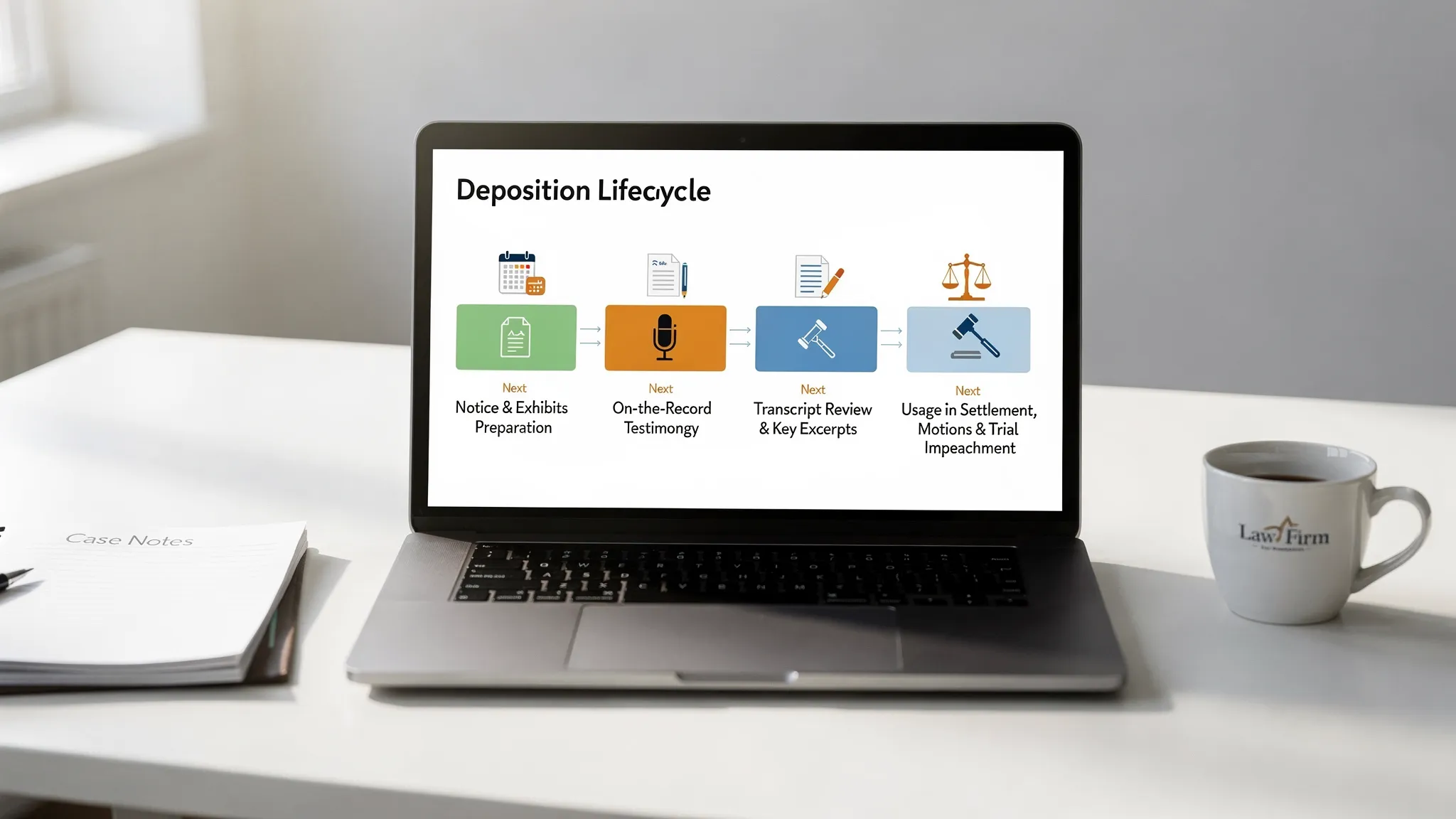
After the deposition: turning testimony into leverage
The deposition is not “done” when the court reporter stops. The follow-through is where the record becomes usable.
Transcript triage
Within 24 to 72 hours, it helps to produce:
- A short highlights memo (key admissions, key denials, key inconsistencies).
- A list of follow-up discovery items.
- A cross-reference to exhibits discussed.
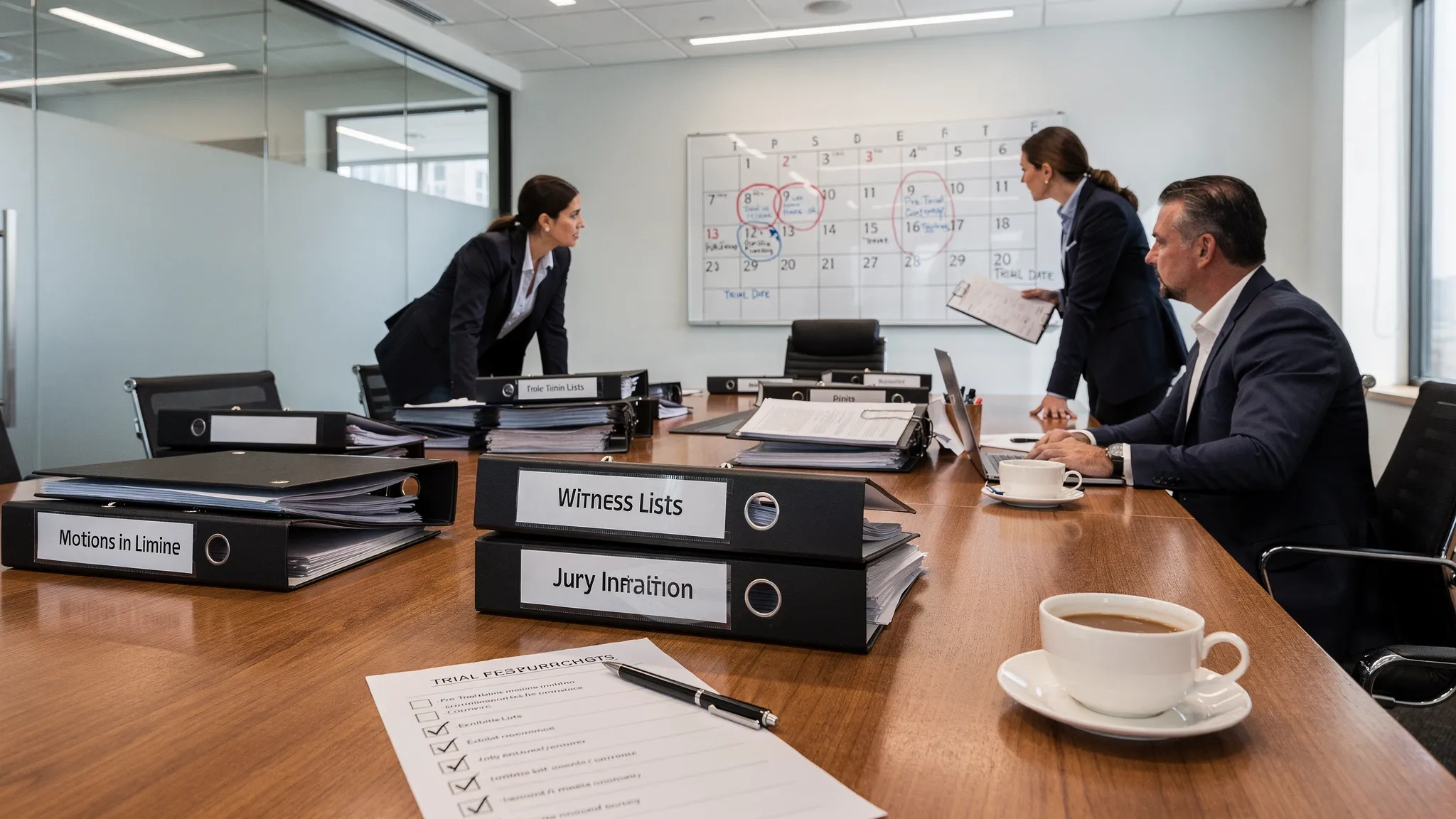
Motion, settlement, and trial planning
Deposition testimony fuels:
- Dispositive motions (clear element admissions or lack of evidence).
- Settlement leverage (credibility and damages clarity).
- Trial impeachment (clean, quotable contradictions).
Bottom line
A deposition is a governed process designed to produce a usable record. When you treat it that way, the roles become clearer, the rules become easier to navigate, and the goals become measurable.
If you walk into each deposition knowing (1) what testimony you must lock down, (2) which documents drive the admissions, and (3) how you will use the transcript afterward, you are no longer “taking” a deposition. You are building a case-ready record.