Legal Demand Letter Template: Structure, Facts, and Damages
.png)

A well-written demand letter is often the first document that shows the other side (and their insurer or counsel) you are prepared to prove liability and quantify damages. It should read like the opening pages of a complaint and a settlement memo combined: clear facts, supported damages, and a specific demand with a deadline.
This guide gives you a practical legal demand letter template plus the structure courts, adjusters, and defense counsel expect.
Note: This is general information, not legal advice. Demand letter requirements vary by jurisdiction, claim type, and professional responsibility rules.
What a legal demand letter needs to accomplish
A strong demand letter should do three things quickly:
- Establish liability with a tight fact narrative and supporting exhibits.
- Prove damages with a clean, readable breakdown tied to evidence.
- Create settlement leverage by presenting a reasonable demand, clear terms, and a firm response deadline.
If the reader has to guess what happened, what you can prove, or what you want, you lose momentum.
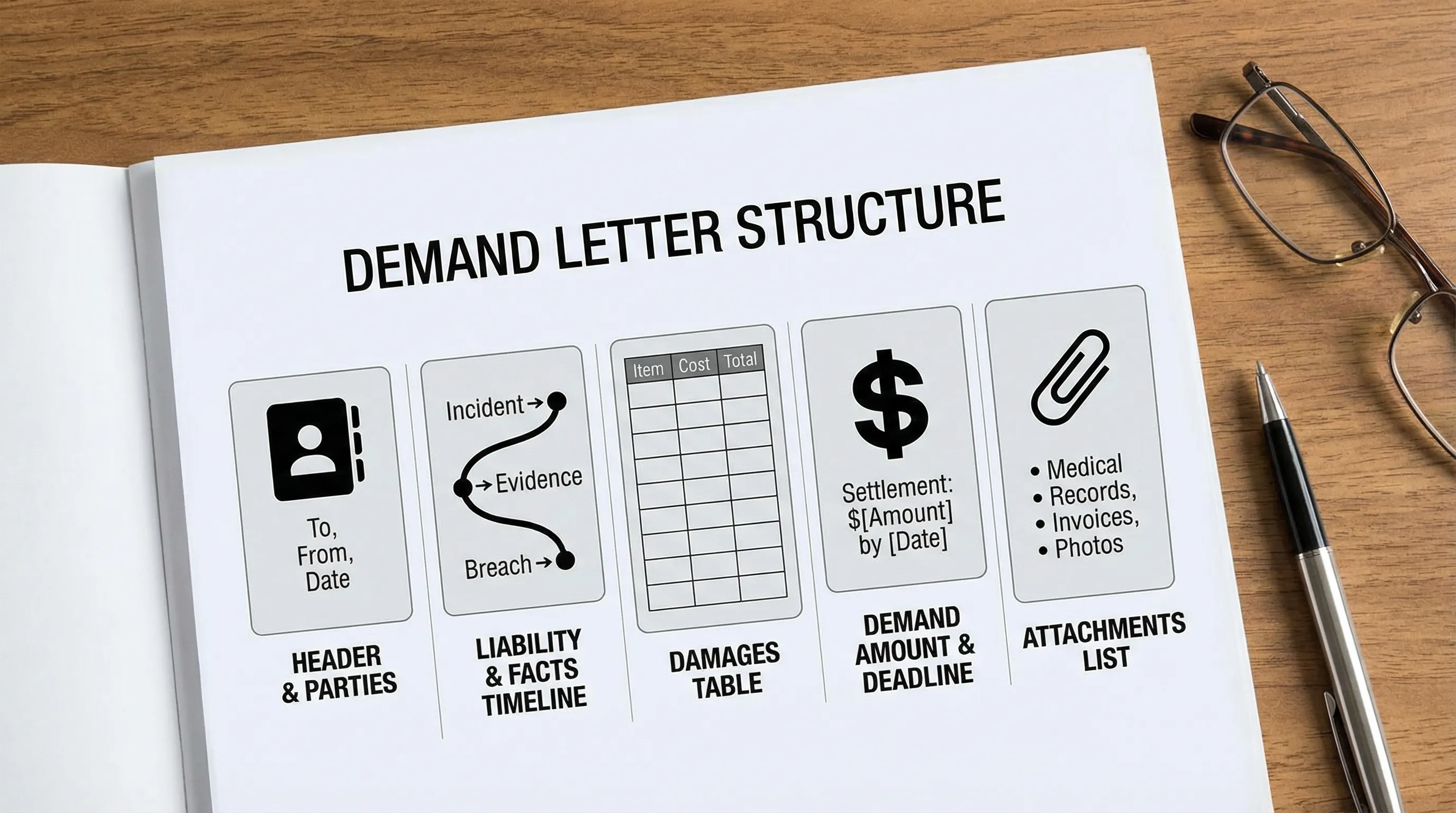
Legal demand letter template (copy and adapt)
Use the structure below as a starting point. Brackets indicate placeholders.
1) Letterhead, date, and delivery
[Your Firm Name]
[Address]
[Phone] | [Email]
Date: [Month Day, Year]
Via: [Email / Certified Mail / Portal]
To: [Adjuster or Defense Counsel Name, Company/Firm]
Re: Demand for Settlement
Claimant: [Client Name]
Insured/Defendant: [Name]
DOI/DOL: [Date]
Claim No.: [If known]
2) Representation and purpose
I represent [Client Name] regarding injuries and losses arising from [incident description] on [date]. This letter is a settlement demand based on the facts and documentation summarized below.
3) Liability position (the “why you pay” section)
Based on available evidence, liability rests with [insured/defendant]. The key bases are:
- Duty: [Brief statement]
- Breach: [What they did or failed to do]
- Causation: [How breach caused harm]
- Damages: [High-level summary]
If applicable, address comparative fault in one paragraph: identify the allegation and explain why the evidence does not support it.
4) Facts and timeline (the “what happened” section)
Provide a tight narrative, then a timeline. Keep it chronological and cite exhibits.
Narrative summary: On [date/time], [client] was [doing what] when [insured] [did what], causing [impact/outcome]. [Client] immediately experienced [symptoms] and sought [care]. (See Exhibits [A–C].)
Key timeline:
- [Date]: [Event + exhibit reference]
- [Date]: [Event + exhibit reference]
- [Date]: [Event + exhibit reference]
5) Injuries, treatment, and prognosis
Summarize injuries and treatment in a way a non-clinician can follow.
Injuries diagnosed: [List primary diagnoses]
Treatment course: [ER/urgent care, imaging, PT, specialists, procedures]
Current status/prognosis: [Residual symptoms, restrictions, future care recommendations]
If there is a gap in treatment, address it briefly and factually.
6) Damages (the “how much” section)
A demand letter is stronger when damages are organized and documented. Consider using a table for readability.
| Damages category | What to include | Common supporting documents |
|---|---|---|
| Medical expenses (past) | Itemized totals and dates | Bills, ledgers, EOBs, records |
| Medical expenses (future) | Projected care tied to provider opinion | Narrative reports, care plans |
| Lost wages | Time missed, rate of pay, dates | Employer letter, pay stubs, tax docs |
| Loss of earning capacity | Work restrictions, vocational impact | Medical restrictions, vocational analysis |
| Property damage / out-of-pocket | Repairs, rentals, mileage, meds | Receipts, invoices, photos |
| Non-economic damages | Pain, limitations, disruption of life | Treatment notes, day-in-life summary |
Totals (attach backup):
- Medical (past): $[amount]
- Medical (future): $[amount]
- Wage loss: $[amount]
- Other economic losses: $[amount]
- Non-economic damages: $[amount or narrative basis]
7) Settlement demand and terms
Based on the above, we demand $[total demand] to settle all claims against [insured/defendant], subject to the following:
- Payment within [X] days of acceptance.
- Standard settlement documentation, including [release scope].
- Satisfaction of any applicable liens or subrogation interests per law and agreement.
8) Deadline and next steps
Please provide a written response by [date]. If we do not receive a timely response, we will proceed with [litigation / filing / other action] as appropriate.
9) Exhibits and closing
Enclosures: Exhibit A: [description], Exhibit B: [description], Exhibit C: [description]
Sincerely,
[Attorney Name]
[Bar No., if customary]
[Firm]
Tips for writing “facts” that survive scrutiny
Facts are persuasive when they are specific, sourced, and consistent with the record.
- Use concrete details (time, location, mechanism, who observed what).
- Tie key statements to exhibits (photo set, incident report, medical record page ranges).
- Address weaknesses proactively (treatment gaps, prior injuries, inconsistent statements) in a short, neutral paragraph.
For general legal writing guidance, the ABA has resources on professional standards and practice management.
Tips for writing “damages” that get paid faster
Damages sections delay settlement when the math is unclear or the support is missing. Aim for a clean story:
- Put economic damages in a simple summary and attach the backup.
- Explain non-economic damages with functional impact (sleep, driving, lifting, childcare, work tolerance), not just adjectives.
- If you include future care, anchor it to a provider recommendation or documented plan, not speculation.
Common demand letter mistakes (and quick fixes)
Overreaching and under-documenting are the two fastest ways to lose credibility.
- Mistake: No clear demand number. Fix: State a specific amount and what it resolves.
- Mistake: A long narrative with no exhibits. Fix: Add exhibit references and a short timeline.
- Mistake: Damages listed without totals. Fix: Provide subtotals and a clean roll-up.
- Mistake: Threatening tone. Fix: Keep it professional and litigation-ready.
Frequently Asked Questions
What is the best structure for a legal demand letter? A strong structure is: parties and purpose, liability, facts and timeline, injuries/treatment, damages with evidence, demand and terms, deadline, exhibits.
Should a demand letter include a deadline? Yes, a clear response deadline creates urgency and helps demonstrate reasonableness if litigation follows.
How do I present damages clearly in a demand letter? Use subtotals by category, cite supporting documents, and summarize non-economic damages with functional limitations tied to treatment.
Do I need to attach medical records and bills? Often, yes. Even when not required, attaching or clearly itemizing support reduces back-and-forth and speeds evaluation.
Draft faster with TrialBase AI
If drafting demand letters is slowing down your case workflow, TrialBase AI can help you turn uploaded documents into litigation-ready outputs in minutes, including demand letters, medical summaries, and deposition outlines.
Explore TrialBase AI here: ai.trialbase.com