Legal AI in 2026: Practical Use Cases for Litigators
.png)

Legal AI stopped being a novelty for litigators a while ago. In 2026, the firms getting the most value are not the ones “using ChatGPT” for an occasional draft, they are the ones who have repeatable, reviewable workflows for turning messy case files into litigation-ready work product. That shift matters because litigation is time-bound, document-heavy, and accountability-driven. If your AI output cannot be traced, verified, and defended, it is not helpful.
This guide focuses on practical legal AI use cases for litigators across the lifecycle of a case, plus the governance and evaluation habits that keep the work reliable.
What “legal AI” typically means in 2026 (and why it matters)
When litigators say “legal AI,” they usually mean a combination of:
- Document intelligence (OCR, classification, extraction, summarization)
- Retrieval augmented generation (drafting that is grounded in your uploaded record, not the open internet)
- Workflow automation (turning repeat tasks into templates and repeatable outputs)
- Quality controls (citations to the record, auditability, and structured review)
Across industries, the broader trend has been moving from pilots to operationalized AI with measurable value and governance. If you want a business-level view of that shift (including architecture and common scaling mistakes), this AI Report 2025: Key Trends for Businesses is a helpful framing because it mirrors what is happening inside litigation teams: fewer “cool demos,” more production workflows.
In litigation specifically, the most useful systems behave less like a chatbot and more like a litigation support teammate that turns case documents into structured outputs you can verify.
Practical legal AI use cases for litigators (intake to verdict)
The highest ROI use cases share three traits:
- The input is document-heavy (records, discovery, transcripts).
- The output has a known format (summary, outline, chronology, letter).
- A human reviewer can verify accuracy against the record.
Here is where legal AI is typically being deployed in 2026.
| Litigation stage | High-value AI use case | Typical output | Human review focus |
|---|---|---|---|
| Intake and early evaluation | Case file triage and issue spotting | Intake memo, initial timeline, key document list | Completeness, missed red flags, correct parties and dates |
| Pre-suit / demand | Demand package assembly | Demand letter draft, damages narrative, exhibits index | Record support for every factual claim, tone, jurisdictional requirements |
| Medical-heavy matters | Medical record summarization | Medical chronology, treatment summary, causation notes | Accuracy of dates, diagnoses, meds, and provider attribution |
| Discovery | Discovery organization and synthesis | Thematic summaries, document maps, deposition targets | Privilege risk, context, missing attachments, “hot doc” relevance |
| Depositions | Deposition preparation | Deposition outline, impeachment points, topic map | Source citations, sequencing, avoiding assumptions |
| Motion practice | Drafting and record-grounded argument building | First-draft sections, fact statements with citations | Bluebooking, controlling authority, factual precision |
| Settlement and mediation | Negotiation support | Settlement posture memo, risk narrative, exhibits summary | Reasonableness, uncertainty ranges, jurisdiction-specific factors |
| Trial prep | Trial materials and witness prep | Trial binders checklist, witness packets, direct/cross outlines | Consistency with pretrial order, exhibit/witness list alignment |
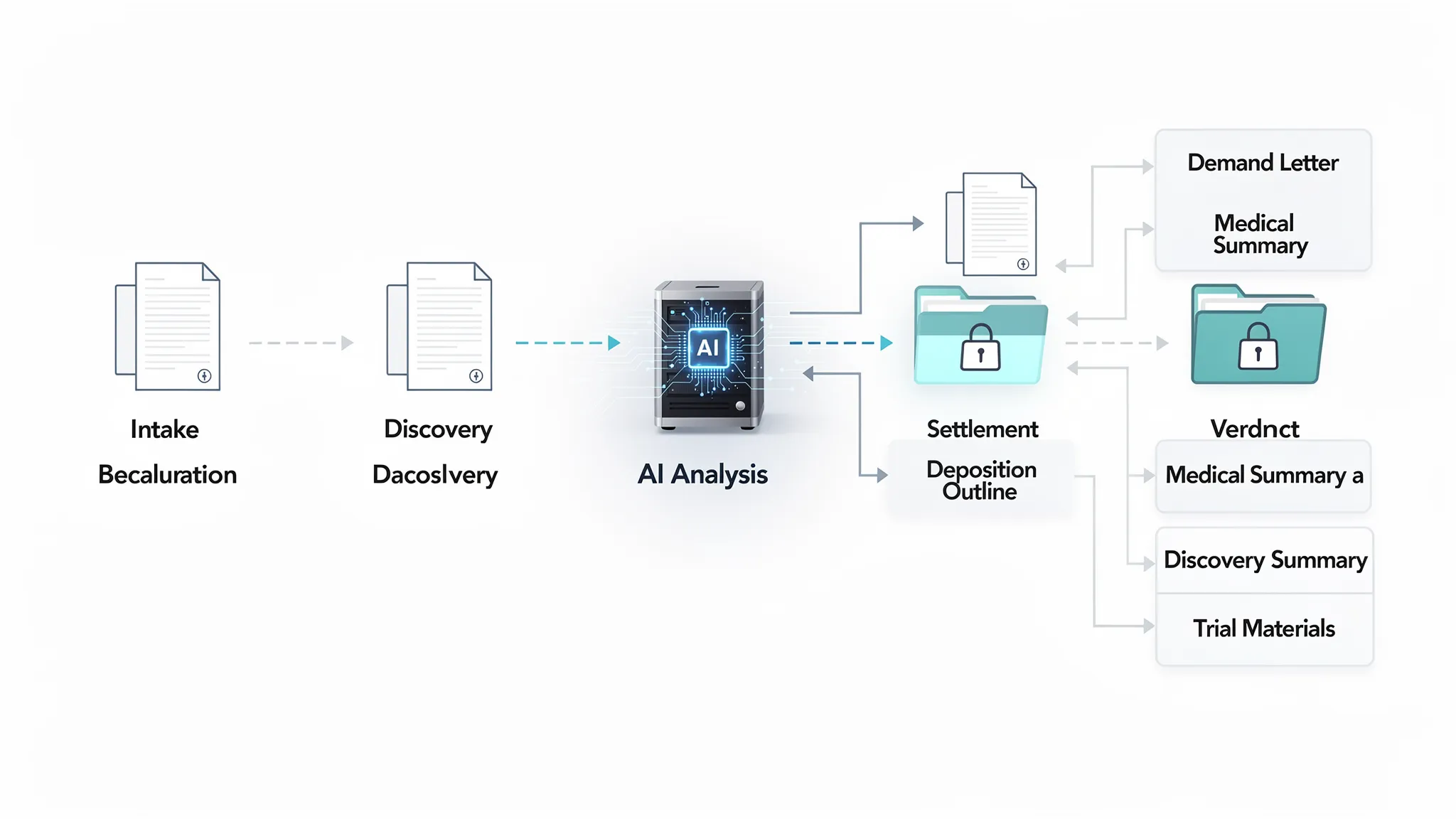
Use case 1: Intake triage and early case evaluation
Intake is where litigators either build leverage early or inherit chaos later. Legal AI is well-suited to turning “here is a folder of PDFs” into a coherent starting point.
What to use AI for in intake
- Creating an initial case chronology from scattered documents
- Extracting the cast of characters (plaintiff, defendants, providers, adjusters, corporate reps)
- Identifying missing documents (gaps in medical treatment, missing incident report, missing policy pages)
- Producing a first-pass liability and damages issue list to guide attorney review
How to keep it reliable
Treat the AI output as a structured checklist, not a conclusion. In intake, the most valuable “accuracy” is often completeness: what might you be missing that will matter in discovery, mediation, or trial?
Use case 2: Demand letters that are faster and more defensible
Demand letters are a sweet spot for legal AI because they are repeatable, time-consuming, and format-driven. The best systems can draft a demand letter that already includes the key pillars you would build anyway:
- Clear liability narrative
- Medical treatment summary
- Damages story and supporting record references
- A clean exhibits structure
What matters in review
Demand drafting is where hallucinations can become expensive. Your review should focus on:
- Every factual assertion has support in an uploaded document
- Medical details are attributed to the correct provider and date
- The letter does not introduce new facts (especially about causation or prognosis)
- Tone matches your strategy (firm, neutral, settlement-focused)
If your tool can produce a draft “in minutes,” that is useful only if it also reduces the time you spend fixing untraceable errors.
Use case 3: Medical summaries and chronologies (especially in personal injury)
Medical record review is one of the most time-intensive tasks in litigation. In 2026, legal AI is commonly used to produce:
- A date-ordered medical chronology
- A treatment summary (initial complaints, diagnostics, procedures, PT, medications)
- A “what changed” narrative (baseline vs post-incident function)
Best practice: separate summary from interpretation
A strong workflow splits outputs into:
- Objective summary (what the records say)
- Attorney notes (what it means for causation, damages, credibility)
That separation makes review faster and helps avoid accidentally treating the AI’s phrasing as medical opinion.
Use case 4: Discovery synthesis that is actually usable
Litigation teams are flooded with documents, but what they need is structure. Legal AI is increasingly used to:
- Cluster documents by issue themes (notice, causation, knowledge, damages)
- Build witness and custodian maps
- Generate topic summaries tied to record citations
Privilege and confidentiality are still human responsibilities
Even with strong tooling, litigators should assume the privilege call remains theirs. Treat AI as a way to navigate and summarize faster, not as a substitute for legal judgment.
Use case 5: Deposition outlines and impeachment prep
Depositions are one of the most practical applications because the output is easy to validate: either the witness said it, the document shows it, or it does not.
Legal AI can help by:
- Producing a deposition outline aligned to claims/defenses
- Suggesting document sequences (foundation, lock-in, confrontation)
- Surfacing conflicts between testimony and documents
A dependable approach
Ask for an outline where each major section includes:
- The goal of the section (what you need to prove)
- The record support (exhibit and page references)
- Follow-ups for evasive answers
Use case 6: Motion practice support (with grounded drafting)
In 2026, the most responsible use of legal AI in briefing is not “write my motion,” it is:
- Drafting a first-pass statement of facts that is grounded in the record
- Turning a set of exhibits into pin-cited factual propositions
- Generating alternative argument structures you can choose from
Guardrail
Do not rely on AI to invent citations or legal authority. If your workflow includes legal research, you still need a verified source of authority (and jurisdiction-specific checking) before anything is filed.
Use case 7: Trial prep and trial materials
Trial is where disorganization becomes visible. Legal AI can accelerate:
- Witness packet assembly (key documents per witness)
- Direct and cross outlines tied to exhibits
- Exhibit lists and trial-ready summaries
The practical win is not “AI makes trial easy.” The win is reducing the mechanical burden so attorneys can focus on theme, credibility, and sequencing.
Ethics and governance: what litigators should operationalize (not just “be aware of”)
By 2026, “I didn’t know the tool did that” is not a satisfying answer to a court or a client. Your legal AI governance should be concrete.
Duty of competence, confidentiality, and supervision
The American Bar Association’s Formal Opinion 512, on generative AI tools, emphasizes that lawyers must understand relevant benefits and risks, protect client confidentiality, and supervise work product. Many jurisdictions have echoed similar themes.
Practically, that means documenting your answers to questions like:
- What information can be uploaded, and under what conditions?
- Is the system designed to keep client data confidential?
- How do we review outputs, and who signs off?
A “litigation-safe” quality standard
A workable standard for litigators is:
- No unsourced factual assertions in any client-facing or court-facing output
- Record citations for summaries and outlines whenever possible
- Human review before external use, always
If a tool cannot help you meet that standard, it may still be interesting, but it is not reliable litigation support.
Security and risk management alignment
For a practical framework to structure AI risk conversations with IT and clients, the NIST AI Risk Management Framework (AI RMF) is a useful reference point because it emphasizes measurable governance and continuous monitoring.
How to evaluate legal AI tools in 2026 (a litigator’s checklist)
Tools often look similar in demos. The difference shows up in real files, real deadlines, and real review time.
Ask for capabilities that reduce review time, not just drafting time
A tool is more valuable when it can:
- Keep outputs tethered to the record (so you can verify quickly)
- Preserve structure (chronologies, outlines, exhibit maps)
- Support collaboration without losing provenance
Use simple evaluation metrics your team can actually track
| Metric | What it tells you | How to measure without overengineering |
|---|---|---|
| Edit distance | How much attorney time goes into fixing drafts | Track how often you rewrite vs refine |
| Source coverage | Whether summaries are grounded | Spot check: % of paragraphs with citations to documents |
| Hallucination rate | Risk of “made up” facts | Count unsupported facts per output in a sample set |
| Turnaround time | Operational impact | Time from upload to first usable draft |
| Consistency | Repeatability across similar cases | Run two similar matters through the same workflow and compare |
Where TrialBase AI fits (and how litigators typically use it)
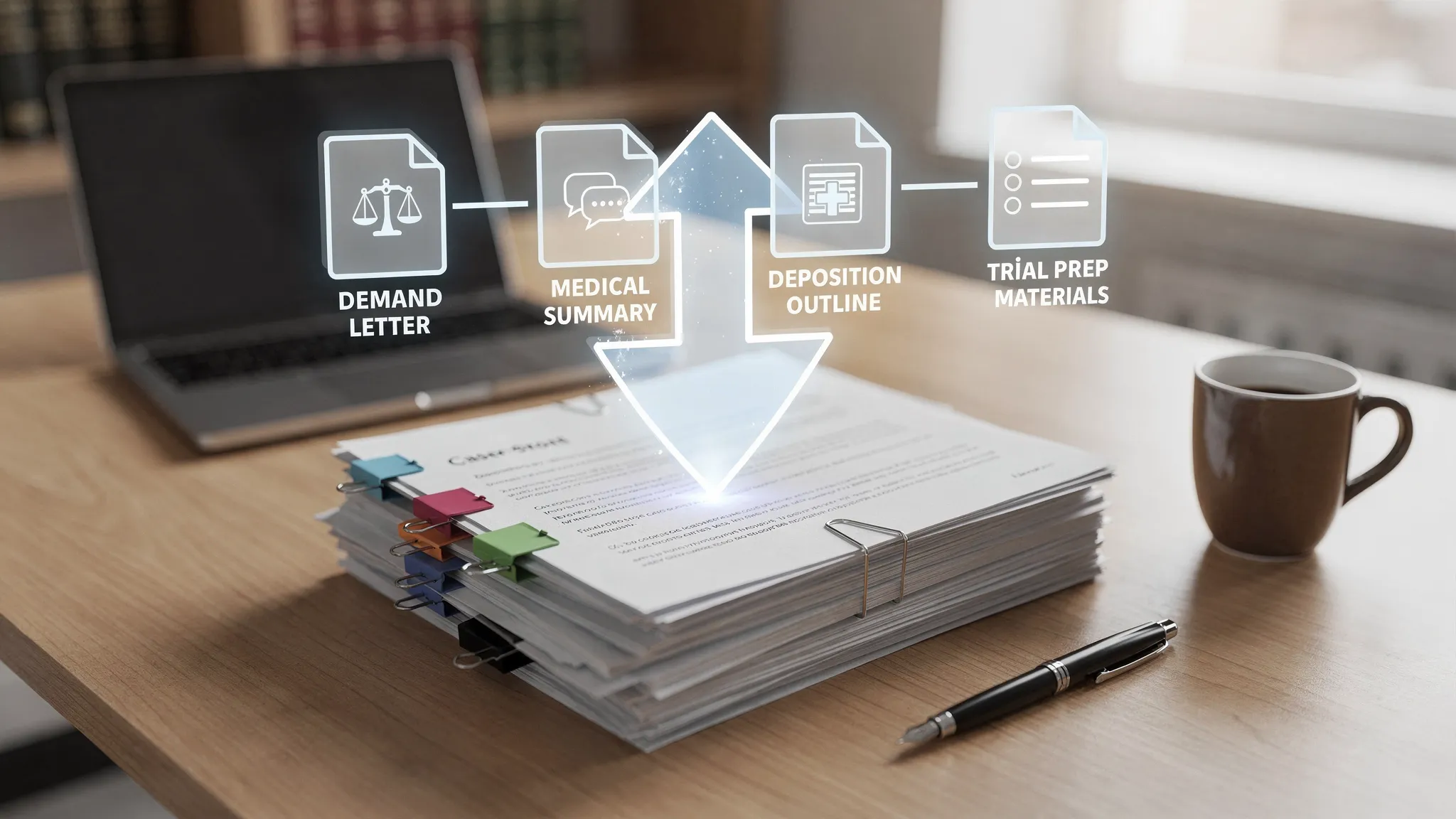
TrialBase AI is positioned as intelligent litigation support from intake to verdict. Based on the platform description, it focuses on turning uploaded documents into case-ready outputs such as demand letters, medical summaries, deposition outlines, and trial materials, with a unified workflow and collaboration features.
If your bottleneck is converting large document sets into litigation deliverables quickly, tools in this category can be a strong fit because the output types map directly to what litigators produce every week.
A practical rollout approach (so the tool sticks)
Start with one workflow that has a clear “before and after”
Pick a workflow that is frequent and measurable, like medical summaries or deposition outlines. Define what “good” looks like (format, citation expectations, turnaround time), then run 10 matters through it.
Build a review habit that is consistent
The teams that succeed with legal AI do not skip review, they standardize it. For example, reviewers can consistently check:
- Dates, names, and amounts
- Whether the narrative matches the exhibits
- Whether anything sounds certain when it should be conditional
Expand only after you can defend the output
Add the next use case only when your team can comfortably explain, internally and externally, how the output was produced and verified.
Frequently Asked Questions
Is legal AI safe to use with confidential client documents? It depends on the tool and your firm’s policies. Litigators should evaluate confidentiality protections, access controls, and vendor terms, then adopt clear rules for what can be uploaded and how outputs are reviewed.
Will legal AI replace paralegals or junior associates? In most litigation teams, AI reduces time spent on repetitive drafting and summarization, but it increases the importance of review, judgment, and case strategy. Many firms use AI to reallocate time toward higher-value work rather than eliminate roles.
What is the biggest risk when using legal AI for litigation work product? The most common risk is treating an AI-generated statement as true when it is not supported by the record. A reliable workflow requires record grounding and consistent human verification.
Can I use legal AI to draft motions and briefs? You can use it to accelerate first drafts and structure arguments, but you still need verified legal research, jurisdiction-specific checking, and careful citation review before anything is filed.
What is the best first use case for litigators adopting legal AI in 2026? Document-heavy, repeatable outputs like medical summaries, demand letters, and deposition outlines usually deliver the fastest measurable gains because review is straightforward and the format is consistent.
Get litigation-ready work product faster
If you want practical legal AI that is designed around litigation deliverables, TrialBase AI focuses on turning your uploaded case documents into outputs like demand letters, medical summaries, deposition outlines, and trial materials, delivered quickly and built for legal workflows.
Explore TrialBase AI here: https://ai.trialbase.com