Lawyer Trial Prep: 10 Checks Before You Pick a Jury
.png)
Jury selection is the point where your trial plan stops being a memo and starts becoming a live performance. Before you pick a jury, you want to know (not hope) that your theme is tight, your witnesses are ready, your exhibits are admissible, and your logistics will not break at 8:55 a.m. on day one.
Below is a practical lawyer trial prep checklist of 10 “go, no-go” checks to run before voir dire.
| Check | What you verify (in plain English) | Why it matters before voir dire |
|---|---|---|
| 1 | Case theory and theme in one sentence | Jurors decide stories, not outlines |
| 2 | Burdens and elements mapped to proof | Prevents “we forgot we had to prove X” |
| 3 | Damages model you can explain fast | Anchors settlement value and credibility |
| 4 | Motions in limine and evidentiary landmines | Avoids trying the case you wish you had |
| 5 | Witness order and purpose for each witness | Keeps examination goal-driven |
| 6 | Exhibit list is trial-ready (auth, foundation, objections) | Stops admissibility surprises |
| 7 | Voir dire plan tied to strikes for cause and theme | You are selecting a decision process |
| 8 | Jury instructions and verdict form strategy | Verdict form often dictates the path to win |
| 9 | Demonstratives and opening structure match the proof | Prevents overpromising |
| 10 | Courtroom tech, time limits, and backup logistics | Avoids preventable credibility hits |
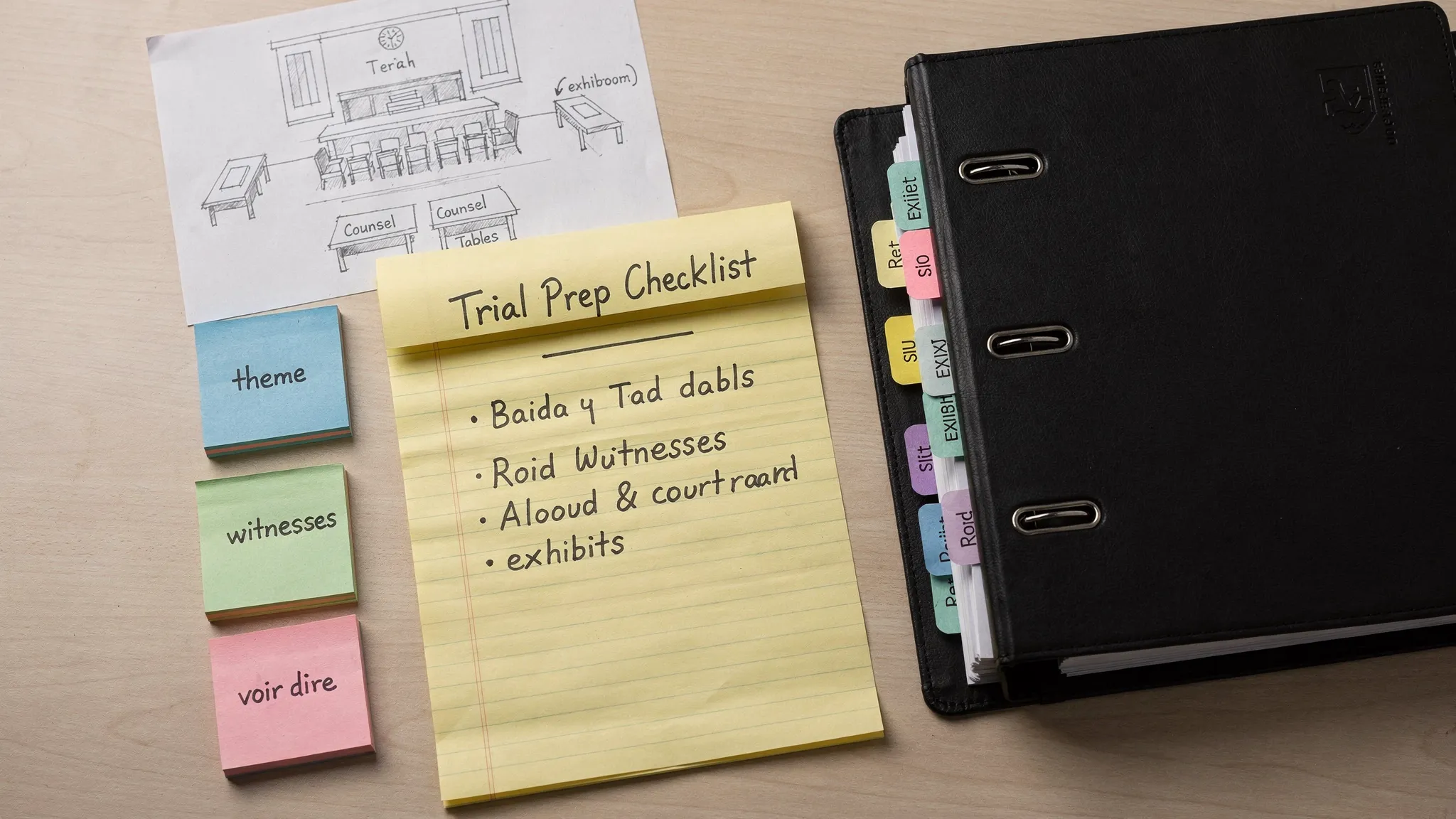
Check 1: Your case theory and theme fit in one sentence
If you cannot say the case in one sentence, your jurors will not either.
Your one-liner should include:
- The rule of the world (what should have happened)
- The violation (what actually happened)
- The consequence (why it matters)
This is not marketing copy. It is a control system for openings, witness exams, objections, and closing.
Check 2: Burdens and elements are mapped to specific proof
Before jury selection, confirm you have a clean map from each claim or defense element to the evidence that proves it.
A fast test: can you point to the witness (or exhibit) for each element without “we will get there”? If you cannot, you may be selecting a jury for a case you are not truly ready to try.
For a refresher on how evidence must connect to facts of consequence, Federal Rule of Evidence 401 is a good anchor point: relevance (FRE 401).
Check 3: Your damages model is simple enough to teach
Jurors do not award damages they cannot explain. Before voir dire, make sure your damages approach is:
- Consistent with your liability story
- Supported by admissible documents and testimony
- Explainable in under two minutes
If your case involves medical records, timelines, or multiple treating providers, do not wait until the week of trial to assemble a coherent narrative. This is exactly where a structured medical summary can prevent omissions and contradictions.
Check 4: Motions in limine and evidentiary “landmines” are identified
The most common trial prep failure is not lack of effort, it is planning based on evidence that will not come in.
Before you pick a jury, confirm:
- What you expect to win or lose on key motions in limine
- What your backup proof is if a category is excluded
- What your opponent will try to keep out, and how you will respond
Even if the court has not ruled yet, you should have a realistic “Plan A / Plan B” that changes how you promise facts in opening.
Check 5: Every witness has a purpose, and the order is intentional
A “witness list” is not a trial plan. For each witness, write one purpose statement, for example:
“Dr. Smith proves causation and future care, and neutralizes the defense gap-in-treatment argument.”
If you cannot write that sentence, the witness may be unnecessary, or your examination plan is not tight enough.
Also confirm sequencing. Many cases benefit from getting the jury oriented quickly (timeline witness, record custodian, investigating officer, corporate rep) before you ask them to hold complex expert opinions.
Check 6: Your exhibits are trial-ready, not just collected
“Having the documents” is not the same as being able to use them.
Before voir dire, validate that your key exhibits have:
- A clean exhibit list with consistent naming
- Authentication plan (who, how, when)
- Foundation plan (why it is what you say it is)
- Objection notes (hearsay, 403, completeness, etc.)
If you are in a jurisdiction with pre-marking requirements or tight pretrial order rules, this check should happen early. The Federal Rules of Civil Procedure also highlight the consequences of failing to disclose: FRCP 37(c)(1).
Check 7: Voir dire is tied to your theme and your strikes
Many lawyers prepare questions. Fewer prepare decisions.
Before jury selection, confirm you have a plan for:
- What attitudes and experiences are disqualifying (cause vs. peremptory)
- What juror traits fit your theory of the case
- How you will follow up when you hear a “red flag” answer
You are not trying to create perfect jurors. You are trying to avoid jurors who will not use your evidence fairly.
Check 8: Jury instructions and verdict form strategy are not an afterthought
Your verdict form can quietly dictate how the jury thinks, in what order they decide issues, and where they might stop.
Before you pick a jury, check whether:
- Your theme matches the legal questions the jury will answer
- Any special interrogatories create unnecessary hurdles
- You need limiting instructions that affect how you present evidence
If you have not drafted (or at least outlined) your proposed instructions and verdict form, you are missing an important preview of what “winning” actually requires.
Check 9: Opening and demonstratives match what you can prove
Jurors punish overpromising.
Run a simple compliance test:
- Each major opening claim is linked to a specific witness or exhibit
- Any timeline graphic matches record dates exactly
- Any medical or technical visual is sourced to testimony you can admit
If your case relies on document-heavy proof (records, discovery responses, prior statements), convert that volume into a few demonstratives that you can defend line-by-line.
Check 10: Courtroom logistics, time limits, and tech are rehearsed
A trial is a live system with failure points. Before voir dire, confirm:
- You know the judge’s time limits and daily schedule
- Your team roles are assigned (who handles exhibits, who tracks impeachment, who watches jurors)
- Your tech works in the courtroom (screens, connectors, audio)
- You have offline backups (printed key exhibits, spare adapters, redundant files)
This is not “ops.” It is credibility.
Frequently Asked Questions
How early should I start lawyer trial prep before jury selection? Start earlier than you think. The moment you can articulate a trial date range, you can begin element-to-proof mapping, exhibit hygiene, and a first pass at jury instructions.
What is the biggest mistake lawyers make right before a trial? Planning openings and witness exams around evidence that is vulnerable to exclusion, then scrambling after motions in limine or foundational objections.
How do I make voir dire more effective without annoying the judge? Focus on a few case-linked attitudes you truly need to learn, ask short questions, follow up efficiently, and connect answers to cause challenges when appropriate.
What documents should be “summary-ready” before trial? Anything that drives your story or damages: key medical records, billing, incident reports, prior statements, discovery responses, and expert materials you will rely on.
Make your trial file faster to audit and easier to use
If your prep is slowing down because the file is huge, records are inconsistent, or key facts are buried across PDFs, an AI-driven workflow can help you turn documents into usable litigation materials.
TrialBase AI supports litigation teams from intake to verdict by analyzing documents and generating case-ready outputs like demand letters, medical summaries, deposition outlines, and trial materials in minutes. Learn more at TrialBase AI.