Law Issue Spotting: A Fast Checklist for Case Intake
.png)

Issue spotting at intake is not about proving the case. It is about quickly identifying the legal and practical “gotchas” that change whether you take the matter, how you staff it, what you request first, and what the case is worth.
A tight, repeatable checklist helps you do that consistently, even when the caller is emotional, documents are incomplete, and the fact pattern is messy.
The 60-second intake snapshot (before you go deep)
Start with a quick frame you can use for almost any civil matter:
- Who was involved (potential plaintiff(s), defendant(s), witnesses)?
- What happened (the event, the transaction, the omission)?
- When did it happen (and when did the client learn about it)?
- Where did it happen (state, county, workplace, online platform)?
- How was the client harmed (injury, loss, rights violated)?
- What does the client want (money, injunction, job reinstatement, custody change)?
If any of those are unclear, you are not “missing details,” you are likely missing an issue.
Law issue spotting: a fast checklist for case intake
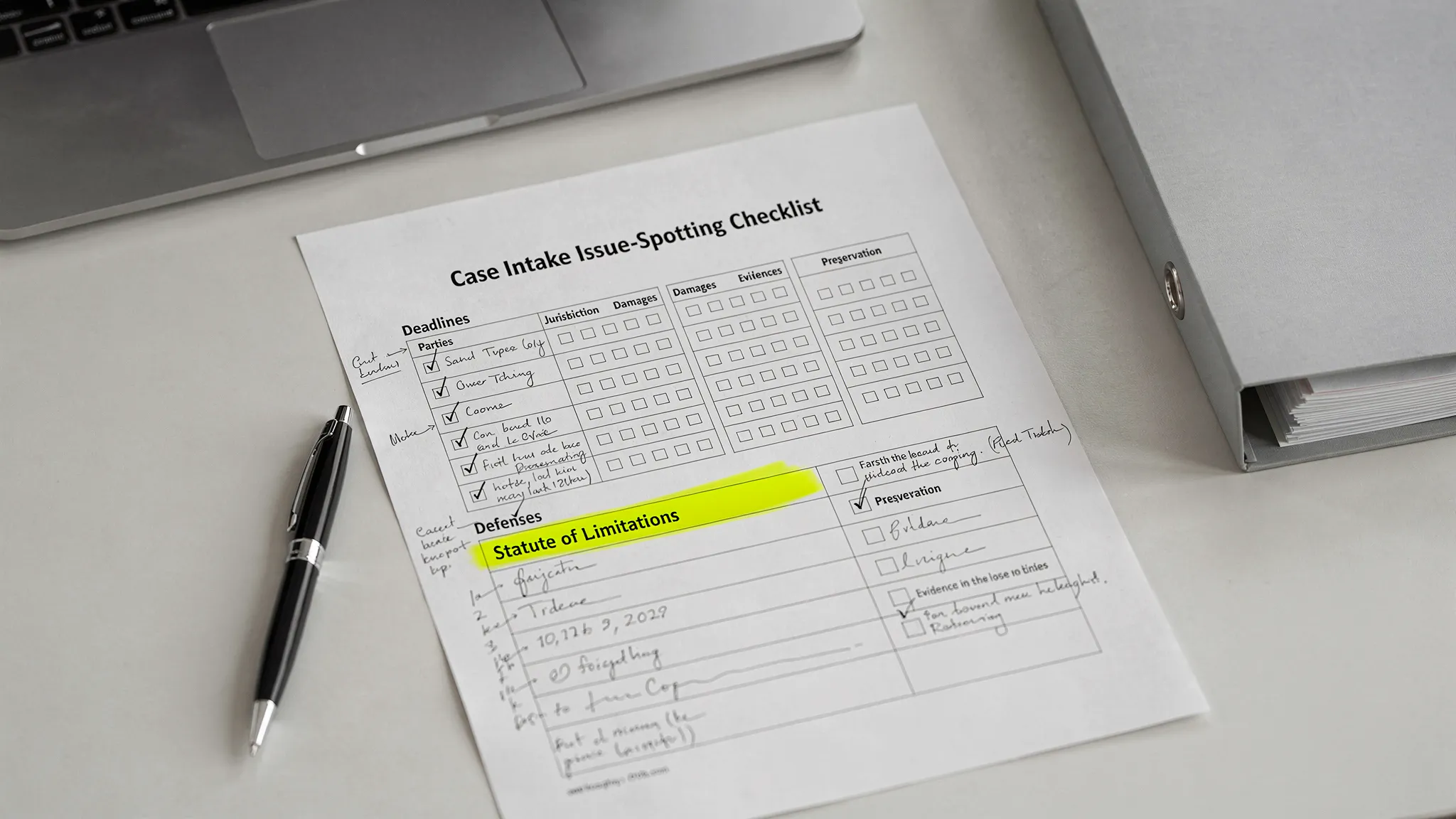
Use the table below as a quick triage tool. It is designed to surface the most common intake breakers and leverage points.
| Issue category | Ask at intake | Red flags to catch early |
|---|---|---|
| Parties, standing, capacity | Who is the proper plaintiff, and do they have authority (individual, estate, guardian, entity officer)? | Wrong plaintiff, minor/incapacitated party without representative, dissolved entity, unclear employer/contracting party |
| Conflicts, confidentiality, privilege | Have we represented any party or key witness? What documents are already in counsel-to-client communications? | Potential conflict, waiver risk, client forwarded privileged threads to third parties (complicates privilege) |
| Jurisdiction and venue | Where are defendants located, where did conduct occur, what forum is required by contract? | Forum-selection clause, arbitration clause, out-of-state defendant with thin contacts, removal risk |
| Statute of limitations and notice deadlines | What is the earliest possible “accrual” date, and were there tolling events? Any government entity involved? | Close or expired limitations period, administrative charge needed (employment), tort claims notice deadlines for public entities |
| Cause of action fit | What legal theory matches the facts (negligence, breach, products, civil rights, fraud, etc.)? What elements are weak? | Facts that do not support a required element (duty, causation, reliance), missing contractual privity, economic loss rule concerns |
| Damages and remedies | What is the damages model (medical bills, wage loss, business loss, statutory damages, punitive)? What proof exists? | Primarily emotional harm with limited support, speculative lost profits, mitigation gaps, lien/subrogation complications |
| Defenses and fault allocation | What will the other side argue, and what is client’s exposure (comparative fault, assumption of risk, consent, waiver)? | Client admissions in texts/social, prior similar injuries, policy violations, surveillance risk |
| Evidence, documents, preservation | What exists today (contracts, photos, emails, EHRs), and what must be preserved (devices, video, logs)? | Auto-delete systems, employer retention policies, missing incident report, spoliation risk, third-party video about to expire |
| Collectability and insurance | Who pays if you win (policy, asset, employer indemnity)? Any coverage letters yet? | Uninsured/underinsured defendant, insolvent business, coverage dispute, exclusions, thin limits |
Quick reference sources (for your internal cross-checks)
- Conflicts and professional responsibility (U.S.): ABA Model Rules of Professional Conduct
- Federal civil discovery framework: Federal Rules of Civil Procedure, Rule 26
(Always confirm controlling state law and local rules for your matter.)
Intake documents to request immediately (to confirm or kill the case fast)
You do not need “everything.” You need the minimum set that proves deadlines, liability hooks, damages, and defenses.
- Timeline anchors: incident date, diagnosis date, termination date, demand/refusal date, last payment date, notice date.
- Identity and relationship proof: contracts, policy declarations, invoices, corporate filings, employment offer letter, job description.
- Damage proof: medical bills and records, wage loss documentation, repair estimates, profit and loss statements (if business loss).
- Key communications: the 10 to 30 most important emails/texts (not entire dumps), including admissions and refusals.
- Visuals and logs: photos, video links, incident reports, maintenance logs, app logs, police report number.
If the client cannot produce any of the above, that is not necessarily fatal, but it changes your first discovery and preservation priorities.
Turning issue spotting into a litigation-ready file
Once you have the checklist filled, the goal is to convert raw intake into work product your team can actually use.
Step 1: Normalize the story
Create a clean chronology and identify “unknowns” as explicit tasks (for example, “confirm employer entity name,” “verify accrual date,” “request prior claim history”). This prevents the file from becoming a collection of scattered PDFs.
Step 2: Convert documents into usable case outputs
This is where litigation support tools can compress days of prep into a structured starting point.
With TrialBase AI, firms can upload case documents and generate litigation-focused outputs like demand letters, medical summaries, deposition outlines, and trial materials. Used well, that helps your team spend less time re-summarizing and more time evaluating case themes, damages posture, and settlement strategy.
(As with any AI-assisted workflow, attorney review is essential, especially for deadlines, jurisdictional calls, and element-by-element analysis.)
Step 3: Decide the first “make or break” move
Issue spotting should drive your first action, not just your notes. Examples:
- If deadlines are tight, prioritize filing or tolling and postpone perfection.
- If preservation is fragile, send preservation letters and secure devices/video quickly.
- If collectability is uncertain, confirm coverage and defendant identity early.
- If damages are the hinge, focus on medical chronology, causation, and wage verification.
Common intake traps (and how the checklist prevents them)
Even experienced teams miss these because they sit between “facts” and “law.”
- Multiple potential defendants: the wrong entity name can break service, coverage, and vicarious liability.
- Client’s best facts are late: a tight chronology forces you to ask, “What changed between day 1 and today?”
- Evidence decay: surveillance footage, device data, and SaaS logs often disappear on short retention cycles.
- The case is legally strong but practically weak: no insurance, insolvent defendant, arbitration clause, or poor venue.
A simple way to use this in your intake process
Print the table (or turn it into a form) and require a yes/no/unknown for each category. “Unknown” is not a failure, it is a task list. The win is consistency: you catch the same law issues every time, regardless of who took the call.
If you want to accelerate the step from intake to first draft work product, you can pair the checklist with an AI workflow like TrialBase AI to turn documents into summaries and outlines that your attorneys can refine and use immediately.