Intake Law: Turn Raw Calls Into Litigation-Ready Facts
.png)

“We got a call. Rear-end collision. Client says they’re hurt.”
That is not a case file, it is a starting signal.
In intake law, the difference between a raw call and a litigation-ready claim is how quickly you capture the right facts, preserve the right evidence, and document everything in a way that survives discovery, motions, and trial.
What “intake law” really means in practice
Most firms think of intake as scheduling and conflict checks. Litigators know it is also early case theory, early damages framing, and early risk control.
Done well, intake produces:
- A clean chronology you can defend later.
- A verified party and insurance map (who pays, who is liable, who is missing).
- A damages roadmap (medical treatment, wage loss, future care).
- A record that supports ethical compliance and client expectations.
Done poorly, intake produces silent problems that get expensive later: missing witnesses, missing policies, inconsistent histories, and avoidable confidentiality mistakes.
The intake law goals that matter most (and why)
1) Lock down the claim’s “skeleton”: who, what, when, where, how
Before you draft a demand letter or outline a depo, you need a stable spine:
- Parties and roles (driver, owner, employer, premises operator, medical providers).
- Date, time, location, and jurisdiction.
- How the event happened, including what the client saw, heard, and did.
- Immediate aftermath (911 call, ER visit, photos, tow, incident report).
This is where inconsistencies are born. The client is anxious, in pain, or guessing. Your job is to capture statements accurately, mark uncertainty clearly, and build a list of items to verify.
2) Preserve evidence before it disappears
Many high-value cases are won because evidence was preserved early (and lost because it was not). Think:
- Surveillance video retention windows.
- Vehicle damage photos and repair records.
- Scene photos, weather conditions, signage.
- Social media posts that can cut both ways.
Even a simple preservation letter strategy is easier when intake data is structured and searchable.
3) Prevent ethical and procedural missteps from day one
Intake is also compliance.
- Conflicts and prospective client duties: Many jurisdictions follow rules similar to the ABA Model Rules, including duties to prospective clients (often aligned with Model Rule 1.18).
- Confidentiality and data handling: Protect client information in a way consistent with professional responsibility obligations (often aligned with Model Rule 1.6).
- Competence and supervision: Intake systems should help lawyers and staff work competently and consistently (often aligned with Model Rules 1.1 and 5.3).
This is also where you set expectations on timeline, treatment, communications, and what the firm needs from the client.
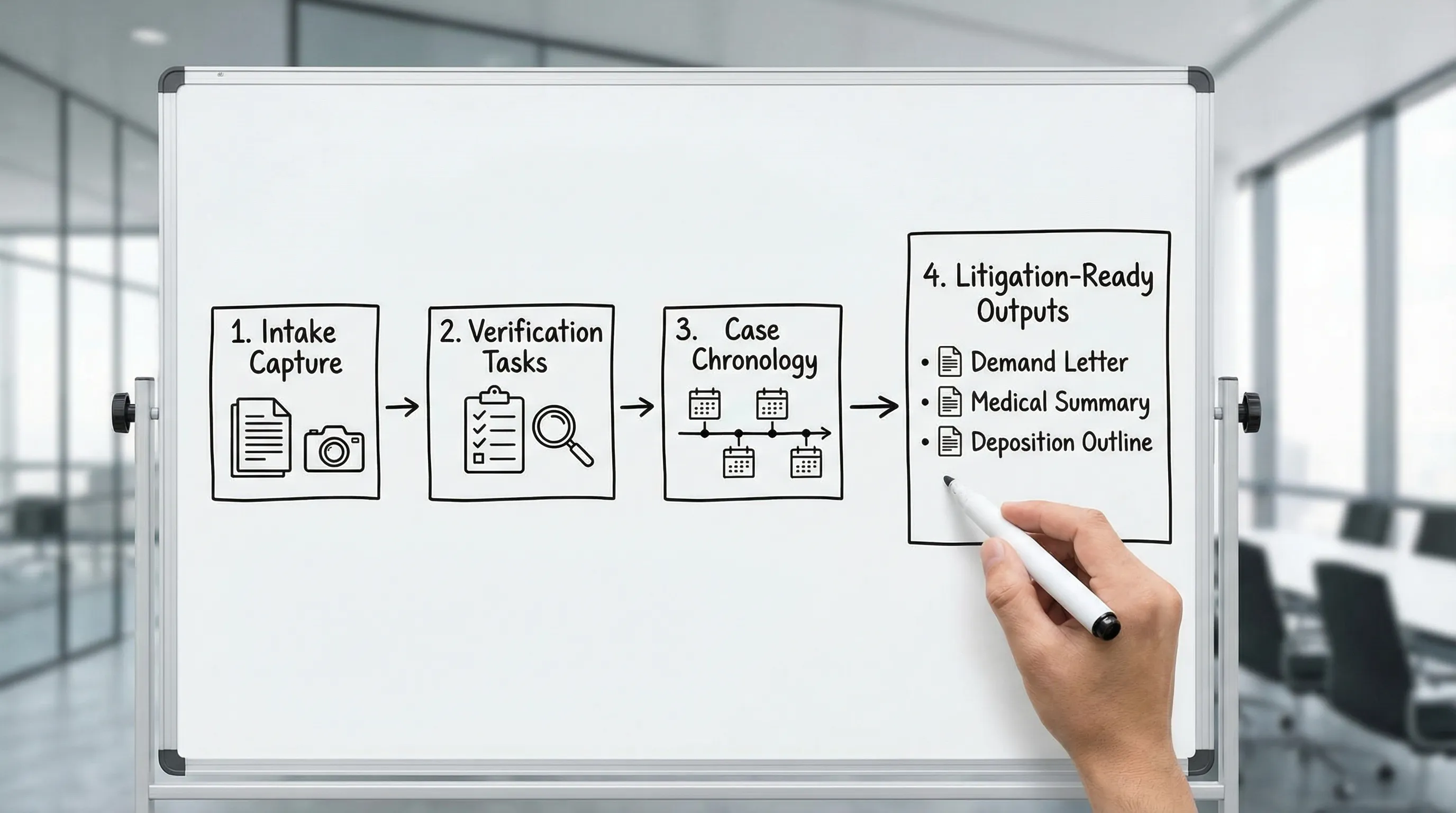
A simple framework: convert “raw” into “litigation-ready” in 3 passes
Most intake errors happen because firms try to do everything in one pass. A more reliable approach is staged.
Pass 1: Capture (fast, faithful, and time-stamped)
Capture what the client says, in their words where useful, and label unknowns.
Examples of high-leverage fields to capture consistently:
- Identity and contact details for all parties
- Incident basics (date, time, location, how it happened)
- Injury complaints and current treatment status
- Prior injuries or similar claims (flag for verification)
- Insurance information (auto, health, workers’ comp, umbrella)
- Lost time from work and wage details
- Photos, videos, witnesses, reports, and where each item lives
This is the “raw materials” layer. Do not over-polish it.
Pass 2: Verify (turn statements into defensible facts)
Now convert raw intake into a checklist of proof:
- Order or request incident reports.
- Identify all treating providers and facilities.
- Confirm coverage and policy information.
- Build the initial chronology from records, not memory.
A practical rule: if it affects liability, causation, or damages, you need a way to prove it.
Pass 3: Package (outputs that are ready for the next legal step)
Once you have structure and verification targets, packaging becomes straightforward:
- Demand letters built on a coherent timeline and itemized damages.
- Medical summaries that separate subjective complaints from objective findings.
- Deposition outlines keyed to contradictions, records, and exhibits.
This is where speed matters, because the earlier you package the case, the earlier you can negotiate, file, or prepare for discovery with confidence.
What “litigation-ready” looks like: a quick mapping table
A useful intake law habit is to translate each intake artifact into a litigation deliverable.
| Intake artifact | Common problem | Litigation-ready version |
|---|---|---|
| Client narrative | Incomplete, inconsistent, emotional | Clean chronology with open questions flagged |
| Provider list | Missing facilities, wrong dates | Verified treatment timeline with record request list |
| Insurance info | Partial, outdated, wrong adjuster | Coverage map (who insures what, claim numbers, contacts) |
| Photos and docs | Stored across texts, email, paper | Centralized exhibit set with labels and dates |
| Damages notes | “Pain is 8/10,” no substantiation | Itemized specials and documented wage loss leads |
Where TrialBase AI fits into an intake law workflow
Once you have intake notes, forms, medical records, incident reports, and any other documents collected, the bottleneck is usually turning that pile into usable work product.
TrialBase AI is designed for that conversion. You upload your documents and generate litigation-ready outputs in minutes, such as:
- Demand letters
- Medical summaries
- Deposition outlines
- Trial materials and other case-ready drafting
For intake teams, that means faster movement from “we got a call” to “we have an organized case theory and a first set of draft materials,” while keeping the underlying facts and documents connected to the outputs.

Intake law quality checks that prevent expensive rework
A lightweight QA step can save hours later. Before your file moves forward, confirm:
- The timeline has no obvious gaps (incident, first treatment, follow-ups).
- All parties are identified (including employers, owners, and agencies where relevant).
- You can answer, “What evidence proves each key fact?”
- Confidential information is stored and shared consistently with your office policies.
If you can do those four things, you are no longer managing intake, you are building a case.
Frequently Asked Questions
What is intake law? Intake law is the set of practices and legal considerations involved in collecting, documenting, and organizing new client information so it is usable for litigation, settlement, and compliance.
Why do intake mistakes hurt cases later? Because early statements harden into the story of the case. Missing evidence, unclear timelines, and incomplete party or insurance identification often surface during discovery, when fixes are slower and more expensive.
What should I capture during an intake call for a personal injury case? Capture incident basics, parties, injury and treatment status, insurance details, wage loss, witnesses, photos or videos, and a list of items that need verification.
How do I turn intake information into a demand letter faster? Structure the intake into a timeline and damages outline, then use your documents (medical records, reports, bills) to support each claim. Tools like TrialBase AI can help generate a demand letter draft from uploaded documents.
Does intake involve ethical duties even before a signed retainer? Often, yes. Many jurisdictions impose duties to prospective clients and require careful handling of confidential information, even if the firm does not ultimately take the case.
Turn intake into case-ready work product
If your team is spending hours turning intake notes and records into demand letters, medical summaries, and deposition prep, TrialBase AI can help you compress that timeline. Upload your documents and generate litigation-ready materials in minutes at TrialBase AI.