Drafting Discovery Requests: A Practical Playbook for Speed
.png)
Discovery is where cases are won, delayed, or quietly devalued. Yet many teams still draft from scratch, over-serve with boilerplate, and then spend hours fixing avoidable defects after objections arrive. This playbook is built for speed in drafting discovery requests, without sacrificing leverage, proportionality, or usability at deposition and summary judgment.
The goal: faster drafts that get better answers
Speed is not about sending fewer requests. It is about sending cleaner requests that (1) match the elements you must prove, (2) anticipate common objections, and (3) force production in a format you can actually use.
A fast set is usually the product of three things:
- A tight theory of the case (issues first, paperwork second)
- A repeatable structure you can reuse matter to matter
- A review loop that catches overbreadth, ambiguity, and privilege traps before the other side does
The 30-minute workflow (repeatable on any file)
If you want a practical clock to work against, use this sequence.
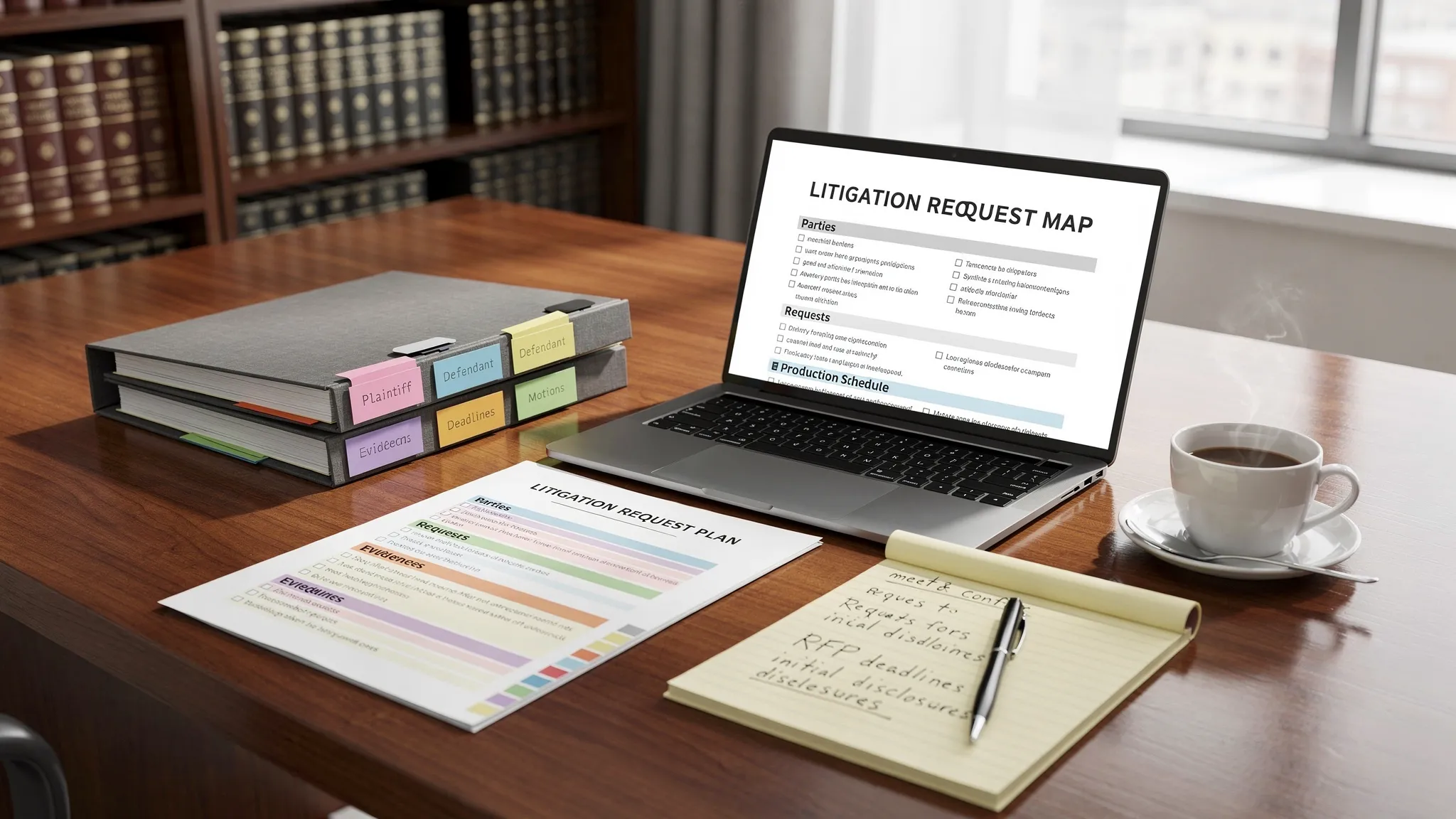
1) Build a one-page “Request Map”
Before you write a single interrogatory, list what you need to prove and what you need to reduce risk.
Include:
- Liability elements (duty, breach, causation, damages)
- Damages categories (medical bills, wage loss, future care, property loss)
- Defenses you must defeat (comparative fault, mitigation, preexisting conditions)
- Key players and systems (custodians, insurers, vendors, devices, ESI sources)
This map becomes your drafting outline. It also prevents the common speed killer, writing discovery that is “comprehensive” but not case-driving.
2) Define your terms once, then stop
Over-definition is a speed trap and an objection magnet. Define only what you will reuse.
Good defaults:
- “Document(s)” (include ESI)
- “Communication(s)”
- Party names and key entities
- Relevant time period (tie to pleaded events)
Avoid defining “relate to” as “directly or indirectly,” unless you want an automatic overbreadth objection.
3) Draft in blocks (not one-off requests)
Write in reusable blocks that match recurring case patterns:
- Background and insurance coverage
- Incident facts and investigations
- Prior similar incidents or complaints
- Medical history and damages support
- ESI and custodians (if relevant)
This is how fast teams draft. They do not reinvent, they assemble.
4) Add the “format clause” early (RFPs)
If you only remember one speed tip, remember this: most discovery pain comes from unusable production.
Where permitted by your rules and ESI protocols, specify:
- Native vs PDF (and for what)
- Load files, metadata fields, Bates format
- Email threading and families (parent-child)
Federal practice often ties these issues to Rule 34 production specifics, see FRCP 34.
5) Run a fast objection audit
Before you send, scan each request for:
- Ambiguous verbs (replace “regarding” with a specific target)
- Missing time limits
- Duplicative requests
- Requests that require a legal conclusion (move to contentions only if strategic)
- Disproportionate scope (especially in ESI)
Proportionality is not just a buzzword in federal court, it is embedded in FRCP 26(b)(1).
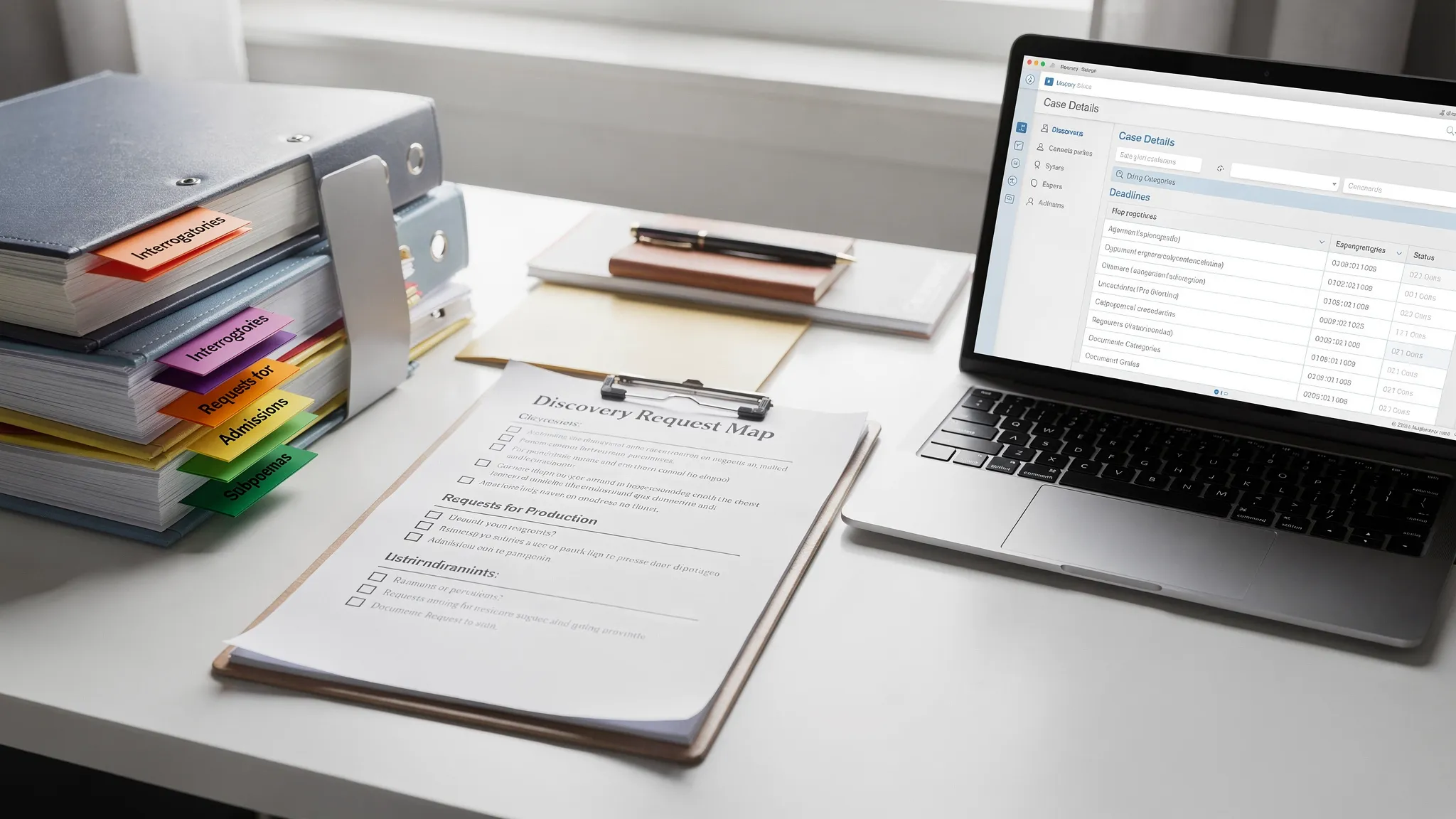
Choose the right tool for the job (Interrogatories, RFPs, RFAs)
Draft faster by using each device for what it does best.
| Tool | Best used for | Speed tip that reduces objections |
|---|---|---|
| Interrogatories (FRCP 33) | Identify witnesses, timelines, custodians, insurance, contentions (sparingly) | Ask for “identify and describe” with discrete subparts, and set a clear time period |
| Requests for Production (FRCP 34) | Get the paper trail and ESI you will use in depo and motions | Tie each RFP to a pleaded issue or element, and include a usable format clause |
| Requests for Admission (FRCP 36) | Narrow issues, authenticate, lock in basic facts | Keep RFAs simple, single fact per request, avoid compound phrasing |
A simple heuristic: if you want a thing, use an RFP. If you want a name/source, use an interrogatory. If you want to narrow, use an RFA.
Practical drafting patterns you can paste (and adapt)
These are intentionally generic. Adjust for your jurisdiction, local rules, protective orders, and case facts.
Pattern 1: Custodians and data sources (Interrogatory)
“Identify each person with knowledge of the incident and each custodian reasonably likely to have Documents or ESI concerning the incident, including their role, employer, and the categories of information they control.”
Why it is fast: you can build targeted RFPs from the response instead of guessing.
Pattern 2: Investigation file (RFP)
“Produce all Documents and Communications concerning any investigation of the incident, including reports, photographs, videos, statements, and findings.”
Speed upgrade: add a time period and specify whether drafts are included, if that matters.
Pattern 3: Prior similar incidents (RFP)
“Produce Documents sufficient to show incidents substantially similar to the incident at issue during the period [X] to [Y], including complaints, claims, and corrective actions.”
Why it is objection-resistant: “Documents sufficient to show” can reduce burden while still forcing meaningful disclosure.
The fastest way to avoid rework: meet-and-confer-ready drafting
Objections do not slow you down, unclear requests do. Draft as if you will quote your own request in a meet and confer email.
Two habits that save hours:
- Write requests so a neutral could understand what a complete response looks like.
- Where possible, group requests by topic so you can negotiate scope in chunks, not line by line.
Where AI can actually help (without creating risk)
AI is most useful when it accelerates structure and coverage, while you control strategy and accuracy.
With a platform like TrialBase AI, teams can upload key case documents and quickly generate case-ready work product (like summaries and outlines) that helps you draft discovery from the facts you already have, not from memory. For example:
- Use document analysis and medical summaries to identify damages categories and missing providers.
- Use deposition outline generation to spot the exact documents and communications you need before you notice gaps at deposition.
- Use unified workflow and collaboration to standardize templates and reduce version churn across the team.
Always apply your confidentiality obligations, verify outputs, and keep humans responsible for final requests, privilege boundaries, and strategic choices.
Quick checklist: “send-ready” discovery in under an hour
Use this as a final pass before service.
- Each request ties to an element, defense, or damages category
- Defined terms are minimal and consistent
- Every request has a clear time scope (or a reason it does not)
- RFPs include format expectations for usable production
- No accidental privilege traps (attorney mental impressions, work product)
- You can explain the purpose of any request in one sentence
- You are comfortable reading each request aloud to a judge
Frequently Asked Questions
What is the biggest mistake in drafting discovery requests? Writing broad, generic requests that are not tied to a case theory. They invite boilerplate objections and produce unusable documents.
How do I draft requests that survive proportionality objections? Narrow by time, custodian, and category, then explain relevance through issue-focused language. In federal practice, align scope with FRCP 26(b)(1).
Should I use “documents sufficient to show”? Often, yes, when you want summaries of policies, prior incidents, or organizational facts and want to reduce burden fights. Use it carefully when you truly need the whole file.
How many requests should I serve? Enough to cover your elements, damages, and key defenses, while staying within your jurisdiction’s limits. Quality and clarity typically beat volume.
Can AI draft my discovery for me? AI can accelerate first drafts and help you spot gaps, but you still need attorney review for strategy, jurisdictional compliance, and privilege.
Turn drafting speed into case momentum
If discovery drafting is slowing your team down, the fix is usually not more boilerplate, it is a better workflow tied to the documents you already have. TrialBase AI helps legal professionals transform case documents into litigation-ready outputs in minutes, so you can move from intake to deposition to settlement with fewer gaps and less rework.