Discovery Request Examples and Common Objections
.png)

Discovery is where strong cases get built (or quietly fall apart). The right discovery request can surface the key email, policy, or medical record that drives settlement value. The wrong request can invite boilerplate objections, motion practice, and delays that drain momentum.
Below are practical discovery request examples (interrogatories, requests for production, and requests for admission) plus a guide to common objections and how to draft in a way that makes them harder to sustain.
Note: This is general information, not legal advice. Always confirm governing rules and local practice for your jurisdiction.
What counts as a “discovery request” in civil litigation?
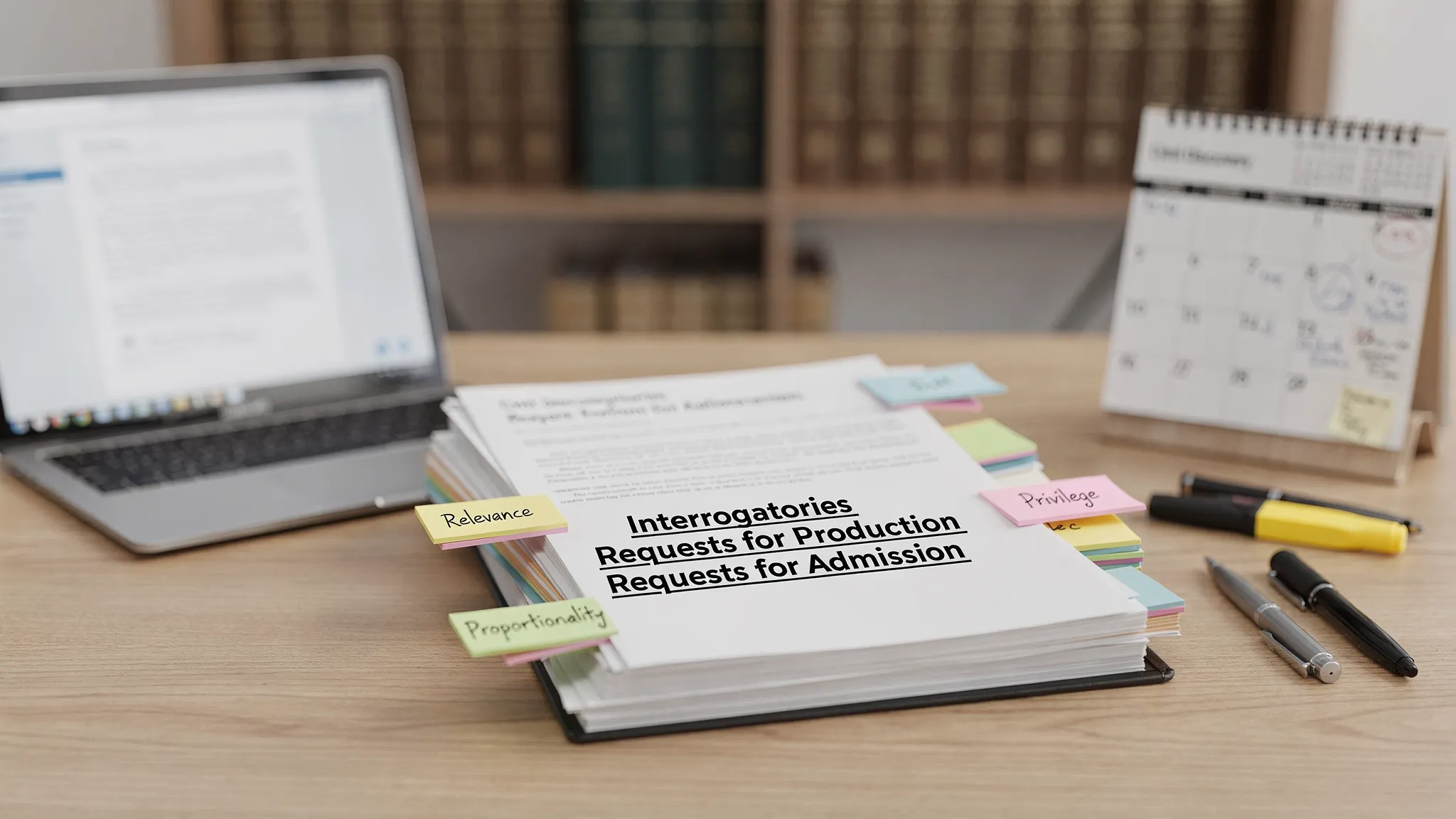
In most civil cases, “discovery requests” typically include:
- Interrogatories (written questions), see FRCP 33
- Requests for Production (documents, ESI, tangible things, inspection), see FRCP 34
- Requests for Admission (narrowing issues, authenticity, foundational facts), see FRCP 36
- Subpoenas (often for third parties), see FRCP 45
Even if you practice primarily in state court, the Federal Rules are a useful “common language” for thinking about proportionality, specificity, and modern ESI expectations.
Drafting checklist: what makes discovery “stick” (and reduces objections)
Before you copy and paste a set of form requests, do a quick scope check. Most discovery fights are really scope fights.
A defensible request usually ties clearly to:
- Claims and defenses (what must be proven or negated)
- Damages categories (medical bills, future care, lost earnings, loss of consortium, punitive exposure, etc.)
- Time window (pre-incident history, incident period, post-incident mitigation)
- Custodians and systems (who has the information and where it lives)
- Proportionality considerations (importance, access, burden, amount in controversy), see FRCP 26(b)(1)
If you can explain in one sentence why you need the information, you can usually draft it in a way that survives the most common objections.
Discovery request examples (by type)
The examples below are intentionally written in “plug-and-play” style. You will still want to tailor definitions, instructions, date ranges, and parties.
Interrogatory examples
Interrogatories are best for identifying people, pinning down positions, and forcing a narrative you can test in deposition.
Interrogatory: identify witnesses and knowledge holders
“Identify each person known or believed to have knowledge of any facts relating to the Incident, and for each person state (a) the subject matter of their knowledge, (b) their relationship to you, and (c) their last known contact information.”
Interrogatory: describe the incident from the responding party’s perspective
“Describe in detail your version of how the Incident occurred, including the date, time, location, sequence of events, and all acts or omissions you contend caused or contributed to the Incident.”
Interrogatory: insurance and coverage position
“Identify all insurance policies that may provide coverage for the claims asserted in this action, including the insurer, policy number, effective dates, and available limits.”
Interrogatory: affirmative defenses and factual support
“For each affirmative defense asserted, state the facts supporting the defense and identify all documents and witnesses that support your contention.”
Interrogatory: prior similar incidents (liability and notice)
“Identify all prior incidents, complaints, claims, or lawsuits within the last [X] years involving the same condition, product, location, procedure, or hazard alleged in this case, and state the disposition of each.”
Interrogatory: medical and damages foundation (personal injury)
“Identify all healthcare providers who treated Plaintiff for injuries alleged in this action, including dates of treatment, diagnoses, and services provided.”
Interrogatory: lost earnings and mitigation
“State the factual basis for any claim of lost wages or diminished earning capacity, including dates missed from work, employer information, and all documents supporting the calculation.”
Interrogatory: social media and recorded statements (when relevant)
“Identify any recorded statements, photographs, videos, or social media posts you contend relate to the Incident or Plaintiff’s claimed injuries, including the date created, platform or device, and current location.”
Drafting tip: If you anticipate a “vague/ambiguous” objection, define the “Incident” and “you” (including agents, employees, and representatives where appropriate) and include a date range.
Requests for Production (RFP) examples
RFPs are where you obtain the documents that will drive expert opinions, impeachment, and settlement leverage.
RFP: incident reports and internal investigations
“Produce all incident reports, investigation files, witness statements, photographs, videos, diagrams, or internal summaries concerning the Incident.”
RFP: communications (email, text, messaging apps) about the incident
“Produce all communications, including emails, text messages, and messages on collaboration platforms, that reference the Incident, the conditions leading to it, the response to it, or the parties involved.”
RFP: policies, procedures, training (negligence and standard of care)
“Produce all policies, procedures, manuals, training materials, or guidelines in effect on the date of the Incident that relate to [the activity/product/condition at issue].”
RFP: maintenance, inspection, and repair logs (premises/equipment cases)
“Produce all inspection records, maintenance logs, repair records, and work orders for the location/equipment at issue for the period [X] months before through [X] months after the Incident.”
RFP: contracts and scope of responsibility (control/agency issues)
“Produce all contracts, service agreements, leases, or written understandings that define responsibility for maintenance, supervision, safety, or operations for the location/equipment/activity at issue.”
RFP: documents supporting affirmative defenses
“Produce all documents that support each affirmative defense asserted in your Answer, including any documents you contend show comparative fault, assumption of risk, mitigation failures, or intervening cause.”
RFP: surveillance and recordings
“Produce all surveillance video, body camera footage, dashcam footage, or other recordings depicting Plaintiff or the Incident, including footage from [X] hours before through [X] hours after the Incident.”
RFP: medical billing and specials (when you represent plaintiff or need verification)
“Produce all medical bills, billing ledgers, and payment records relating to treatment at issue, including explanations of benefits and payment postings.”
Drafting tip: For “overbroad” objections, requests improve dramatically when you specify (1) a narrow time period, (2) particular custodians, and (3) the categories of documents you actually need.
ESI-focused RFP examples (designed for 2026 realities)
Courts increasingly expect litigators to be specific about ESI scope. If you leave it vague, you risk either underproduction or weeks of negotiation.
RFP: ESI in native format with metadata
“Produce electronically stored information responsive to these requests in native format where reasonably available, including associated metadata fields sufficient to identify author, date created, date modified, recipients, and file path or source location.”
RFP: targeted collections from key custodians
“For the custodians [Name/Title], produce emails and attachments referencing [topic] from [date range], including items located in sent mail, inbox, deleted items, archives, and shared mailboxes.”
RFP: text messages and call logs for narrow windows
“Produce text messages and call logs from the phone(s) used by [custodian] for the period [narrow date range] that reference [incident/topic], including screenshots or exports that preserve date/time and participants.”
RFP: collaboration platforms
“Produce messages and files from collaboration platforms (for example, Teams/Slack or similar) from channels or threads used by [department/team] that reference [topic] within [date range].”
Drafting tip: If you anticipate a “not reasonably accessible” or “undue burden” objection, propose a scoped search protocol (custodians, date range, and topic keywords) and offer to refine after an initial hit count.
Requests for Admission (RFA) examples
RFAs are underrated. Use them to lock down authenticity and foundational facts so depositions focus on disputes that matter.
RFA: authenticity of key records
“Admit that the document produced as [Bates range or exhibit name] is a true and correct copy of a record kept in the ordinary course of business.”
RFA: control and responsibility
“Admit that you owned, operated, managed, or controlled the location/equipment involved in the Incident on the date of the Incident.”
RFA: notice
“Admit that before the Incident you were aware of complaints, reports, or prior occurrences relating to the condition alleged in the Complaint.”
RFA: timeline anchors
“Admit that [named employee/agent] was present at [location] at [time window] on the date of the Incident.”
Drafting tip: RFAs get “compound” objections when you stack multiple facts. Keep them single-purpose.
Common discovery objections (and what they usually mean)
Many objections are legitimate when requests are sloppy. Many are also strategic. The key is to recognize which category you are dealing with and respond accordingly.
Quick reference table: objections, typical targets, and better drafting
| Common objection | Usually raised when | How to tighten the request (or counter) | Example of a more defensible scope |
|---|---|---|---|
| Relevance / outside scope of discovery | Request is untethered to claims/defenses | Tie explicitly to elements, damages, notice, causation, impeachment | “Documents relating to prior complaints about the same condition within 3 years” |
| Overbroad | No time limits, no subject limits, “any and all” | Add date range, location, custodian, and topic | “From Jan 1 to Mar 31, emails from Safety Manager about spill cleanup” |
| Unduly burdensome | Requires large-scale searches, legacy systems, broad ESI | Propose phased production, sampling, custodian-first approach | “Start with 3 custodians and expand if needed” |
| Not proportional (FRCP 26(b)(1)) | Low value issue or massive cost relative to case | Explain importance, propose cost-aware protocol | “Native files for the 10 key documents only” |
| Vague / ambiguous | Undefined terms like “related to,” “concerning,” “communications” | Define terms, give examples, narrow topics | “Communications referencing the Incident, the hazard, or the response plan” |
| Privilege / work product | Requests sweep in attorney advice or investigation strategy | Ask for non-privileged facts and require a privilege log | “Produce non-privileged incident facts and identify privileged communications in a log” |
| Confidentiality / privacy (HIPAA, personnel files, trade secrets) | Medical, HR, pricing, proprietary processes | Offer protective order, redact sensitive fields | “Produce with SSNs redacted, subject to protective order” |
| Calls for expert opinion / legal conclusion | RFA or interrogatory asks to “admit negligence” broadly | Focus RFAs on discrete facts and authenticity | “Admit you owned the premises” rather than “Admit you were negligent” |
The most frequent objections, explained
“Overbroad” and “unduly burdensome”
These often show up when requests use open-ended language like “all documents relating to…” with no time period and no clear issue.
How to respond effectively:
- Ask what part is burdensome: custodians, date range, systems, volume.
- Offer a narrowed version in writing (courts like seeing cooperation).
- If ESI is the issue, propose a search protocol and phased production.
“Not proportional to the needs of the case”
Since the 2015 amendments, proportionality is embedded in FRCP 26(b)(1). A strong proportionality argument is fact-specific.
Practical ways to strengthen your position:
- Identify why the material is important (liability, notice, causation, damages).
- Explain why the responding party is the best source.
- Narrow scope and show you are not asking for “everything,” you are asking for the critical subset.
“Vague” and “ambiguous”
Courts have limited patience for undefined terms, especially in ESI.
Fixes that work:
- Define “Incident,” “you,” “document,” and “communication.”
- Replace “relating to” with categories that a reasonable person can search.
- Add examples in the instruction section rather than broadening the request itself.
“Privilege” and “work product”
Privilege objections are valid, but they should not be a black hole.
Common pressure points:
- Privilege generally protects communications and legal advice, not underlying facts.
- Ask for a privilege log where required and for enough detail to assess the claim.
- Consider narrowing to non-privileged portions and agreeing on redactions.
“Confidential” (trade secrets, HR files, medical privacy)
Confidentiality is often resolvable without motion practice.
Practical options:
- Stipulated protective order.
- Redaction of sensitive identifiers.
- “Attorneys’ eyes only” treatment for truly proprietary material.
Common mistakes that invite objections (and delay your case)
A few patterns almost guarantee a fight:
- Boilerplate requests that do not match your case theory.
- “Any and all” language with no time limit.
- Unbounded ESI demands (all emails, all chats, all phones).
- RFAs that try to win the case in one sentence instead of narrowing issues.
- Failure to connect requests to damages (especially in injury cases where medical and wage components require structured proof).
On the response side, federal practice also expects specificity in objections and clarity on whether documents are being withheld, see FRCP 34(b)(2). If you are receiving only boilerplate, it can be effective to cite these requirements early during meet and confer.
A practical meet-and-confer framework (that actually moves production)
When discovery stalls, a disciplined meet-and-confer agenda can save weeks.
- Identify the top 5 disputed requests that matter most to settlement or dispositive motion practice.
- For each, propose one narrow revision (time, custodian, category).
- Ask the responding party to state whether they are withholding anything based on each objection.
- Confirm format (native, PDF, load file) and rolling production dates.
- Memorialize agreements the same day.
The goal is not to “win” the call. The goal is to get usable evidence into your case timeline.
Where TrialBase AI fits in a discovery-heavy workflow
Discovery is document-intensive by design. The bottleneck is usually turning raw production into litigation-ready work product.
TrialBase AI is built for intelligent litigation support from intake to verdict. Once you upload case documents, it can help generate litigation outputs such as:
- Demand letters
- Medical summaries
- Deposition outlines
- Trial materials and other case-ready drafting
If your current process involves manually reviewing productions, summarizing medical records, and building outlines from scattered notes, an AI-supported workflow can reduce turnaround time and keep your case strategy moving while discovery disputes play out.
Frequently Asked Questions
What is the difference between interrogatories and requests for production? Interrogatories are written questions that require narrative answers (who, what, when, where, and the party’s contentions). Requests for production seek documents, ESI, and tangible things that support or undermine those narratives.
What discovery requests are most useful early in a case? Typically: witness identification, insurance/coverage, incident reports, key policies/procedures, and a targeted ESI request to preserve the most time-sensitive communications.
How do I draft discovery requests to reduce “overbroad” objections? Use a narrow time frame, specify the subject matter, and where possible identify likely custodians or systems. Avoid “any and all documents relating to…” unless you truly mean it and can defend proportionality.
Are boilerplate objections allowed? Many courts disfavor boilerplate objections that do not explain the burden or the basis. Federal practice also expects clarity on whether materials are being withheld under an objection (see FRCP 34(b)(2)). Check local rules and standing orders.
How should I handle privilege objections? Ask for production of non-privileged facts and for a privilege log where required. If the dispute is about an investigation file, consider negotiating redactions or category logging depending on your jurisdiction.
What are good requests for admission to send in most cases? Authenticity of records, control/ownership facts, and timeline anchors are often high-value RFAs because they reduce foundation fights later.
How do ESI requests differ from traditional document requests? ESI requests often need added specificity around custodians, date ranges, systems (email, chat, phones), format (native vs PDF), and metadata. Without those details, parties frequently dispute what “production” even means.
Turn discovery into case-ready work product faster
If you are collecting discovery responses, medical records, and incident documents and need to convert them into litigation deliverables quickly, TrialBase AI can help streamline the jump from raw documents to usable attorney work product.
Explore TrialBase AI at ai.trialbase.com to upload documents and generate demand letters, medical summaries, deposition outlines, and more in minutes.