Discovery Phase of Trial: What Must Be Done Before Pretrial
.png)

The discovery phase is where most cases are won or lost. Before you ever reach pretrial, you need a defensible fact record, clean evidence, credible damages support, and a plan for what will and will not come into evidence.
Below is a practical, litigation-focused walkthrough of what must be done in the discovery phase of trial (civil cases), so you are not scrambling when the court sets the final pretrial conference.
What “discovery” actually covers (and why pretrial depends on it)
Discovery is the structured exchange of information between parties (and sometimes non-parties) so each side can evaluate claims and defenses, prepare witnesses, and narrow disputes. In federal court, discovery obligations and limits are primarily governed by the Federal Rules of Civil Procedure, especially Rule 26.
Pretrial deadlines typically assume that discovery is largely complete. If your record is incomplete, your pretrial filings (witness lists, exhibit lists, motions in limine, trial briefs) become guesswork, and you risk exclusion, sanctions, or leverage loss.
The discovery work that must be completed before pretrial
Initial planning and disclosures
Most discovery problems start with poor planning.
- Rule 26(f) conference and discovery plan: Parties must meet and confer early about the discovery plan, ESI, privilege, and proposed deadlines. See Rule 26(f).
- Initial disclosures: Many cases require early disclosure of key witnesses, documents, and damages computations under Rule 26(a)(1).
What to do now so pretrial is easier later: define your theory, map elements to evidence, identify custodians, and build a discovery tracker that ties requests to claims/defenses.
Preservation, collection, and ESI hygiene
Courts expect parties to preserve relevant information once litigation is anticipated. Before you serve your first request, make sure you can defend your preservation and collection choices.
Key actions:
- Issue and update litigation holds.
- Identify ESI sources (email, texts, Slack/Teams, cloud drives, case management exports, social media).
- Decide on formats for production (native, TIFF, PDF) and metadata needs.
- Establish a privilege workflow (clawback agreements, review protocol).
If you do not handle this early, you risk costly re-collection, motion practice, and credibility damage.
Written discovery: interrogatories, requests for production, admissions
Written discovery builds the backbone of your record.
- Interrogatories: Use Rule 33 to lock in contentions, identify witnesses/custodians, and establish timelines.
- Requests for production: Use Rule 34 to obtain the documents you will actually use at deposition and trial.
- Requests for admission: Use Rule 36 to narrow issues (authenticity, undisputed facts, foundational items).
Pretrial impact: if you have not forced clarity on key facts and document authenticity, you will spend pretrial briefing time fighting preventable disputes.
Non-party discovery and subpoenas
If critical records are held by third parties, build time for subpoenas and follow-up.
- Subpoenas are governed by Rule 45.
Common examples:
- Medical providers, billing services, insurers
- Employers and payroll processors
- Prior treating providers or imaging facilities
- Product/service vendors, premises owners, or maintenance contractors
Pretrial impact: third-party productions are often slow. If you wait, you may miss cutoffs and be forced to try a damages case without the clean support you need.
Depositions: sequencing matters
Depositions are where stories become testimony. Treat them as an evidence-production exercise, not just an outline.
What must be done before the pretrial push:
- Depose the right witnesses in the right order (custodian or “document driver” first, decision-makers later).
- Use documents strategically to authenticate, impeach, and lock in admissions.
- Confirm your trial themes (what the witness helps prove, or what they cannot credibly deny).
Federal deposition rules are largely under Rule 30.
Pretrial impact: your deposition designations, motions in limine positions, and witness list all depend on transcripts that are complete and usable.
Expert discovery (do not treat this as a formality)
Expert timing often dictates pretrial timing.
- Expert disclosures and reports are covered under Rule 26(a)(2).
Before pretrial, you should have:
- Final expert theories aligned with your liability and damages proof
- Clean data inputs (medical chronology, wage loss, causation materials)
- Depositions completed for key experts (yours and theirs)
- A plan for Daubert-type challenges if applicable (deadlines vary by jurisdiction)
Pretrial impact: many courts set dispositive and expert-motion deadlines close to pretrial. If your expert file is messy, your settlement leverage and trial readiness both suffer.
Discovery disputes and motion practice
The fastest way to lose time is to delay conflicts until the deadline.
- Use meet-and-confer requirements and motion practice under Rule 37 when needed.
What “done” looks like before pretrial:
- All key productions received (or you have court orders compelling them)
- Privilege issues resolved (logs exchanged, disputes narrowed)
- Protective orders and confidentiality designations in place
Pretrial impact: unresolved discovery fights spill into pretrial filings and can affect admissibility, witness availability, and the court’s patience.
A simple “ready for pretrial” checklist
You are usually in good shape heading into pretrial when you can confidently answer yes to these:
- You can prove each element of your claims/defenses with specific documents and testimony cites.
- Your damages file is supported by complete records (medical, billing, wage loss, future needs).
- Depositions are completed, transcripts reviewed, and impeachment clips/issues flagged.
- Experts have what they need, and opposing expert weaknesses are documented.
- Outstanding discovery is either resolved or tee’d up for court action.
- You can draft witness and exhibit lists without guessing.
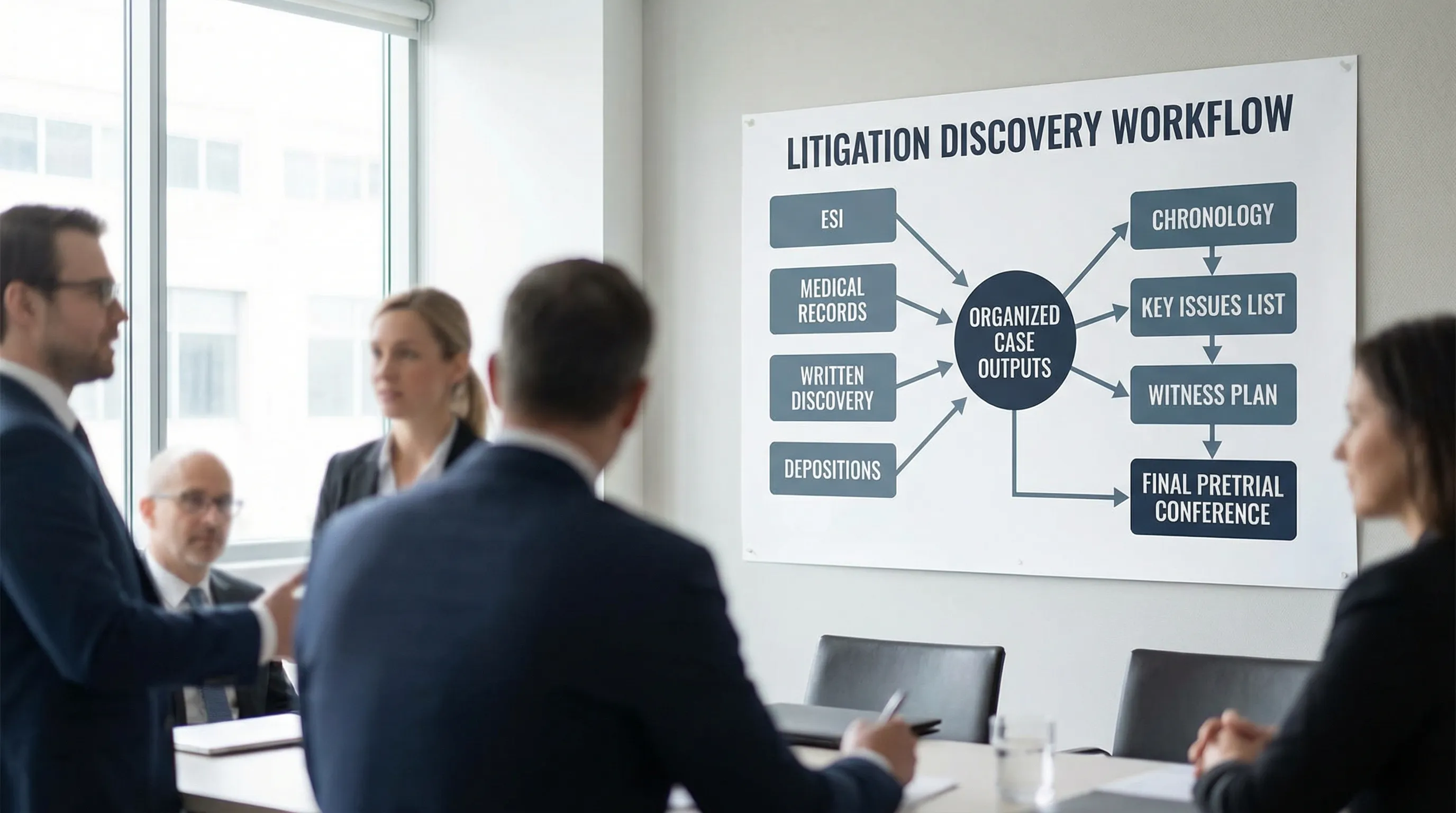
Discovery tasks, outputs, and common pitfalls (quick reference)
| Discovery task | What you need to produce or obtain | What can go wrong (and hits you at pretrial) |
|---|---|---|
| Initial disclosures and discovery plan | Key witnesses, categories of documents, damages computation, ESI plan | Surprise witnesses/documents, incomplete damages support |
| Written discovery | Verified responses, organized productions, authentication admissions | Boilerplate objections, missing custodians, unusable productions |
| ESI preservation and collection | Defensible holds, targeted collections, consistent production format | Spoliation claims, missing texts/emails, metadata disputes |
| Non-party subpoenas | Complete third-party records with declarations where possible | Late/partial returns, cutoff issues, authenticity gaps |
| Depositions | Testimony tied to exhibits, clear admissions, clean transcripts | Poor sequencing, weak document use, no trial-ready designations |
| Expert discovery | Reports, data inputs, expert deposition transcripts | Incomplete record, late supplementation fights, avoidable Daubert risk |
| Disputes and motions to compel | Orders, narrowed issues, protective order terms | Deadline crunch, sanctions risk, evidence exclusion |
Frequently Asked Questions
When does the discovery phase of trial end? It typically ends at the court-ordered discovery cutoff in the scheduling order. After that, the case shifts to pretrial disclosures, motions, and trial preparation.
Do I need depositions completed before the final pretrial conference? In most cases, yes. Even if a court allows limited exceptions, your witness list, exhibit list, and motions in limine are far stronger when depositions are complete and transcripts are in hand.
What should I prioritize if discovery deadlines are tight? Focus on the evidence that proves or defeats the core elements, high-value damages support (medical and wage loss), and depositions that lock in liability or causation admissions.
How do requests for admission help before pretrial? They narrow issues and reduce foundation fights by establishing authenticity and undisputed facts, which can simplify pretrial motions and shorten trial.
What is the biggest discovery mistake that causes pretrial chaos? Waiting too long to pursue third-party records, ESI sources (like texts), or motion practice. By the time pretrial deadlines arrive, courts are less receptive to “we are still trying to get it.”
Turn discovery documents into case-ready work product faster
If your team is spending hours turning productions, medical records, and deposition transcripts into usable litigation materials, TrialBase AI can help streamline that last-mile work. You can upload documents and generate items like medical summaries, deposition outlines, demand letters, and trial materials in minutes, helping you move from raw discovery to pretrial-ready outputs.
Explore TrialBase AI at ai.trialbase.com.