Discovery Deposition Prep: How to Use Docs to Control Testimony
.png)

Depositions are rarely “won” by a clever question. They are controlled by documents: what exists, what is missing, what the witness has already said, and what they cannot plausibly deny once you put paper in front of them.
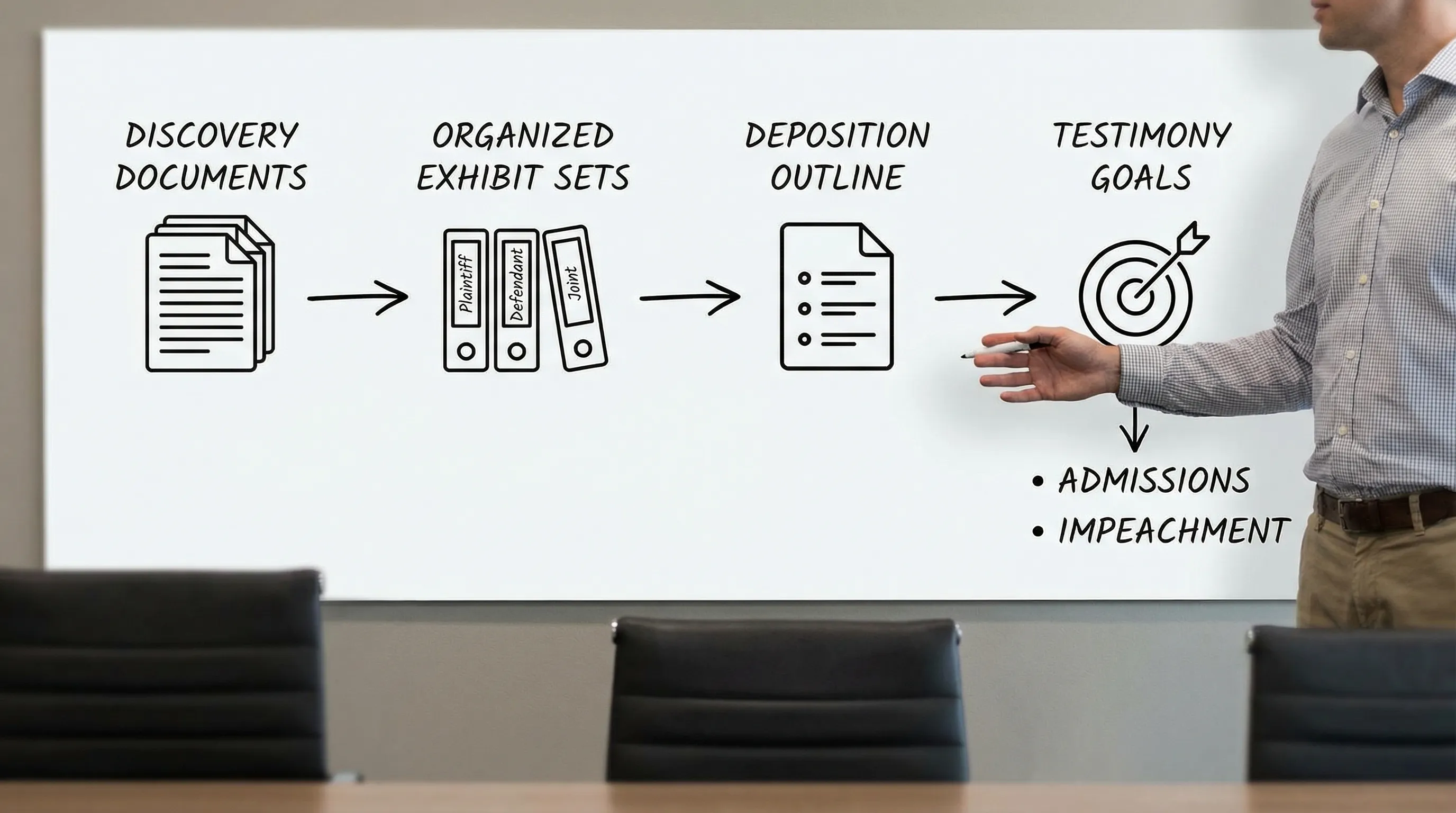
Discovery deposition prep is the process of turning your production, responses, and records into a testimony funnel: authenticate, commit, narrow, and only then confront.
Start with the deposition’s job (not the witness)
Before you outline a single topic, define what the deposition must accomplish for your case posture today.
In discovery-phase depositions, your core jobs usually fall into one of these buckets:
- Lock in elements (duty, breach, causation, damages, notice, policy, procedure).
- Establish foundations (authenticity, business records, custody, course of dealing).
- Preserve impeachment (prior statements, inconsistent documents, changed timelines).
- Surface missing discovery (what should exist, where it lives, who touched it).
If you do not decide which bucket matters most, you end up with an “interesting” transcript that does not move summary judgment or settlement.
Build a document map from discovery (what you produced is your playbook)
A strong deposition outline is basically a cross-examination of the file.
Create a document map that groups what you have into a few litigation-relevant lanes:
- Pleadings and theories (what must be proven or defended)
- Written discovery (interrogatories, requests, responses, verifications)
- Key communications (emails, texts, letters, claims notes)
- Policies and procedures (handbooks, SOPs, training materials)
- Event records (incident reports, logs, timestamps, photos)
- Damages records (medical bills, wage loss, repair estimates)
Then mark each document one of three ways:
- Foundation doc: you will use it to authenticate a category of evidence.
- Commitment doc: you will use it to lock the witness into a timeline or admission.
- Confrontation doc: you will use it to impeach, refresh recollection, or show inconsistency.
This prevents the most common deposition mistake: showing exhibits that feel persuasive, but do not actually force an answer.
Turn documents into a “control sequence” of questions
Documents control testimony when you sequence questions so the witness has fewer exits over time.
A practical sequence looks like this:
1) Authenticate first, while the witness is comfortable
Use low-friction foundation questions early. The goal is to make later exhibits “normal,” not adversarial.
Examples of what you are building:
- “This is your company’s standard incident report form?”
- “This email is from your work address?”
- “These are the medical records you received in the ordinary course?”
2) Commit second, using the witness’s own words and your opponent’s discovery
Written discovery is underused for controlling testimony. Interrogatory answers, verifications, and document responses can narrow the witness into a corner.
You are trying to lock in:
- Dates (when the witness learned something, when a policy changed)
- Actors (who approved, who trained, who reviewed)
- Scope (what searches were performed, what was relied upon)
3) Confront last, with a clean choice for the record
When you confront, make the record binary:
- “Is the report accurate, yes or no?”
- “If this timestamp is correct, your earlier answer cannot be correct, agreed?”
If a witness hedges, your documents let you pivot into either “lack of knowledge” (helpful for corporate reps) or inconsistency (helpful for credibility).
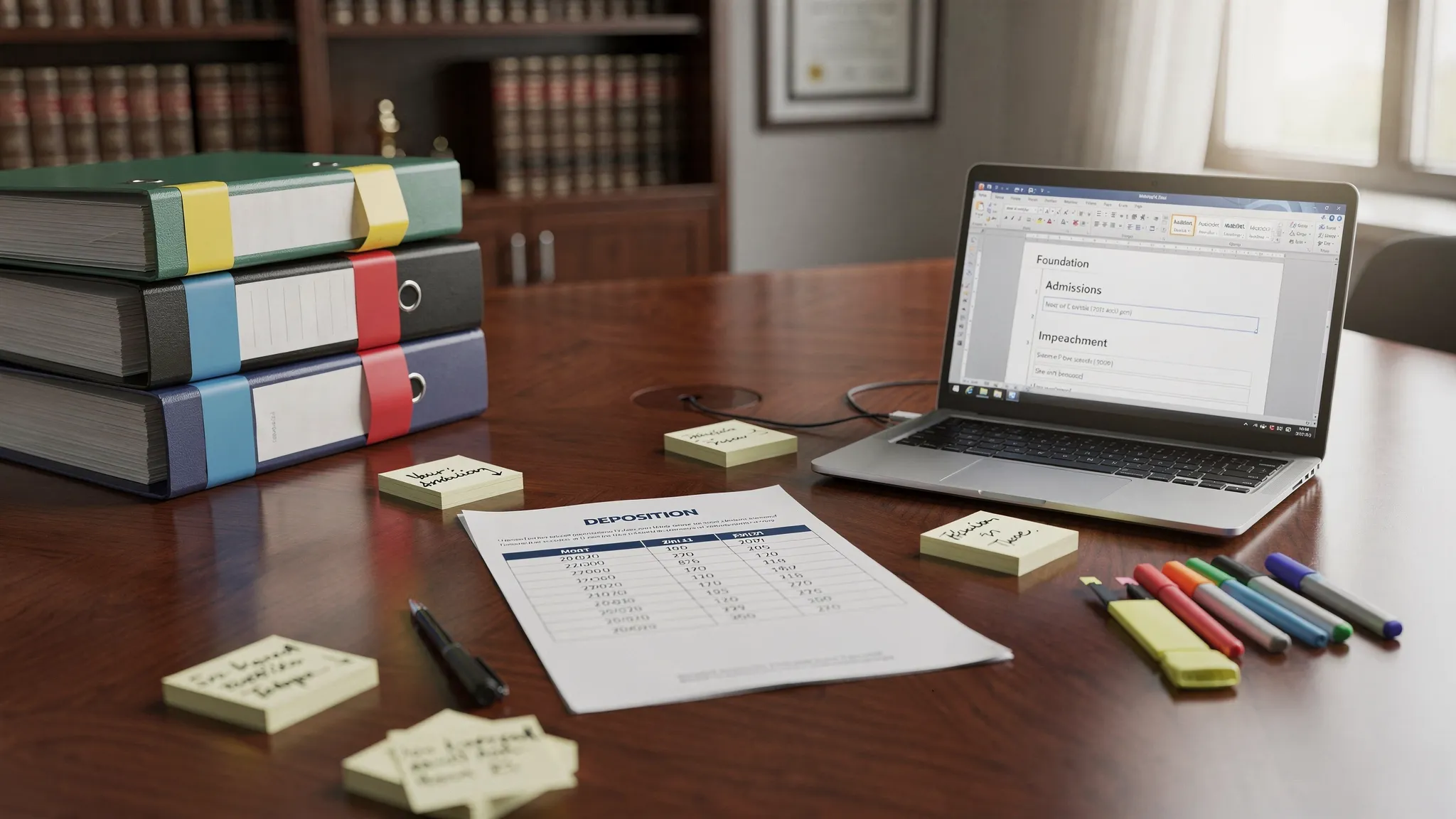
Use a deposition control table (fast, repeatable, and team-friendly)
A simple table makes your outline executable and reduces missed follow-ups.
| Document / exhibit | Purpose | What you want the witness to commit to | Best follow-up if they hedge |
|---|---|---|---|
| Interrogatory answer + verification | Commitment | “This was your sworn position as of X date.” | “What did you do to verify it before signing?” |
| Policy / SOP | Foundation + Commitment | “This policy applied on the incident date.” | “Show me where it says it did not apply.” |
| Email thread | Commitment | “You received it and understood it.” | “What did you do after reading it?” |
| Record with timestamp (log, claim note) | Confrontation | “This fixes the timeline.” | “If the log is wrong, who is responsible for accuracy?” |
| Medical record summary / bill ledger | Commitment | “These are the damages categories you reviewed.” | “What records did you not review before forming your opinion?” |
When you prepare like this, the deposition becomes less about brilliance and more about inevitability.
Don’t let “missing documents” stay vague
One of the highest-value outcomes of discovery deposition prep is building the missing record.
Instead of asking, “Are there any other documents?”, tie your questions to categories your production suggests should exist:
- “You produced training slides. Where are the attendance records?”
- “You produced a policy. Where are the revision histories?”
- “You produced the incident report. Where are the underlying photos?”
This not only supports motions to compel, it also pressures settlement because it signals you understand the file’s gaps.
Where AI can accelerate doc-driven deposition prep (without changing your strategy)
The bottleneck is usually not legal knowledge, it is document throughput: reviewing, extracting timelines, cross-referencing discovery responses, and converting all that into an outline.
TrialBase AI is designed for this workflow: you upload your documents, and it can generate litigation-ready outputs like deposition outlines, medical summaries, and other case materials in minutes, helping you move from “document pile” to “question sequence” faster.
If you use AI here, the best practice is to treat it like a force multiplier:
- Start with your theory and goals.
- Use AI outputs to accelerate organization and first drafts.
- Finalize with attorney judgment, especially on admissions targets and objection risk.
Quick mistakes that weaken document control
- Introducing exhibits before locking foundation, then fighting about authenticity.
- Asking broad “what happened” narratives when your documents can narrow the answer.
- Using too many exhibits for one point, instead of one exhibit with a tight follow-up.
- Failing to connect written discovery to testimony (missed sworn inconsistency).
Frequently Asked Questions
What is discovery deposition prep? Discovery deposition prep is the process of using produced documents, written discovery, and records to build a structured outline that locks in admissions, foundations, and impeachment.
How do documents help control deposition testimony? Documents limit the witness’s ability to speculate or reframe. You can authenticate the record, commit them to a timeline, and confront inconsistencies with precise exhibits.
What should I mark as key exhibits for a deposition? Prior statements, verified discovery responses, policies/SOPs, timestamped logs, critical communications, and damages records are usually the highest-control exhibits.
How do I handle a witness who claims they do not remember? Use documents to refresh recollection, establish what they should know (role, process, recordkeeping), and build “lack of knowledge” admissions that support credibility attacks or corporate notice issues.
Turn your discovery into a deposition outline faster
If you want to get from production to a clean, exhibit-driven outline without spending days building timelines and cross-references, explore TrialBase AI. Upload your documents and generate deposition outlines, medical summaries, and other litigation materials designed to help you prep smarter and move the case forward.