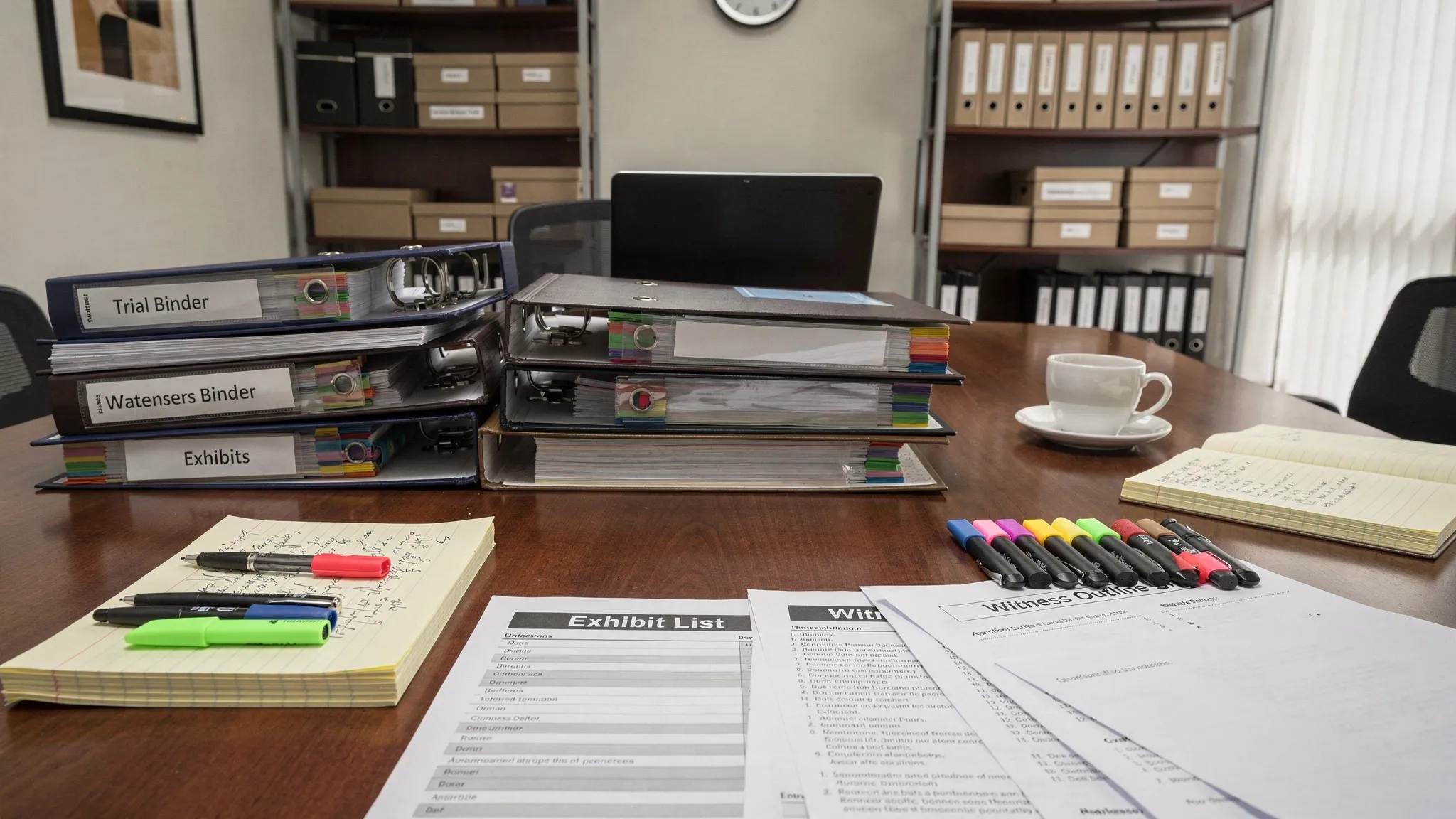
Deposition Question Outline: Build It From Claims and Defenses
.png)

A strong deposition rarely starts with “what do I want to ask?” It starts with “what must I prove (or defeat)?” When you build your deposition question outline from the claims and defenses, your transcript becomes a tool for settlement, dispositive motions, and trial, not just a memory dump.
Below is a practical, litigation-focused method you can reuse on almost any case (PI, premises, employment, commercial) while keeping your outline tight and usable at the table.
Step 1: Write your case theory in one paragraph
Before you outline questions, draft a single paragraph that states:
- What happened (your best provable timeline)
- What the other side did (or failed to do)
- Why that conduct satisfies each element
- What damages flow from it
- What defense themes you expect and how you will neutralize them
If you cannot say it cleanly, your outline will sprawl.
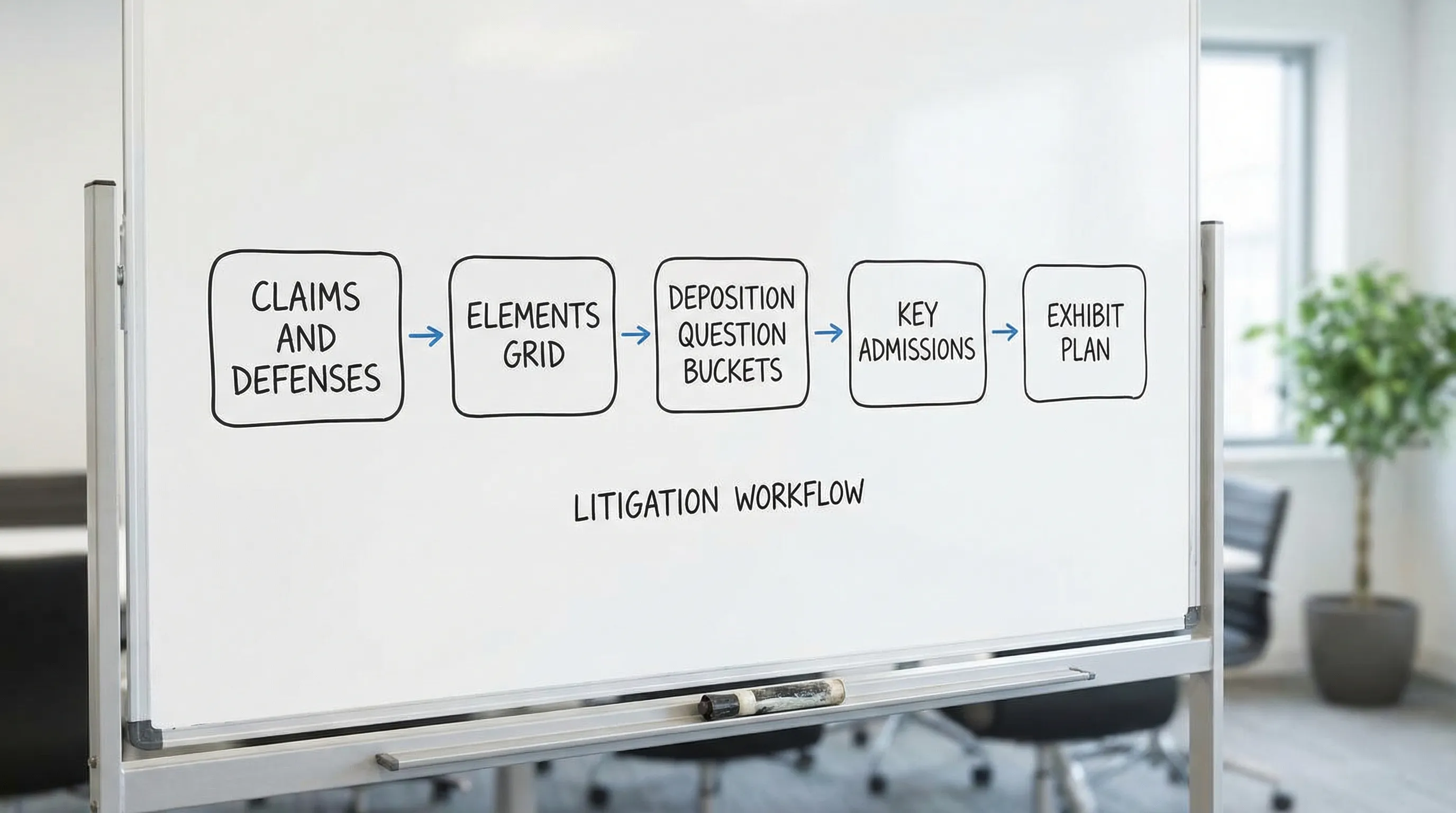
Step 2: Turn pleadings into an “elements grid”
Pull the operative complaint and answer, then list:
- Each cause of action
- Each element you must prove
- Each affirmative defense and its required showings (where applicable)
Now translate that into deposition goals. This prevents common mistakes like spending 40 minutes on background and 8 minutes on causation.
Here is a simple mapping table you can adapt.
| Pleading item | What you need on the record | Deposition question buckets (examples) |
|---|---|---|
| Negligence (duty) | Relationship, control, standard practices | Roles and responsibilities, policies, training, control of premises/operation |
| Negligence (breach) | Specific act/omission, deviation from practice | What was done, what should have been done, prior incidents, safety steps skipped |
| Causation | “But for” narrative, foreseeability, alternative causes | Timeline, mechanism of injury/event, knowledge of risk, other potential causes, intervening events |
| Damages | Nature, duration, impact, reasonableness | Medical course, work impact, daily activities, mitigation, future care basis |
| Comparative fault | Conduct by plaintiff, warnings, choices | What plaintiff knew, signage/warnings, instructions given, opportunities to avoid |
| Failure to mitigate | Reasonable steps not taken | Treatment compliance, follow-up, work search/return-to-work efforts |
| Notice/knowledge defenses | Lack of notice or opportunity to cure | When they learned, inspection routines, complaints, prior reports, escalation pathways |
Your outline should be visibly organized by these buckets so you always know why you are asking each question.
Step 3: Choose admissions that matter (and phrase them like motion language)
For each element or defense, identify 1 to 3 “clean admissions” you want.
Examples of deposition-ready admissions (adapt to your facts):
- “You were responsible for [process/area] on the date of the incident.”
- “There was no written policy requiring [safety step].”
- “No inspection occurred between [time] and [time].”
- “You did not document [the condition/complaint] before the incident.”
- “You cannot identify any witness who saw the plaintiff do [comparative fault theory].”
Keep them simple. Avoid compound questions, adjectives, and arguments.
Step 4: Build the outline in the order a court reporter transcript reads best
Most deposition outlines work better when they flow from foundation to disputed elements, then defenses.
A practical deposition question outline structure
1) Witness and scope foundation
Establish identity, role, job duties, and what the witness is prepared to testify about.
2) Documents, systems, and recordkeeping
What systems exist, who inputs data, retention practices, and what is missing.
3) Timeline (anchor points, then fill gaps)
Lock in times, locations, sequence, and who was present. Build a “no surprises” chronology.
4) Element-by-element proof
Run your elements grid as your spine (duty, breach, causation, damages). If a question does not serve an element, move it to the end or cut it.
5) Defenses and alternative narratives
Treat defenses like mini-claims the defense has to live with in writing.
6) Authentication and impeachment setup
Confirm emails, reports, photos, policies, and who created them. Establish prior statements and what the witness reviewed.
Note: Your jurisdiction’s rules control deposition conduct and scope. For federal practice, see Federal Rule of Civil Procedure 30.
Step 5: Add “trap doors” for evasive answers
Evasive answers are predictable. Prepare short follow-ups you can repeat.
Use a three-part funnel:
- Define the term: “When you say ‘inspection,’ what exactly does that include?”
- Fix the scope: “On that day, did you personally do it, or are you relying on someone else?”
- Force the record: “As you sit here today, you cannot identify any document showing it happened, correct?”
This keeps the outline functional even when testimony is slippery.
Step 6: Plan exhibits as “proof modules,” not a stack of paper
Pick exhibits that each accomplish one job:
- Establish a policy or standard
- Prove notice/knowledge
- Lock down time and sequence
- Show absence of documentation
- Quantify damages (medical bills, wage records) or narrow disputes
Then script the authentication path in your outline: what it is, who created it, when, where it is kept, and whether it is a fair and accurate copy.
Step 7: Keep it lean with a one-page “at-the-table” cover sheet
Your full outline can be detailed, but create a one-page front sheet with:
- Top 5 admissions you need
- Top 5 exhibits you must get through
- Defense themes to neutralize
- The two weakest elements in your case (so you actually cover them)
This is the difference between a good outline and a usable outline.
How TrialBase AI can speed up your deposition outline workflow
If your outline is built from pleadings plus a pile of records (medical charts, incident reports, emails, discovery responses), the slow part is often extracting the right facts and organizing them into question-ready buckets.
TrialBase AI is designed for litigation support from intake to verdict. After you upload case documents, it can help generate deposition outlines, produce medical summaries, and streamline trial prep in a unified workflow, so you can spend more time on strategy and less time on manual sorting. Learn more at TrialBase AI.
A final quality check before you defend your outline
Before you walk into the deposition, confirm:
- Every section ties to an element or a defense
- You have at least one “clean admission” per disputed element
- You have a plan for the 2 to 3 most likely evasions
- Your exhibit order matches your story (and your authentication steps are written)
A deposition question outline built this way is not just organized. It is outcome-driven.