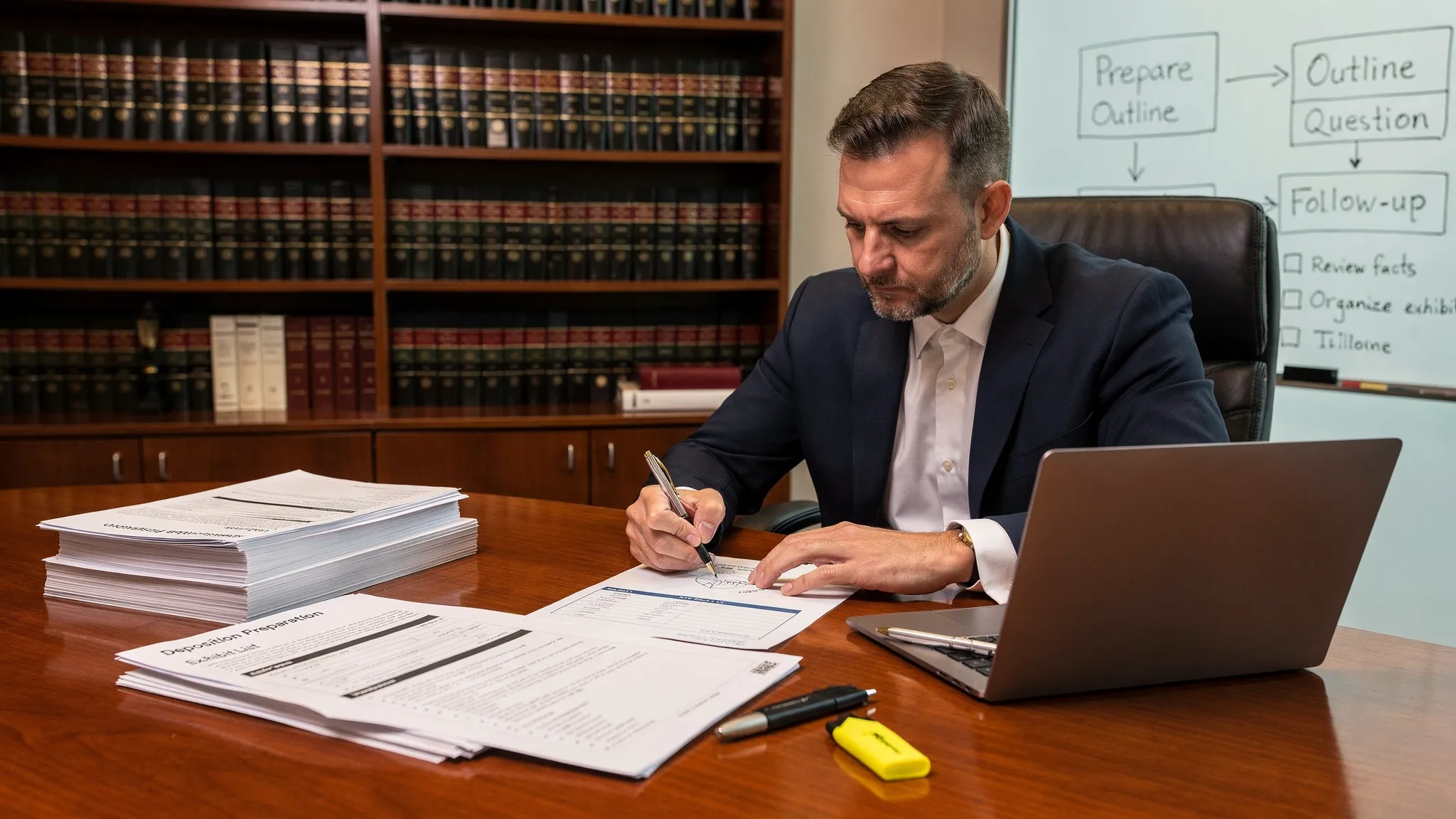
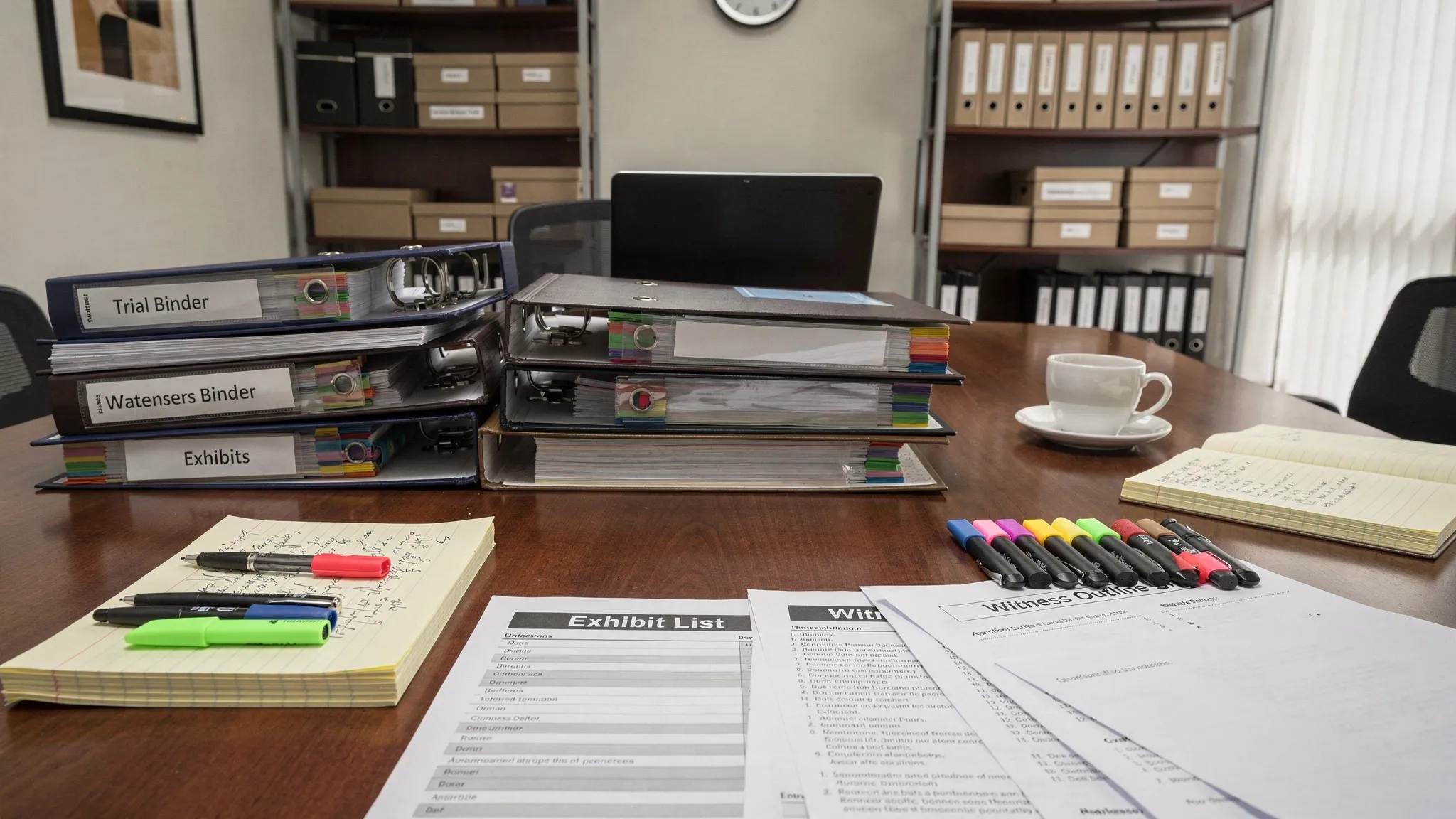
Deposition of Case Witnesses: Goals, Order, and Exhibits
.png)

Depositions can feel like a sprawling conversation, but the best ones are engineered: you know exactly what you must prove, who must say it, and which documents will make the testimony stick. When you approach the deposition of case witnesses with clear goals, a deliberate order, and a tight exhibit plan, you reduce surprises and increase settlement leverage.
The real goals of deposing case witnesses
A deposition is not just about “getting their story.” It is about building a record you can use in motion practice, mediation, and at trial.
Goal 1: Lock testimony into usable admissions
You want clean, quotable answers on the elements that matter: duty, breach, notice, causation, damages, and credibility. The record should support later use under the applicable rules (for example, impeachment or substantive use in certain circumstances). See FRCP 32 for federal deposition use.
Goal 2: Discover what you do not know (and what they will claim later)
Use depositions to surface:
- New witnesses (“Who else was there?”)
- New documents (“What did you review to prepare?”)
- New defenses and alternative causation theories
- The witness’s trial themes and language
Goal 3: Set up dispositive motions and evidentiary fights
Depositions often decide summary judgment and key evidentiary rulings. A strong record includes foundation testimony (what the document is, how it is kept, who created it) and precise timelines.
Goal 4: Evaluate value and risk for settlement
After the deposition, you should be able to answer: if this witness testifies this way at trial, what happens to liability and damages? If you cannot answer that, the deposition did not do its job.
The best order for deposing case witnesses (and why it matters)
There is no single “right” order, but there is a logic that helps you build momentum and avoid tipping your hand too early.
Start with neutral fact and custodian-type witnesses
Early depositions should help you map the case and authenticate key records.
- Records custodians (medical, employment, business records)
- 30(b)(6) corporate topics when you need foundational facts (in federal cases, see FRCP 30)
- Dispatch, scheduling, safety, or policy witnesses
Why first: you get the “how the system works” testimony and the document foundation before witnesses start tailoring narratives.
Then depose independent or semi-independent witnesses
These witnesses can give you credibility anchors.
- Treating providers (for injury cases)
- Third-party eyewitnesses
- Prior employers or supervisors (as relevant)
Why here: you can test causation and damages with less partisan framing.
Depose party witnesses after you understand the documentary record
For plaintiffs: depose defendants after you have policies, training docs, incident reports, and communications. For defendants: depose plaintiffs after you have medical chronology, prior claims, social media/activities, and wage records.
Why later: party witnesses are more likely to posture. You want exhibits ready to pin down evasions.
Save true “closing” witnesses for last
These are witnesses whose testimony you want to tailor based on everything learned.
- Experts (often later, subject to scheduling and disclosure rules)
- High-level corporate decision makers
- The witness you expect to drive settlement value (sometimes the plaintiff, sometimes a key employee)
Why last: you can incorporate contradictions found in earlier depositions and force commitments.
A practical sequencing table
| Witness type | Primary objective | What you need before you take it | Exhibits that usually matter |
|---|---|---|---|
| Records custodian / foundation witness | Authenticate and explain record-keeping | A document list and Bates range | Business records, retention policy, certification forms |
| Eyewitness / third party | Fix timeline, observations, and vantage | Scene photos, maps, 911/audio if any | Photos, diagrams, call logs |
| Treating provider | Link complaints, treatment, and causation | A medical chronology and key records | Chart excerpts, imaging reports, billing summaries |
| Corporate rep / operations | Prove notice, policy, training, deviations | Policies, emails, prior incidents | Manuals, training logs, incident history |
| Party witness | Admissions, credibility, damages story | Your strongest documents and inconsistencies | Prior statements, texts/emails, photos, records |
Exhibits: how to use them without losing control of the room
The fastest way to waste deposition time is to improvise with exhibits. Treat your exhibit plan like a trial outline: purposeful, finite, and tied to specific admissions.
Build an exhibit “ladder,” not a document dump
A good ladder moves from simple to decisive:
- Orientation exhibit: photo, diagram, timeline, or policy excerpt that sets context
- Commitment exhibit: something the witness must agree is accurate (signature, timestamped record, objective measurement)
- Contradiction exhibit: prior statement, inconsistent record, missing entry, altered version
- Damages or causation exhibit: medical record, wage record, repair estimate, utilization review note
Use exhibits to control pace and prevent narrative sprawl
When a witness answers with speeches, exhibits help you narrow the question to what the paper shows. The goal is not to “win the argument” in the room, it is to create a clean transcript.
Foundation: decide what must be authenticated now
You do not need to authenticate every document in every deposition. Prioritize documents you expect to rely on later for:
- Summary judgment
- Key impeachment
- Admissibility disputes (business records, chain of custody, completeness)
For evidentiary framing, it helps to keep the Federal Rules of Evidence nearby, especially around relevance, hearsay exceptions, and prior statements.
Exhibit handling do’s and don’ts
| Do | Why it works | Don’t | Why it backfires |
|---|---|---|---|
| Mark exhibits in a planned sequence | Keeps transcript easy to cite | Bounce randomly between documents | Creates confusion and weak citations |
| Get commitments on what the document is | Builds later usability | Argue about what it “means” | Invites speeches, not admissions |
| Read key lines into the record when needed | Avoids ambiguity if exhibit is lost/misread | Assume everyone will interpret it later | Increases wiggle room |
| Ask “what did you do next?” with timestamps | Forces a timeline | Let the witness narrate without anchors | Leads to vague, noncommittal answers |
A tight pre-deposition workflow (that saves hours)
If you want a deposition that is truly “litigation-ready,” prep should produce three deliverables.
1) A one-page goal sheet
Include:
- The 5 to 10 admissions you need
- The top disputes you must clarify
- The three exhibits that matter most
2) A chronology you trust
For injury cases, this often means a medical timeline with dates, complaints, diagnoses, imaging, treatment, and gaps. For liability cases, it means events, notice, policy triggers, and decision points.
3) A witness-specific outline tied to exhibits
Organize by themes, not by your questions. Your questions will adapt, your themes should not.
Where TrialBase AI can fit (without changing your style)
If your bottleneck is turning a document pile into a usable deposition plan, TrialBase AI is built for that workflow: you upload records and generate litigation outputs such as deposition outlines, medical summaries, demand letters, and trial materials in minutes. Used carefully, it can help you:
- Convert large records into a usable chronology before you outline
- Draft a first-pass deposition outline you can refine to your theory
- Create summaries you can share internally so your team is aligned
As with any legal AI tool, attorney judgment matters: verify citations, confirm facts against the source documents, and follow your confidentiality and protective-order obligations.
If you want to see how an AI-first workflow supports depositions from intake to verdict, explore TrialBase AI.