Deposition in Law: Rules, Objections, and Clean Transcripts
.png)
Depositions are one of the few moments in civil litigation where you can lock in a witness’s story under oath, test themes, and build impeachment material, long before trial. But a “good” deposition is not just about strong questioning. It is also about procedure, tight objection practice, and creating a transcript that can actually be used later, at summary judgment, mediation, or in front of a jury.
This guide breaks down deposition in law fundamentals, the rules that most often matter in practice, the objections you should (and should not) make, and how to protect a clean transcript.
What a deposition is (and why the transcript matters)
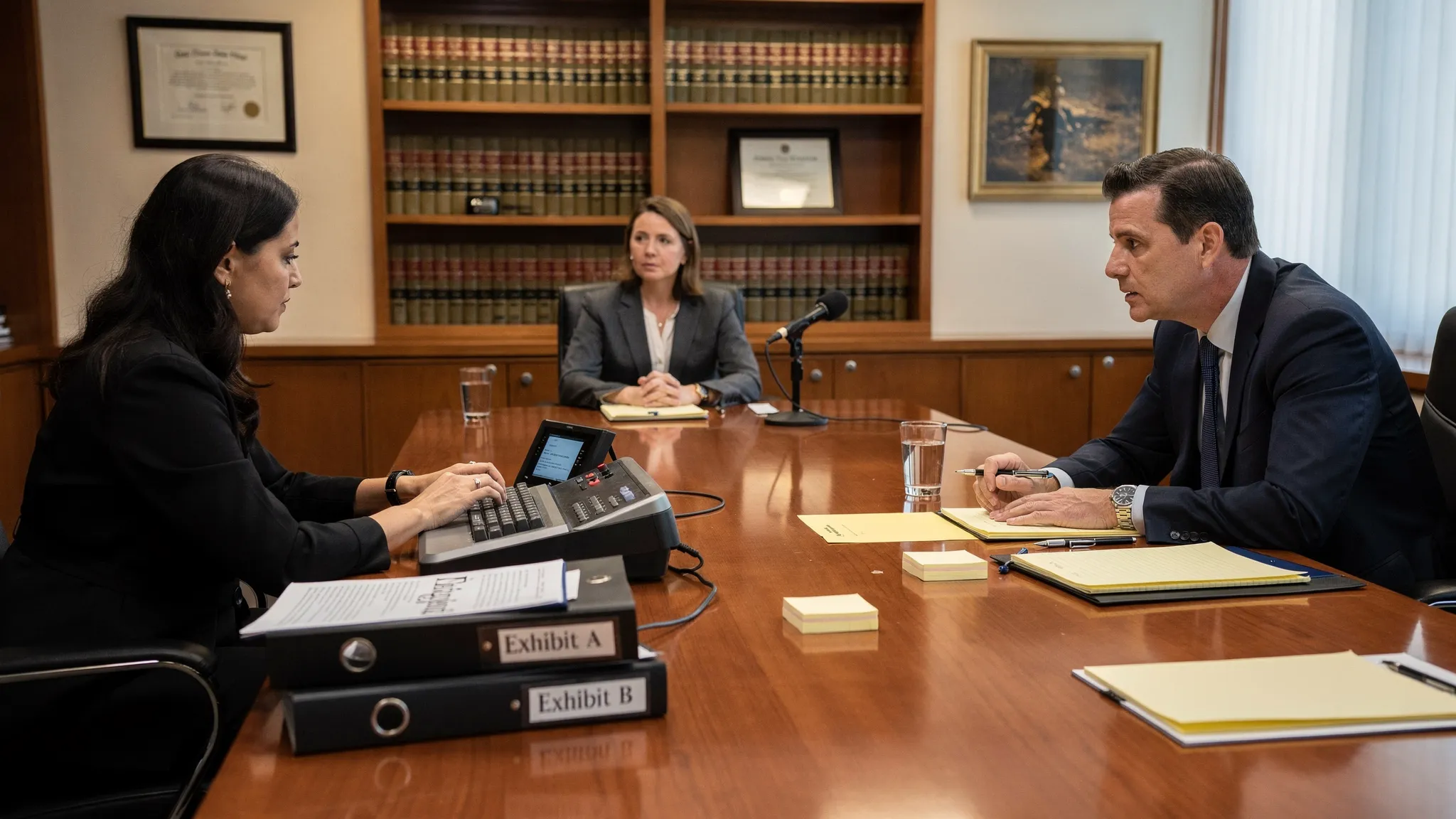
A deposition is sworn testimony taken outside court, typically recorded by a court reporter (and sometimes video). In most U.S. jurisdictions, depositions are discovery tools first, and trial tools second.
A deposition transcript becomes valuable when it is:
- Clear (questions and answers read cleanly without side talk)
- Defensible (objections are proper and not excessive)
- Usable (the record supports impeachment, admissions, and motion practice)
A messy transcript, even from a “win” deposition, can be hard to cite, hard to designate, and easy for opposing counsel to rehabilitate.
Core rules that govern depositions (Federal baseline)
Procedure is state specific, but many litigators use the Federal Rules of Civil Procedure as the baseline reference, especially in federal court or when state rules track similar concepts.
Here are the federal provisions that most often drive day to day deposition conduct:
| Issue | Practical takeaway | Federal baseline (for reference) |
|---|---|---|
| Notice, place, method | Depositions require proper notice and method, including remote details when applicable | FRCP 30 |
| Duration limits | One day of 7 hours unless stipulated or ordered otherwise | FRCP 30(d)(1) |
| Conduct, bad faith, sanctions | Court can limit abusive examination; sanctions possible | FRCP 30(d)(2)-(3) |
| Use of depositions in court | Rules for using depo testimony at hearings and trial | FRCP 32 |
| Deponent review and errata | Witness may review and sign changes (with limits and controversy) | FRCP 30(e) |
Even if you practice in state court, this table helps you spot the “pressure points” to confirm in your local rules and standing orders.
The practical deposition “rules” that create clean testimony
Beyond formal rules, certain habits consistently produce transcripts that are easier to use later.
Start with on-the-record ground rules
Before substance, establish record hygiene. Many lawyers do a short stipulation script, then confirm:
- The witness will wait for the full question.
- Everyone will avoid overlapping speech.
- Counsel will use verbal cues for nonverbal answers (for example, “yes” instead of nodding).
- Breaks are fine, but there will be no coaching on pending questions.
You are not just being polite, you are designing a transcript that can survive motion practice.
Keep exhibits simple and clearly identified
Exhibit confusion is a top cause of transcript ambiguity. When introducing an exhibit, slow down and make it easy to cite later:
- Mark it clearly.
- Identify it on the record.
- Confirm the witness is looking at the same page.
- Read key lines into the record when they matter.
If the case may be tried, assume that six months from now, a judge or juror will only have the cold transcript.
Watch the “two questions at once” problem
Compound questions generate objections, and they also generate unusable answers. If you want a clean record:
- Ask one fact per question.
- Use short time frames.
- Separate “what happened” from “why it happened.”
This is one of the fastest ways to increase the number of tight admissions in the transcript.

Deposition objections: what to say, when to say it
In most jurisdictions, deposition objections are limited. The general idea is:
- Preserve what must be preserved.
- Do not coach.
- Do not turn the deposition into oral briefing.
In federal practice, objections are typically stated concisely and in a nonargumentative, nonsuggestive manner (see FRCP 30(c)(2) within Rule 30).
The objections you will actually use
Here is a practical cheat sheet of common objections and what they do to the record.
| Objection | Use it when | What it accomplishes (typical) |
|---|---|---|
| Form | Question is compound, vague, ambiguous, assumes facts, lacks foundation, misstates prior testimony | Preserves “form” defects for later, and cues a cleaner re-ask |
| Leading | Usually in jurisdictions that restrict leading of friendly witnesses, or when it distorts testimony | Signals improper suggestion, may help on later disputes |
| Asked and answered | Same question repeated without a legitimate purpose | Helps manage harassment, sometimes supports a protective record |
| Mischaracterizes testimony | Question inaccurately summarizes prior answer | Protects the record from a distorted premise |
| Speculation | Witness lacks personal knowledge to answer | Forces counsel to lay foundation or limit scope |
| Calls for legal conclusion | Witness is being asked to apply legal standards | Preserves boundary between fact testimony and legal argument |
| Privilege | Attorney-client, work product, etc. | Basis to instruct not to answer (depending on rules) |
When you can instruct a witness not to answer
This is where lawyers get sanctioned. In many systems (including federal practice), instructions not to answer are typically limited to situations involving:
- Privilege
- A court ordered limitation
- A motion to terminate or limit based on bad faith or oppression
If you need to shut down abusive questioning, build the record calmly and consider a protective order or motion under the applicable rule (for federal, see FRCP 30(d) within Rule 30).
Avoid “speaking objections” that poison your transcript
Speaking objections are transcript pollution. They interrupt the cadence, invite argument, and can look like coaching. If you want a clean transcript, train yourself to:
- Say “objection, form” and stop.
- Save explanations for court, unless your jurisdiction requires specificity.
If you need to preserve a particular “form” issue, do it with the briefest label your local rules allow.
How to create a clean transcript that is trial-ready
A clean transcript is not luck. It is a workflow.
During the deposition: protect clarity
The highest leverage moves are simple:
- Slow the pace when the witness is key.
- Ask for verbal answers (no nods, no gestures).
- Separate the record when people overlap, and ask to have the last question read back.
- Spell names and terms that will matter later.
If you plan to use video, clarity matters even more because video designations live and die on clean audio and clean Q and A structure.
After the deposition: audit the record fast
Transcript value drops when you wait weeks to process it. Within a few days of receipt, consider:
- Pulling page line designations for admissions and impeachment.
- Tagging testimony by issue (liability, causation, damages, notice, credibility).
- Tracking “fix it later” items (missing exhibits, unclear references, follow-up discovery).
Errata sheets: handle with care
Most rules allow some level of review and correction (federal: FRCP 30(e)), but material changes can create motion practice and credibility issues. If you anticipate errata games:
- Make sure key admissions are unmistakably clear in the original Q and A.
- Consider asking questions that lock in “today’s testimony” and the witness’s certainty.
The goal is not to prevent corrections, it is to preserve usable impeachment if the story changes.
Where AI fits without compromising judgment
Depositions generate volume, and volume creates delay. AI can help you move faster from transcript to litigation decisions, as long as attorney judgment stays in the loop.
With a litigation support platform like TrialBase AI, firms can turn depositions and case documents into work product faster, for example drafting deposition outlines, generating summaries, and organizing case-ready materials. The practical win is cycle time: you can get from testimony to strategy while the deposition is still fresh, and while there is still time to notice follow-ups.
The bottom line
A deposition in law is not only a Q and A session. It is a record-building exercise governed by rules, shaped by objection discipline, and measured by how usable the transcript is later. If you treat transcript quality as an output, not an afterthought, you will get more leverage from the same testimony, whether the case settles, gets briefed, or goes to verdict.