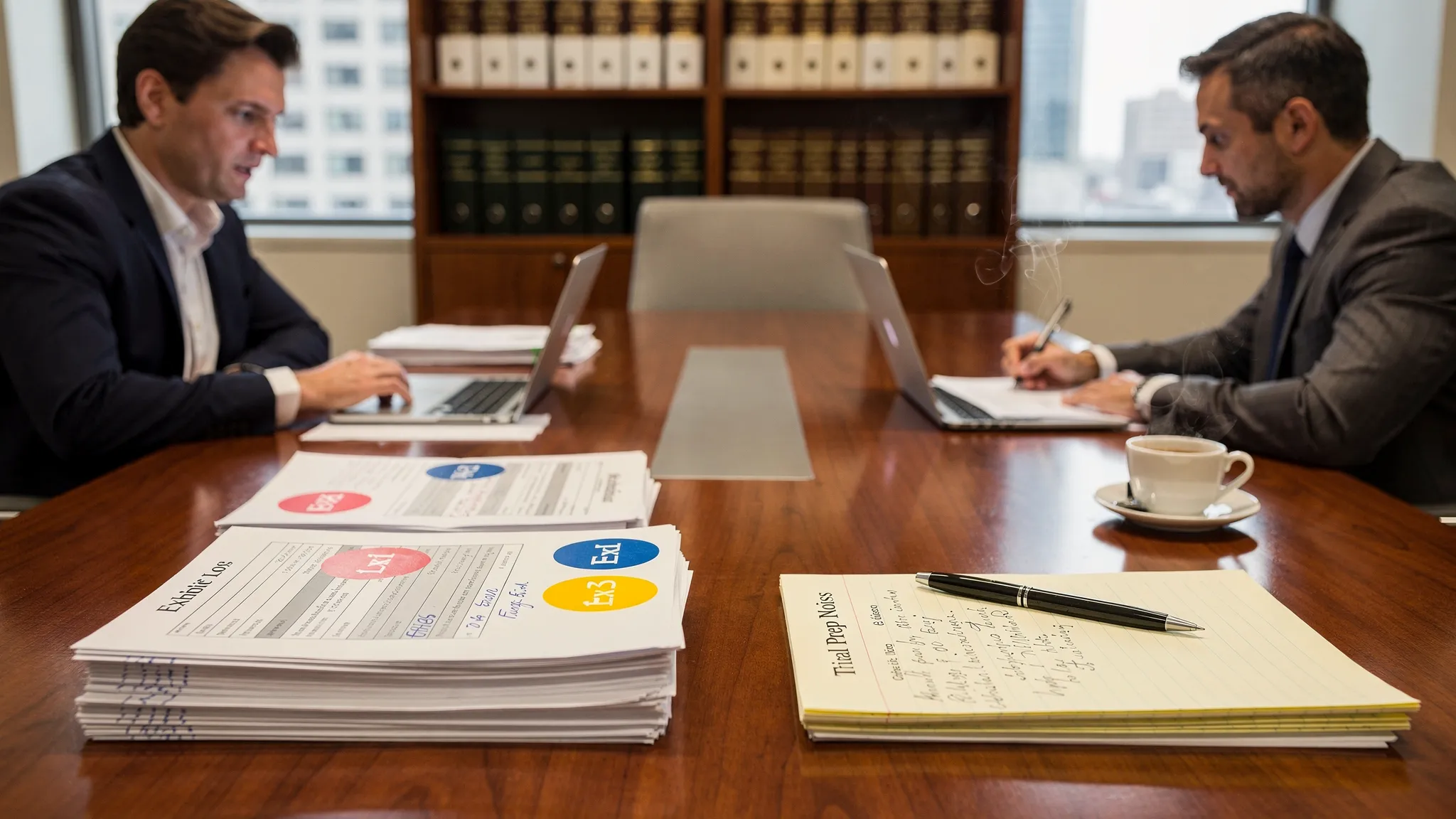
Depo Summaries: How to Capture Key Quotes Fast
.png)
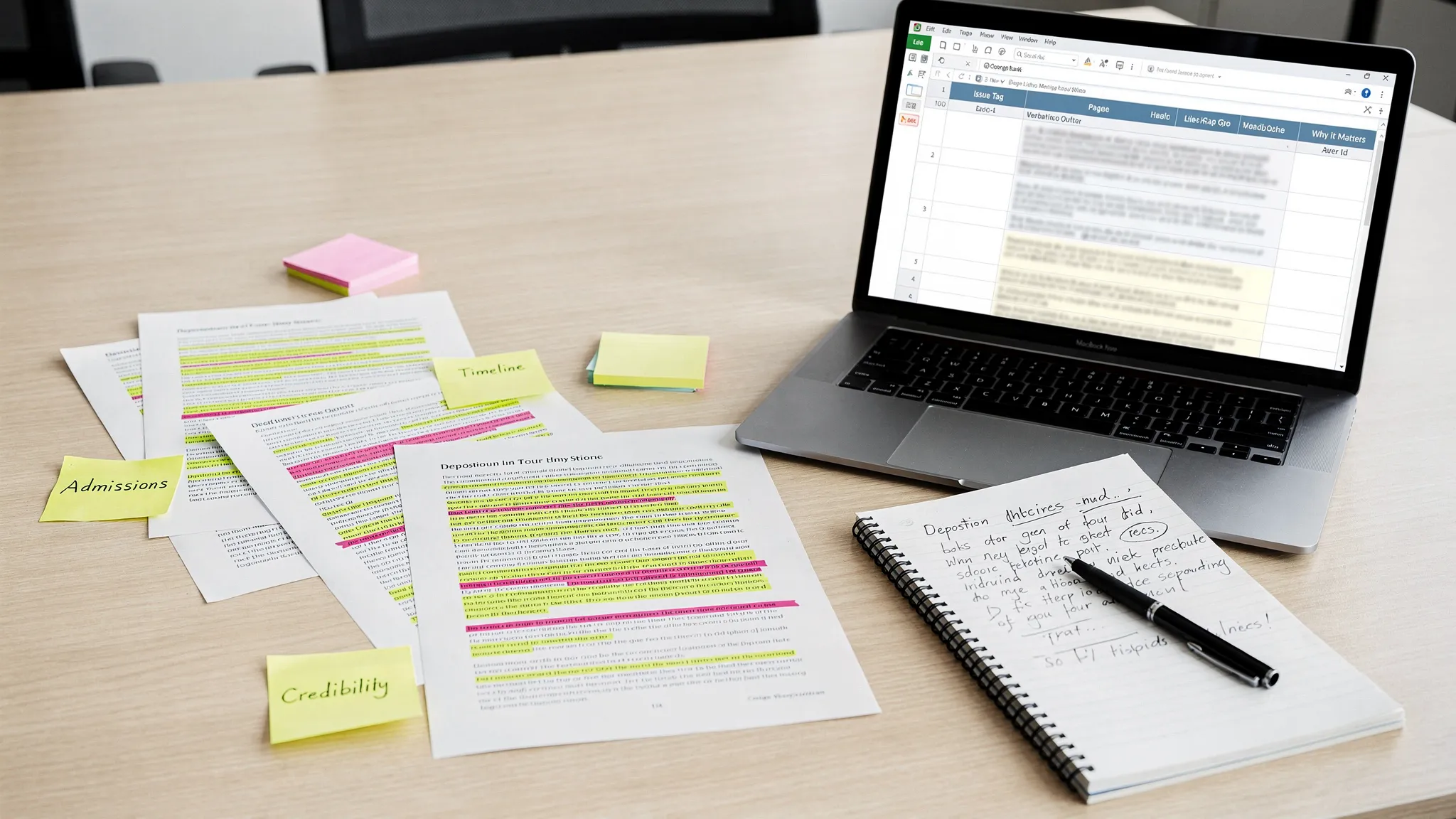
A deposition transcript is only valuable if you can use it, quickly. The fastest litigators and paralegals are not reading 200 pages line by line, they are building depo summaries that surface admissions, lock in timelines, and preserve impeachment-ready quotes with clean page:line citations.
Below is a practical, repeatable workflow to capture key quotes fast, without sacrificing accuracy.
What a “fast” depo summary actually delivers
A good depo summary is not a condensed transcript. It is a case tool. In practice, the most useful depo summaries have three layers:
- Executive snapshot (1 page): Who the witness is, what they conceded, what they denied, what changed, what to use in motion practice or mediation.
- Issue-based sections (3 to 8 pages): Organized by claim elements, defenses, damages, and credibility topics.
- Quote bank (impeachment-ready): The most important lines, captured verbatim with page:line and a short note on why each quote matters.
This structure aligns with how depositions are actually used later, especially for impeachment and motion practice (see FRCP 32 for federal rules on using depositions in court proceedings).
Step 1: Build an “issue map” before the transcript arrives
Speed is mostly decided before you start summarizing.
Create a one-page issue map that reflects how your team will argue the case. Keep it tight. For most matters, 10 to 20 tags is enough.
Common tags that make quote capture faster:
- Liability elements (duty, breach, notice, causation)
- Damages (past meds, future care, wage loss, limitations)
- Comparative fault / mitigation
- Timeline anchors (dates, times, sequence)
- Credibility (prior inconsistent statements, memory gaps)
- Policies and procedures (training, compliance)
- Document authentication (who created what, when, how kept)
When you later scan the transcript, you are not “reading.” You are tagging and extracting.
Step 2: Start your quote capture with a targeted keyword sweep
Once you have the transcript, don’t begin at page 1. Start with a sweep for “quote rich” language and high-leverage fact patterns.
Look for:
- Absolutes: “never,” “always,” “no,” “none,” “impossible”
- Commitment language: “I admit,” “that’s correct,” “I agree,” “yes”
- Memory disclaimers: “I don’t recall,” “I can’t say,” “not sure”
- Timeline anchors: dates, times, “before/after,” “first time,” “last time”
- Numbers: speed, distance, dosage, frequency, costs
- Policy/process: “our procedure,” “training,” “protocol,” “required”
This is the fastest way to locate testimony that tends to matter in mediation briefs, MSJs, Daubert challenges, and trial themes.
Step 3: Extract “anchor quotes,” not paragraphs
The goal is not volume. It is usability.
A strong anchor quote is typically:
- 1 to 3 sentences (long enough for meaning, short enough for slide decks)
- Verbatim (no paraphrase)
- Paired with a page:line citation
- Labeled with an issue tag
- Paired with a “why it matters” note (one line)
If the witness meanders, capture the smallest clean segment that still preserves context.
Step 4: Tie testimony to exhibits while it’s fresh
Many teams lose time later because the summary is disconnected from the record.
When a quote references a document, photo, or medical record, note it immediately:
- Exhibit number (or bates range)
- What the witness said the exhibit proves
- Any authentication language (“that’s my signature,” “that’s our form”)
That single habit pays off when you are building a demand package, preparing a motion, or drafting a trial examination outline.
A simple quote bank template you can reuse
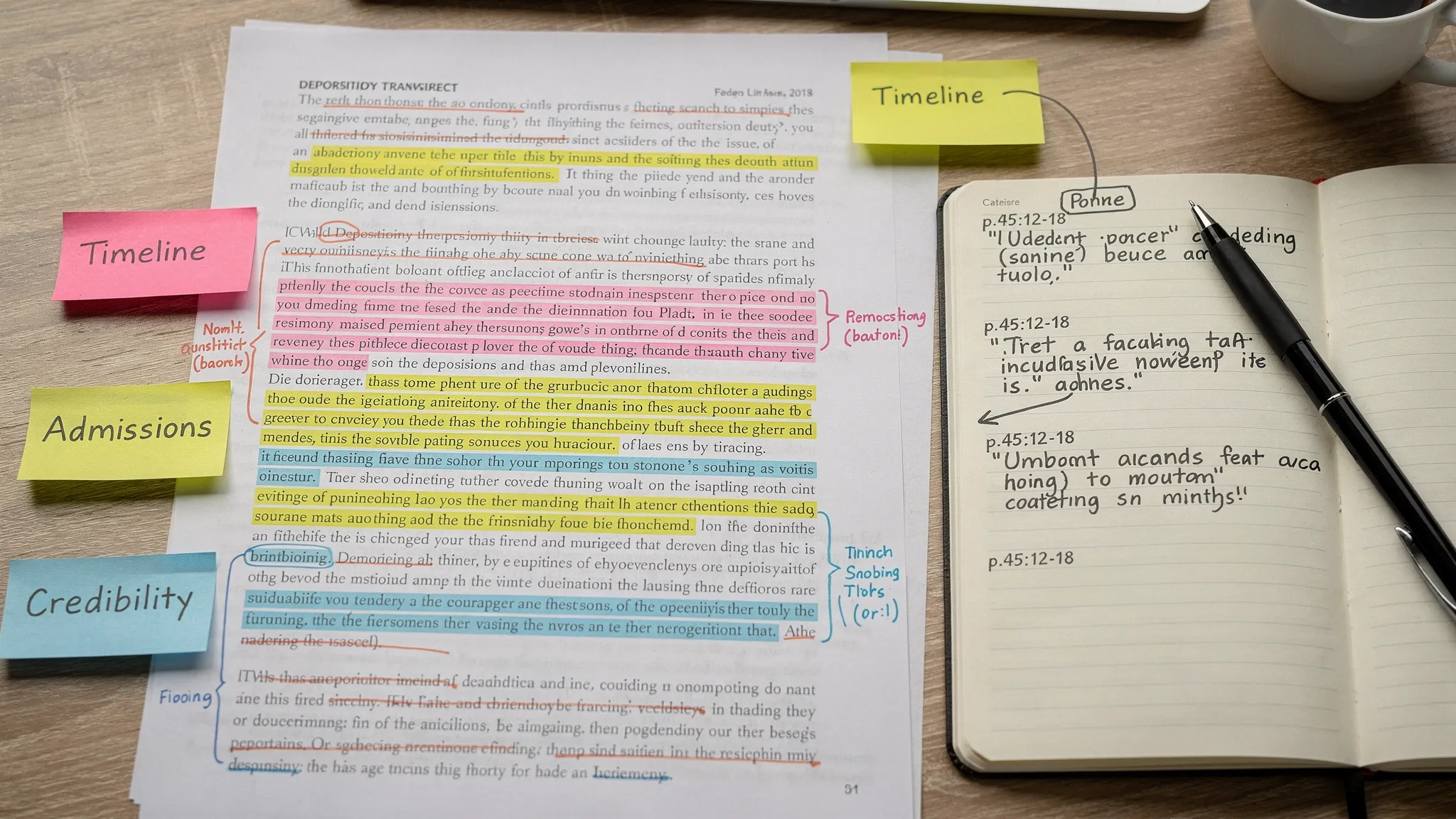
A quote bank is where depo summaries become trial-ready. Here is a format that stays fast and forces clarity.
| Issue tag | Page:line | Verbatim quote | Why it matters | Follow-up action |
|---|---|---|---|---|
| Liability (notice) | 45:12-18 | “…” | Establishes notice before incident | Add to mediation brief; prep impeachment clip |
| Timeline | 62:3-7 | “…” | Locks sequence of events | Cross-check with records/exhibit |
| Credibility | 88:20-89:4 | “…” | Inconsistent with prior statement | Flag for trial cross outline |
| Damages | 120:9-14 | “…” | Admits limitations/work impact | Add to demand narrative |
Keep the “Why it matters” column brutally short. If you cannot explain the point in one sentence, the quote is probably not an anchor quote.
The fastest way to draft the narrative portion of depo summaries
Once your quote bank is 70 percent built, the narrative summary becomes easy.
Use this order:
Executive snapshot
Write five blocks, each 2 to 4 sentences:
- Witness role and scope (who they are, what they were there for)
- Biggest admissions (with 1 to 2 page:line cites)
- Biggest denials (with 1 cite)
- Key credibility points (1 cite)
- How this affects next steps (settlement, motion, additional discovery)
Issue sections
For each tag in your issue map, write:
- A 1 to 2 sentence conclusion (“Witness concedes X, but disputes Y…”)
- Then place 3 to 6 anchor quotes underneath (each with page:line)
This approach prevents the common mistake of writing long paragraphs that nobody can quickly repurpose.
Mistakes that slow you down later (and how to avoid them)
- Paraphrasing instead of quoting: paraphrases create disputes and rework. Keep the quote verbatim.
- Missing page:line: a quote without a citation is not usable in motion practice.
- Over-collecting: if everything is highlighted, nothing is. Prioritize admissions, numbers, timelines, and authentication.
- No issue tags: untagged quotes are hard to find when you are building a mediation brief at midnight.
- Ignoring qualifiers: “as far as I know,” “generally,” and “typically” can change the meaning. Capture them.
Using AI to accelerate depo summaries (without compromising accuracy)
AI is most valuable for first-pass organization and extraction, especially when you already have an issue map.
With a litigation support platform like TrialBase AI, teams can upload deposition transcripts and other case documents to generate case-ready work product in minutes, including summaries and deposition-focused materials. The best workflow is:
- Use AI to draft an issue-organized summary and pull candidate quotes.
- Validate every “anchor quote” against the transcript before it goes into a filing, mediation brief, or trial outline.
- Store the final quote bank in a shared workspace so your team is working from the same record.
This is how you get speed and reliability.
A 10-minute quality check before you circulate
Before you send depo summaries to the team:
- Spot check citations (at least 10 percent of quotes) for exact wording and page:line.
- Confirm names, dates, and numbers match the transcript.
- Ensure every issue section has a takeaway sentence at the top.
- Verify you captured at least one quote on each critical element or defense.
When this becomes habit, your summaries stay consistent, fast, and immediately usable.
If you want depo summaries that move from transcript to litigation-ready output faster, build the issue map, capture anchor quotes with clean citations, and use AI for the heavy lifting, with human verification where it counts.