Depo Prep: The 60-Minute Plan Before You Walk In
.png)

Depositions rarely go “off the rails” because someone forgot a rule. They go off the rails because the last hour before you walk in is chaotic, fragmented, and focused on the wrong things. A tight 60-minute depo prep routine helps you show up calm, consistent, and ready to control the record.
Below is a practical, repeatable plan for the final hour before a deposition, whether you’re defending your client or taking testimony.
The goal of the last 60 minutes
Your objective is not to relearn the file. It is to lock in three things:
- The theory you’re protecting (liability, damages, causation, credibility).
- The few facts that must land cleanly (and the few that must not).
- Your plan for predictable problems (documents, objections, privilege, “I don’t recall,” rabbit holes).
If you do those well, you will spend less time reacting and more time steering.
Depo prep: the 60-minute plan (minute-by-minute)
| Time left | What you do | Output you should have in hand |
|---|---|---|
| 60 to 45 | Re-anchor on case theory and deposition purpose | 1-paragraph theory, 5 must-hit facts |
| 45 to 30 | Review the key documents and build the exhibit path | A short exhibit list with “why it matters” |
| 30 to 20 | Script the openings and the “danger zones” | 6 to 10 core questions or warnings |
| 20 to 10 | Prep the witness behavior and record control | Coaching points, objection posture |
| 10 to 0 | Logistics, backups, and calm | Clean workspace, backups, first question ready |
60 to 45 minutes: Re-anchor on theory (do not chase every detail)
Start by forcing clarity:
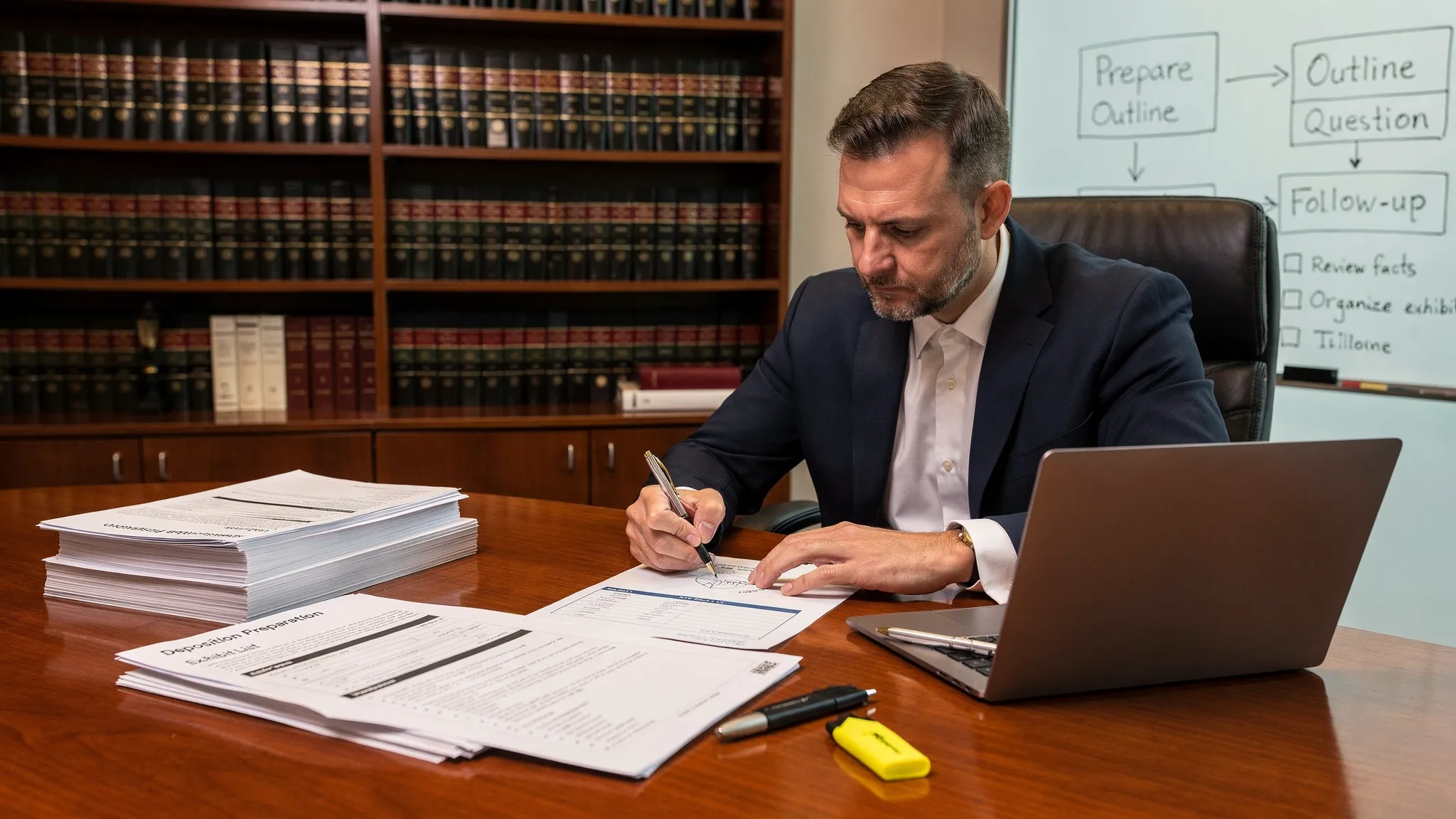
- Write your case theory in 3 to 5 sentences. If it does not fit, you are still researching, not prepping.
- Identify 5 facts that must be true at the end of this deposition. They should be “record facts,” not feelings. For example, dates, who knew what when, what was said, what was done, what was not done.
- Pick your top 2 risks. Examples: a bad timeline admission, a scope-of-employment issue, a prior inconsistent statement, a causation concession.
This is also a good time to confirm the ground rules you are operating under (jurisdictional rules, stipulations, remote platform). If you are in federal practice, you can quickly sanity-check the framework in FRCP 30 (Cornell LII).
45 to 30 minutes: Build the exhibit path (the shortest route to your point)
Most “document problems” in depositions are sequencing problems. Fix that now.
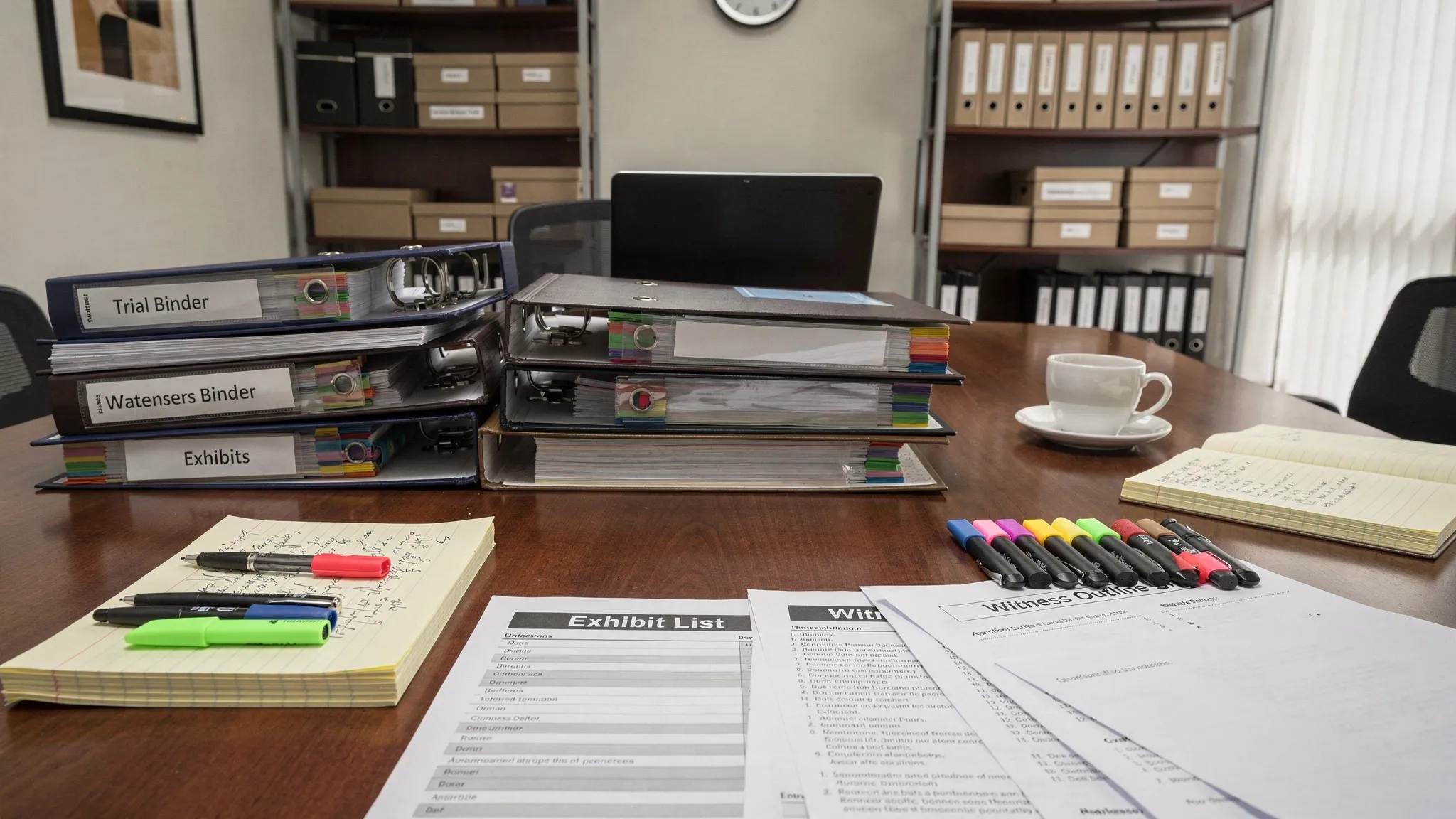
Choose a small set of exhibits that do specific jobs:
- Foundation exhibit(s): the document that orients the witness (contract, chart note, email chain header, incident report).
- Lock-in exhibit(s): the document that nails a date, a statement, a standard, or a change in story.
- Damage or causation exhibit(s): the document that connects event to impact (medical record excerpt, billing summary, photo).
- Impeachment exhibit(s): only if you are likely to use them today.
Keep it light. If you bring 40 exhibits, you will use 8. Prepare for the 8.
Practical tip: next to each exhibit, add one line: “This proves…” If you cannot finish that sentence, the exhibit is probably noise.
30 to 20 minutes: Script the opening lane and the danger zones
This is where you prevent “meandering deposition syndrome.” You want a small, stable question set you can return to.
If you are taking the deposition
Write:
- Your first 3 minutes of questions (identity, role, scope, how they learned the facts).
- Your theme questions (6 to 10 total, plain language, no compound questions).
- Your two “trapdoor” questions that close a topic and keep you from circling (examples: “Is there anything else you relied on?” “Anyone else involved?”).
If you are defending the deposition
Write:
- The topics your witness must handle cleanly (and the one topic you would rather not expand).
- The predictable “gotchas” (prior statement, timeline gaps, social media, medical history, performance issues).
- Your posture on objections and instructions so you are consistent. Consistency matters more than cleverness.
20 to 10 minutes: Witness behavior, record control, and “how to answer”
If you’re defending, this is the tight coaching window. Keep it practical and ethical.
Reinforce these fundamentals:
- Listen, pause, answer only what is asked. Do not volunteer.
- If they do not understand, say so. If they do not remember, say so. Guessing creates permanent problems.
- Stick to personal knowledge. “I don’t know” is better than “I assume.”
- Do not argue with the question. Correct only what truly needs correction.
If you’re taking, decide how you will keep control:
- Where you will slow down (key admissions).
- Where you will speed up (background, unproductive denials).
- How you will handle evasive answers (repeat the question, then narrow it).
10 to 0 minutes: Logistics, backups, and calm
This is not “extra time.” It is when preventable mistakes happen.
Do a fast operational sweep:
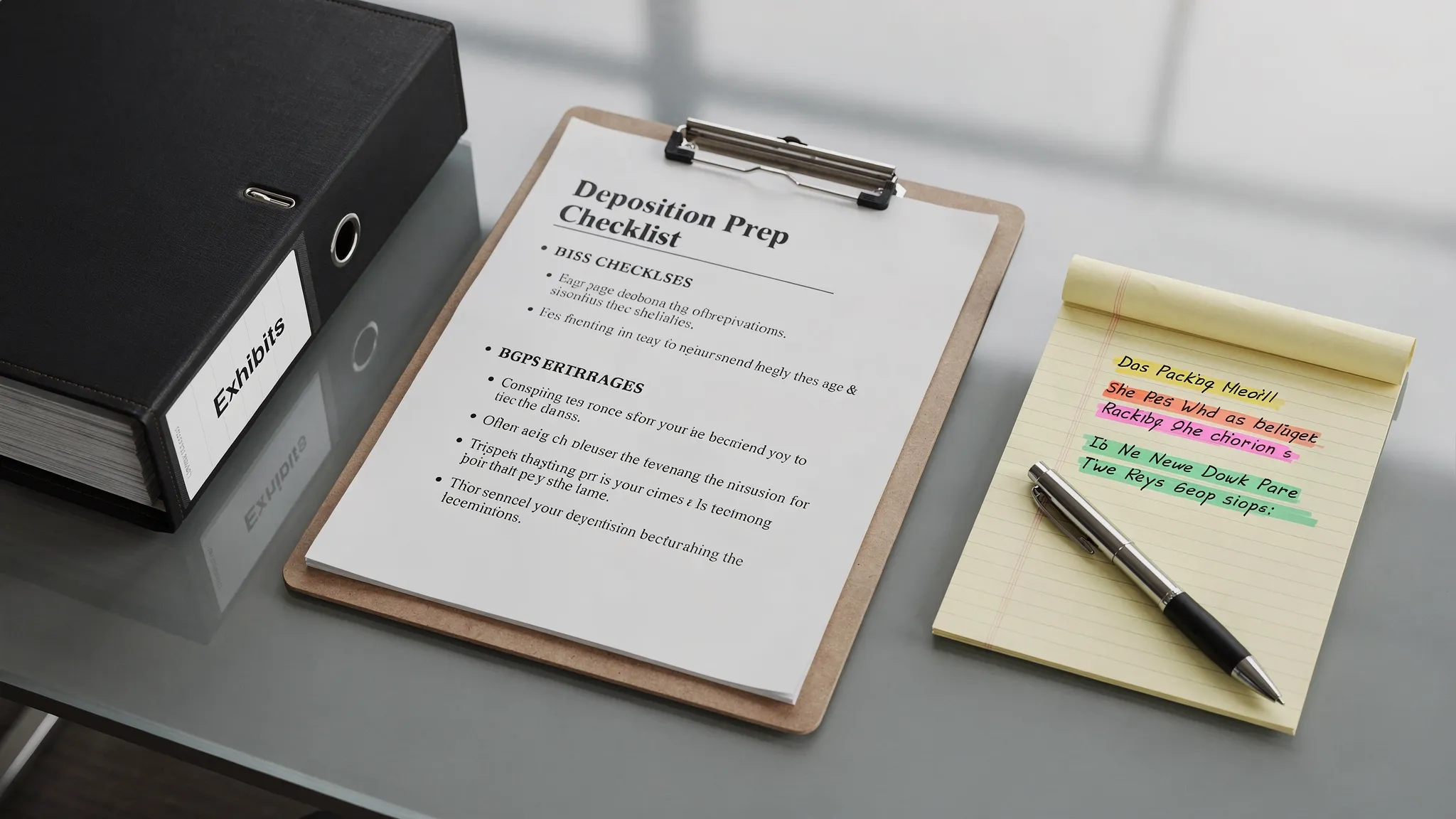
- Exhibits accessible: printed or in a clean digital folder with consistent naming.
- Your outline is one page deep: the first page should carry your themes and the next 10 questions.
- Backup plan: a second way to access key docs (downloaded PDF, local copy) in case a platform fails.
- Room and recording: confirm court reporter instructions, appearance list, and whether any stipulations were agreed.
Then stop. Take two minutes to breathe and visualize your first exchange. Walking in with a steady pace is a tactical advantage.
How AI can compress depo prep without cutting corners
The last hour is often lost to hunting: finding the right page, the right quote, the right medical timeline, the right prior statement. This is where litigation-focused AI can help by turning document piles into deposition-ready materials.
If your workflow includes assembling exhibits, summarizing medical records, or building a clean deposition outline from mixed case documents, a tool like TrialBase AI is designed for that kind of litigation support, from intake to verdict. It can generate items like medical summaries, deposition outlines, and demand letters from uploaded documents, which can help your team spend more of the final hour on strategy and witness readiness, not searching.
The key is to treat AI output as a draft and a map, then apply attorney judgment before you go on the record.
The simple standard: walk in with clarity
A good 60-minute depo prep routine is boring on purpose. It produces clarity, reduces surprises, and gives you a “home base” to return to when testimony gets messy.
If you want one takeaway, make it this: Show up with a short theory, a short exhibit path, and a short set of questions you can execute under pressure.