Demand Letter Lawyer: What to Include to Maximize Value
.png)

A well written demand letter can set the ceiling for settlement talks, frame liability before positions harden, and signal that you are ready to litigate if needed. But “well written” rarely means “aggressive.” It means clear facts, supported damages, and a credible demand.
If you are searching for a demand letter lawyer, the goal is usually the same: maximize the value of the claim while reducing the odds of delay, denial, or an avoidable lawsuit.
When a demand letter lawyer adds the most value
Demand letters show up in many practice areas, but a lawyer’s value is highest when the other side is sophisticated or the record is messy.
Common situations where legal drafting materially changes outcomes:
- Personal injury and insurance claims (auto, premises, UM/UIM): organizing liability proof, medical causation, and damages into a negotiation ready package.
- Employment disputes (wage claims, discrimination, severance negotiations): aligning facts to statutory elements and preserving leverage.
- Contract and business disputes: attaching clean documentary proof, pinning down breach and cure, and proposing practical resolution terms.
- Pre suit preservation and spoliation risk: putting recipients on notice to retain evidence.
A demand letter is also often the first document a carrier, adjuster, or defense counsel will use to evaluate your case. A demand that reads like it was assembled from incomplete records typically gets valued like an incomplete case.
What to include in a demand letter to maximize value
A “max value” demand letter is not longer by default. It is more organized, provable, and easy to evaluate.
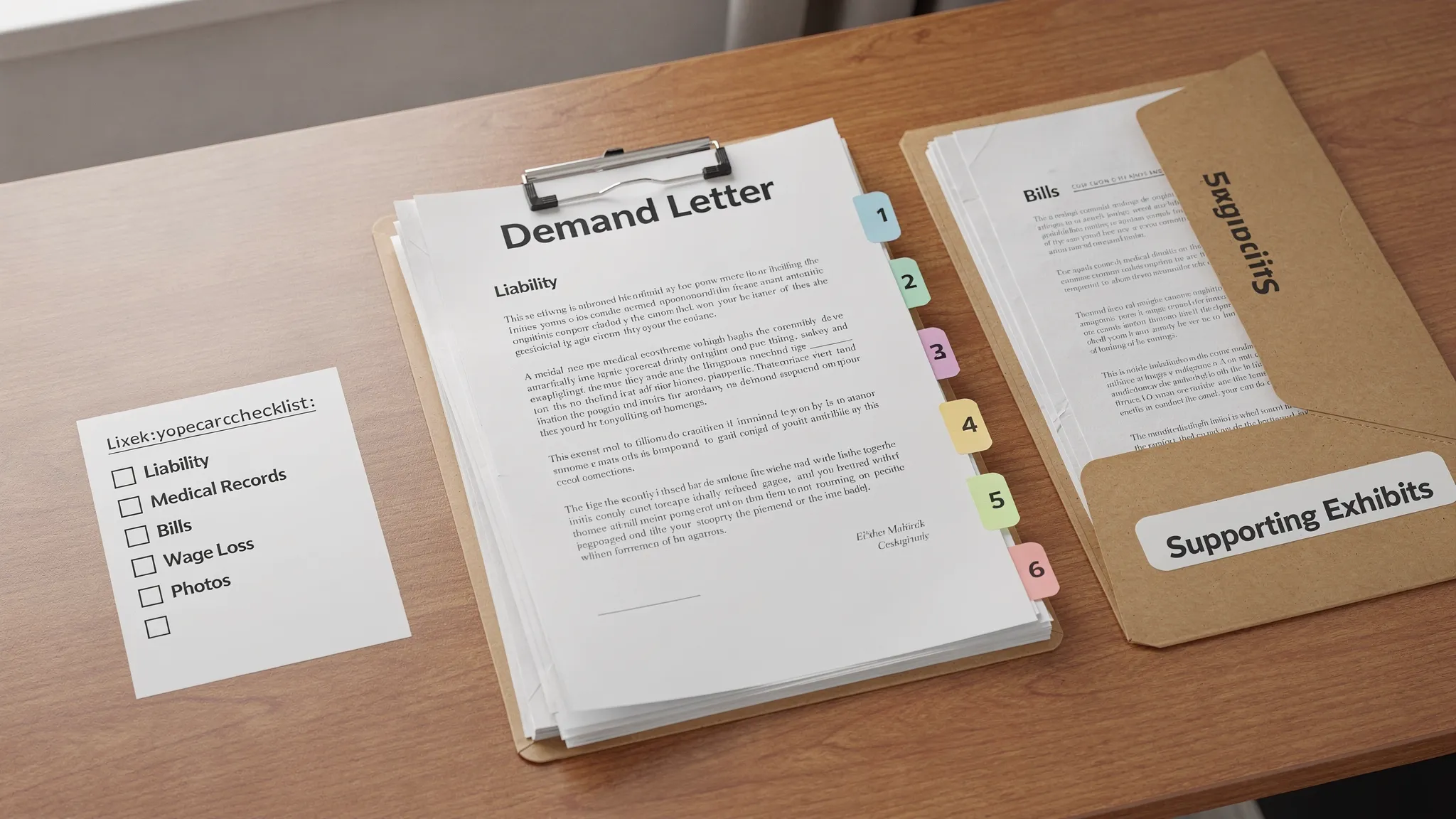
The core sections (and why they matter)
Use the structure below as a checklist. Your exact headings will vary by case type and jurisdiction.
| Section | What to include | Why it increases value |
|---|---|---|
| Parties and claim overview | Names, dates, locations, policy or contract identifiers, claim number if assigned | Prevents misrouting, speeds evaluation, signals professionalism |
| Liability narrative | A tight timeline, duty, breach, causation, and key admissions or objective facts | Makes it easier to say “yes” on liability and focus on damages |
| Damages summary | Medical treatment chronology, diagnoses, procedures, prognosis, wage loss, out of pocket expenses, property damage | Converts a story into numbers and categories evaluators must price |
| Evidence index | A list of attached exhibits (records, bills, photos, reports, statements) | Helps the recipient verify quickly, reducing “need more docs” delays |
| The demand | A specific dollar amount (and what it includes), plus what will resolve the claim | Anchors negotiation and avoids ambiguity |
| Deadline and next step | A reasonable response date and what happens next (file suit, schedule call, mediation) | Creates momentum without sounding like a threat |
1) A liability story that is easy to believe
Maximizing value starts with being credible. That means:
- Chronology over adjectives: dates, times, and actions are more persuasive than labels like “reckless.”
- Objective facts first: photos, measurements, dash cam references, incident reports, work logs, emails, contract clauses.
- Address obvious defenses: comparative negligence, gap in treatment, pre existing issues, mitigation, contract notice provisions.
If you can pre answer the recipient’s likely objections in two sentences each, you reduce the back and forth that typically drags value down.
2) A damages section that ties records to dollars
This is where many demand letters lose value: they list treatment but do not connect it to the claim elements.
A high performing damages section usually includes:
- Medical chronology: symptoms, initial presentation, imaging, referrals, procedures, PT, follow ups.
- Causation narrative: why this mechanism of injury fits the diagnosis, and how treating providers documented it.
- Itemized specials: medical bills, pharmacy, mileage, assistive devices, property damage, wage loss.
- Future damages basis: future care recommendations, impairment ratings, work restrictions, or documented ongoing symptoms.
- Non economic harms: limitations in daily activities, sleep disruption, hobbies lost, family impacts, explained with specifics.
Practical tip: evaluators price what they can verify. If the number is in the letter, show where it comes from.
3) The demand number, and what it includes
A demand letter lawyer will often treat the demand as a negotiation tool, not a moral statement.
To maximize value, make the demand “complete”:
- State whether the demand includes all liens and subrogation interests or whether those will be resolved separately.
- Clarify whether it includes attorney’s fees, statutory penalties, or interest (when applicable).
- If you are making a policy limits demand, consider confirming the requested disclosures (limits, coverage position) consistent with local rules and ethics obligations.
Avoid internal inconsistencies such as specials totaling $18,420 in one paragraph and $19,240 in another. Small math errors create big credibility issues.
4) Settlement terms that remove friction
If the other side is willing to pay, the fastest way to protect value is to reduce closing complexity. Common terms to address:
- Release scope (who is released, which claims, which incident)
- Confidentiality or non disparagement (if relevant, and realistic)
- Payment instructions and payee details
- Dismissal mechanics for filed matters
- No admission language (typical in many settlements)
Your demand should not read like a full settlement agreement, but it should not leave the recipient guessing about what “resolution” means.
Common mistakes that reduce demand letter value
These are avoidable and frequently cited by adjusters and defense counsel as reasons to delay or discount:
- Overstating injuries or liability in ways contradicted by the medical chart, photos, or recorded statements
- Sending a document dump without a summary, index, or medical timeline
- Ignoring obvious defenses (treatment gap, minimal property damage arguments, prior similar complaints)
- Unrealistic deadlines that make your position look performative rather than litigation ready
- Threatening tone that inflames rather than persuades
- Wrong recipient or missing identifiers (claim number, policy number, contract reference)
A practical “max value” demand letter outline (copy and adapt)
Use this as a starting structure:
- Header: parties, date, delivery method, claim number or contract reference
- Introduction: what happened and why you are writing
- Liability: short timeline, key facts, and why the recipient is responsible
- Injuries and treatment: chronological summary with key record cites
- Damages: itemized specials, wage loss support, future care basis, non economic narrative
- Settlement demand: dollar figure, what it includes, and required terms to resolve
- Deadline and contact: response date and how to discuss resolution
- Exhibits: labeled list of attachments
Using AI to draft faster without losing accuracy
Demand letters are time intensive because the hard part is not writing, it is organizing, summarizing, and cross checking the record.
Tools like TrialBase AI are designed for litigation support workflows, turning uploaded documents into demand letters, medical summaries, deposition outlines, and other case ready outputs in minutes. Used correctly, this can help a demand letter lawyer:
- Build a cleaner medical timeline from scattered records
- Catch missing documents before the demand goes out
- Draft a strong first pass demand letter that the attorney then edits for strategy, tone, and jurisdiction specific requirements
As with any legal AI workflow, the lawyer remains responsible for review, accuracy, and compliance.
Frequently Asked Questions
Do I need a demand letter lawyer, or can I send one myself? You can send one yourself, but a demand letter lawyer is valuable when liability is disputed, damages are complex, or the recipient is an insurer or represented party.
Should a demand letter include a specific dollar amount? Often yes, because it anchors negotiation and forces evaluation. In some situations (or stages), counsel may choose a different strategy, but ambiguity commonly slows resolution.
How long should I give the other side to respond? Long enough to be reasonable based on the complexity of records involved. Many claims need time for review, especially with medical documentation.
What exhibits should be attached? The key proof that supports liability and damages: incident reports, photos, medical records, itemized bills, wage loss support, and any expert or repair estimates when relevant.
Can a demand letter be used in court later? Sometimes. Rules vary by jurisdiction and context, and settlement communications may be treated differently. A lawyer can help you manage that risk.
Turn your documents into a demand package faster
If your demand letter process is slowed down by medical records, billing chaos, and exhibit organization, consider using TrialBase AI to generate a solid first draft demand letter and supporting medical summary from your uploaded documents, then refine it with your case strategy before sending.