AI Lawyer Tools: Where They Help and Where They Fail
.png)

AI is now woven into day-to-day legal work, but “AI lawyer tools” are not magic associates. They are pattern engines that can accelerate routine work and surface helpful starting points, and they can also produce confident errors, miss nuance, or create confidentiality and ethics headaches if used casually.
This guide breaks down where AI lawyer tools help most, where they fail, and how to use them safely in a modern litigation workflow.
Where AI lawyer tools help (high leverage, low drama)
1) Turning document piles into usable structure
Litigation is document-heavy, and AI is unusually good at first-pass organization when you provide the right materials.
Common wins:
- Summarizing long records (medical charts, incident reports, claim files)
- Extracting timelines (dates, providers, treatment events, communications)
- Identifying key entities (people, facilities, insurers, adjusters)
The value is not “perfect answers.” It is getting to a navigable map of the file faster, so a lawyer can spend time on strategy and judgment.
2) Drafting that starts closer to “lawyer-ready”
AI can generate serviceable first drafts for:
- Demand letters (fact section, damages categories, supporting exhibits list)
- Deposition outlines (topic trees, impeachment hooks, missing-doc prompts)
- Discovery requests and deficiency letters (issue-based templates)
Used properly, this reduces blank-page time and speeds iteration. Used improperly, it can smuggle in inaccuracies that look polished.
3) Quality control via “second set of eyes” checks
Even when you do not trust AI to be correct, it can be useful for checking
Examples:
- “List internal inconsistencies across these statements”
- “What facts are missing to prove element X?”
- “Generate cross-examination angles based on prior testimony”
This works best when you treat AI like a brainstorming partner, not a source of truth.
4) Team coordination and repeatable workflows
In practice, the biggest time savings often come from workflow standardization, not clever prompts. Tools that support consistent outputs (medical summary format, demand letter structure, depo outline templates) reduce variation and rework across a team.
Where AI lawyer tools fail (and why it matters)
1) Hallucinations and “confident wrong” details
Large language models can generate plausible-sounding facts, dates, and citations that are not in your record. This is especially dangerous in litigation because errors propagate:
- A wrong date changes liability analysis
- A misquoted medical note changes damages
- A fake case citation risks sanctions and reputational damage
If a tool cannot point to the exact supporting passage (and you cannot verify it quickly), treat the output as untrusted.
2) Nuance, local practice, and procedural edges
AI often struggles with:
- Jurisdiction-specific standards and local rules
- Subtle evidentiary issues (foundation, hearsay exceptions in context)
- Strategic sequencing (what to ask now vs reserve for trial)
It can suggest “typical” approaches that are wrong for your court, judge, or posture.
3) Confidentiality, privilege, and data handling risk
Uploading sensitive client materials into a tool without clear terms and safeguards can create risk. Your analysis should include:
- Whether the provider uses your data for training
- Where data is stored and how it is encrypted
- Access controls for your team
- Audit logs and retention policies
For professional responsibility considerations, see the ABA’s guidance on lawyers’ ethical duties when using generative AI.
4) Bias and incomplete factual frames
AI reflects patterns in its training data. In litigation contexts, that can show up as:
- Overconfident assessments from thin records
- Skewed “reasonableness” framing
- Missed cultural or medical context that a human would catch
Bias is often hard to detect because the prose reads neutral.
A practical “fit check” for common litigation tasks
Use the table below as a quick screening tool.
| Task | Where AI tends to help | Common failure mode | Minimum lawyer verification |
|---|---|---|---|
| Medical summary | Fast extraction, chronology, issue grouping | Missing a key visit, misreading abbreviations | Spot-check against source pages, confirm diagnoses and dates |
| Demand letter draft | Clear structure, damages headings, exhibit list | Inserts unsupported facts or overstated claims | Verify every factual assertion, align with record and strategy |
| Deposition outline | Topic coverage, follow-ups, missing-doc prompts | Generic questions, poor sequencing for your theory | Tailor to elements, exhibits, and witness-specific vulnerabilities |
| Discovery review | Clustering, issue tagging, finding repeats | Mislabels relevance, misses privilege nuances | Privilege review, relevance decisions, QC sampling |
| Case law support | Starting points for research paths | Fabricated or inapplicable citations | Pull and read primary sources in a trusted database |
How to use AI lawyer tools safely (a simple operating model)
Keep AI in a “drafting and organizing” lane
Treat AI outputs as working drafts. Your file, your judgment, your signature, and your responsibility.
Require source grounding
Prefer tools and workflows that preserve links back to the underlying documents and page references. If a tool cannot show you where a statement came from, build a habit of adding that step yourself.
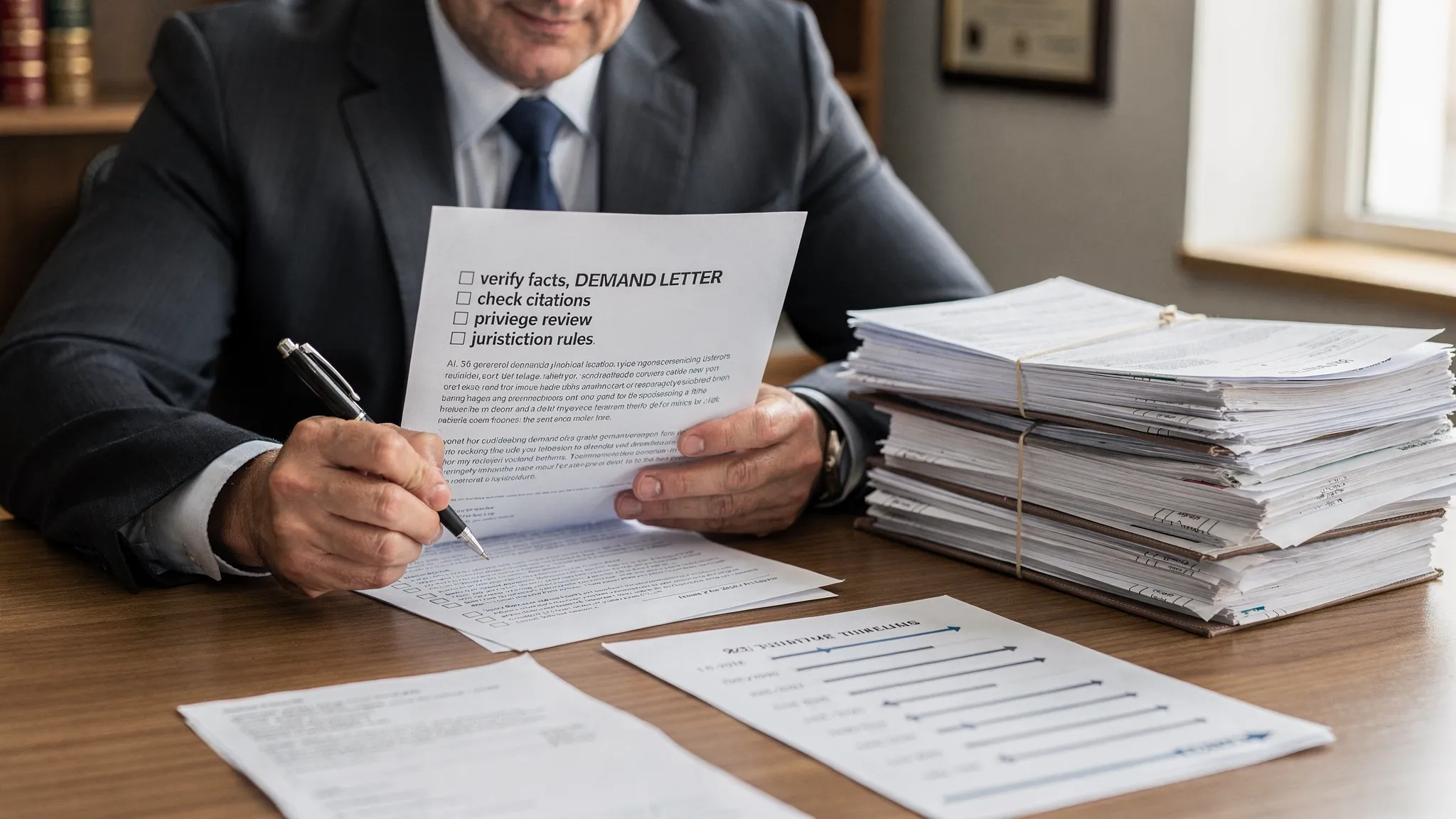
Build a repeatable verification checklist
A lightweight checklist catches most failures:
- Facts: names, dates, amounts, venues, treatment sequence
- Citations: every quote and every authority
- Confidentiality: only approved tools and settings
- Strategy: does this align with your theory and posture?
Use established risk frameworks
For a structured approach to assessing AI risks, the NIST AI Risk Management Framework is a useful reference, even for small firms.
Where TrialBase AI fits
If your goal is litigation support from intake to verdict, platforms designed around legal workflows can be a better fit than a general chatbot.
TrialBase AI is built for turning uploaded case documents into litigation-ready outputs such as demand letters, medical summaries, and deposition outlines, delivered quickly for attorney review. As with any AI, the value is highest when you keep a human-in-the-loop process and verify against the source record.
Frequently Asked Questions
Are AI lawyer tools allowed in legal practice? They can be, but lawyers must comply with competence, confidentiality, supervision, and candor obligations. Review your jurisdiction’s rules and relevant ethics guidance, including ABA resources.
What is the biggest risk when using AI for drafting? Silent factual errors. A polished paragraph can still contain invented dates, misquoted records, or overstated claims, so verification is non-negotiable.
Can AI replace legal research databases? No. AI can suggest research directions, but you still need to retrieve and read primary sources in a trusted database and validate that they apply to your jurisdiction and facts.
Is it safe to upload medical records or discovery to an AI tool? It depends on the provider’s data handling, security controls, and terms. Confirm storage, encryption, retention, access controls, and whether your data is used for training.
What tasks are best to pilot first? Start with low-risk internal work like summarization, chronology building, and first-draft outlines, then expand once your verification workflow is consistent.
Want faster first drafts without losing control?
If you want to compress the time it takes to go from intake documents to case-ready materials, explore TrialBase AI. Upload your documents, generate drafts like demand letters, medical summaries, and deposition outlines, then apply your legal judgment to finalize with confidence.