AI for Legal Teams: Safe Adoption Checklist for 2026
.png)

Legal teams are under pressure in 2026 to move faster without compromising confidentiality, privilege, or accuracy. “AI for legal” is now less about whether to use it and more about whether you can defend the process if a matter escalates, a client asks questions, or a court scrutinizes your work.
This checklist is designed for litigation and disputes teams adopting AI for drafting, summarization, and case preparation. It focuses on safe rollout, risk controls, and documentation you can actually keep in the file.
What “safe adoption” means for legal teams
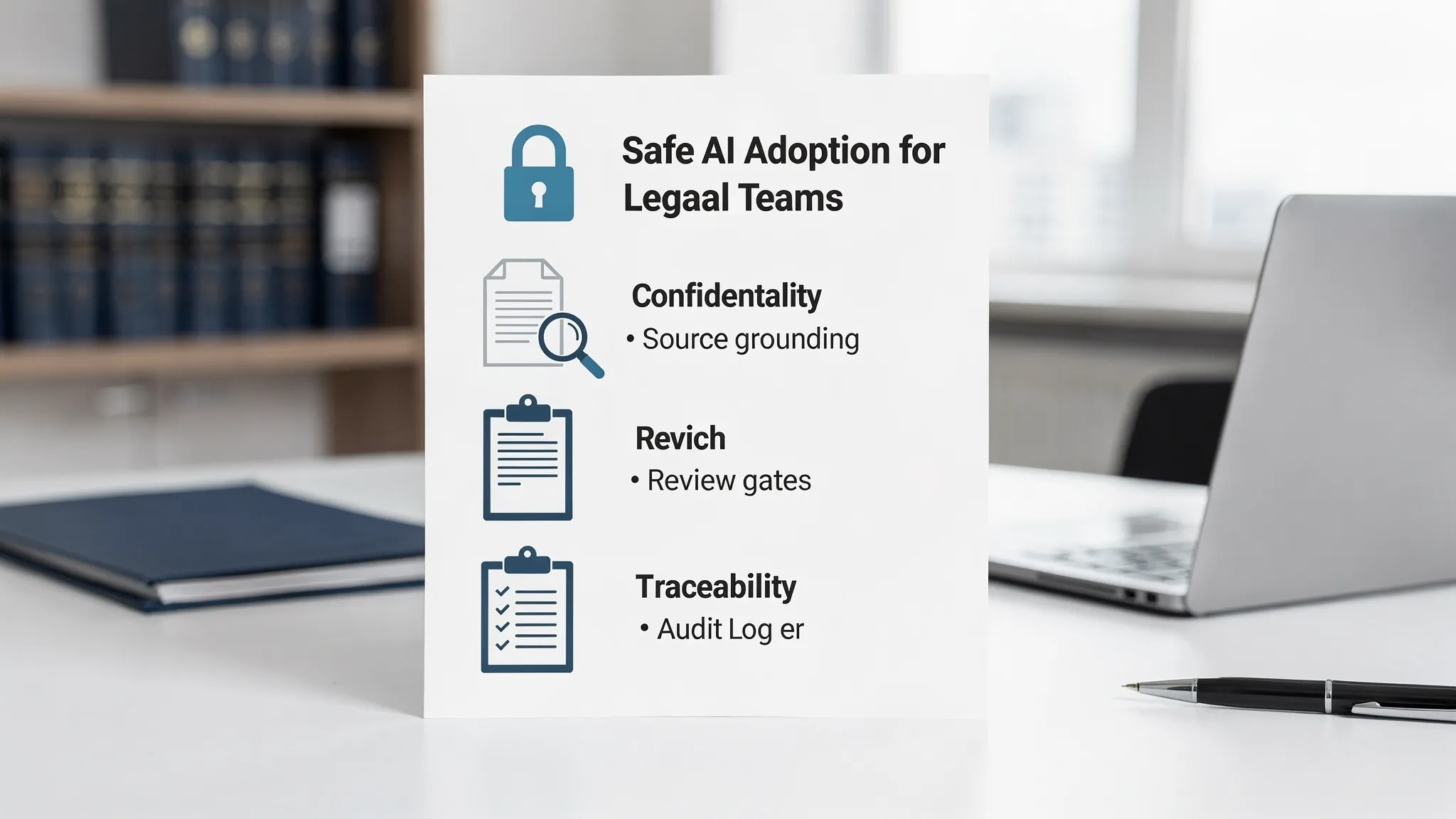
Safe adoption is not just security. It is the combination of confidentiality, reliability, and accountability across the full workflow.
A practical definition:
- Confidentiality and privilege protection: client data stays protected, access is controlled, and retention is understood.
- Accuracy with verifiable grounding: outputs can be traced to source documents, and hallucinations are actively mitigated.
- Auditability: you can show who did what, when, with what inputs.
- Human responsibility: a lawyer remains the decision-maker, with review gates before anything leaves the building.
If you want an external standard to map risks and controls, the NIST AI Risk Management Framework is a helpful reference point for governance, measurement, and monitoring.
Safe adoption checklist for 2026 (keep this in your rollout packet)
Use the table as a working checklist. The “evidence to keep” column is the part many teams miss, and it is what turns a policy into a defensible practice.
| Control area | What to verify (plain-English test) | Evidence to keep on file |
|---|---|---|
| Approved use cases | You can clearly state where AI is allowed (and not allowed), by task type and risk level. | AI use policy, scope statement for pilot, list of approved tasks (example: internal summaries, draft outlines). |
| Data classification | Everyone knows what data can be uploaded, pasted, or summarized, and what is prohibited or requires extra approvals. | Data classification rules, matter intake guidance, “no-go” data list (example: certain identifiers, sealed materials). |
| Vendor data handling | The vendor’s terms match your expectations on data retention, training, and deletion, and are not just marketing claims. | Executed DPA, retention/deletion terms, security documentation (SOC 2/ISO details if provided), support escalation path. |
| Access control | Only the right people can access the workspace and documents, and access is removed quickly when roles change. | Access control policy, role matrix, proof of SSO/MFA settings if used, offboarding checklist. |
| Workspace separation | Matters, clients, and teams are separated to prevent accidental cross-exposure. | Workspace configuration notes, naming conventions, matter separation procedure. |
| Output grounding and citations | Users are trained to require traceability to the record, especially for medical summaries, timelines, and damages analysis. | Internal guidance on citations, sample “gold standard” outputs, review checklist for paralegals/associates. |
| Human review gates | No AI-generated content goes to a client, opposing counsel, or court without documented legal review. | Sign-off workflow, drafting templates that include reviewer fields, file note standard. |
| Quality assurance | The team has a repeatable way to test accuracy and catch recurring failure modes. | QA protocol, sampling plan (example: 10% spot checks), issue log, remediation steps. |
| Logging and audit trail | You can reconstruct how an output was created (inputs, user, time, versions) when needed. | Logging policy, retention window, export procedure for audits or incident review. |
| Incident response | There is a plan if something goes wrong (wrong document uploaded, sensitive info leaked, output error discovered). | Incident runbook, notification tree, containment steps, post-incident review template. |
| Client communication | Client expectations are managed, especially for sensitive litigation steps, billing, and responsibility allocation. | Engagement letter language (where appropriate), client-facing disclosure guidance, internal FAQ for partners. |
| Cross-border matters | You have a plan for where data is processed and who to involve when legal regimes differ. | Cross-border data checklist, matter-level approvals, contact plan for local counsel. |
Practical red flags that should pause rollout
If any of the following are true, slow down and fix them before expanding adoption.
- Your team cannot clearly explain whether uploaded documents are retained, for how long, and whether they are used to train models.
- Users are pasting sensitive text into tools outside an approved workspace because “it’s faster.”
- Drafts are being sent externally without a documented lawyer review step.
- You have no repeatable method to verify key factual assertions against the record.
How to pilot safely in 30 days (without boiling the ocean)
A safe pilot is intentionally narrow. The goal is to validate value while proving your controls work.
First, pick one or two high-frequency, low-to-medium risk tasks where time savings are measurable, such as internal medical chronologies, deposition outline first passes, or demand letter drafts that will be heavily revised.
Next, define success metrics that legal teams actually care about:
- Cycle time reduction (from documents received to first draft)
- Rework rate (how much of the output survives review)
- Error categories (missing facts, wrong dates, unsupported conclusions)
- Adoption friction (time to upload, organize, and collaborate)
Finally, schedule a short weekly review to examine a small sample of outputs, log failures, and update guidance. This is where most teams either mature quickly or lose trust in the tool.
Where a litigation-focused platform can fit
General-purpose AI tools often struggle with legal defensibility because they are not designed around matter workflows, review gates, and repeatable outputs.
A litigation-focused workspace like TrialBase AI is positioned around the artifacts litigation teams produce, such as demand letters, medical summaries, deposition outlines, and trial materials, with document analysis and a unified workflow to move from intake to case-ready work product faster. Regardless of platform, apply the checklist above so your adoption remains secure, reviewable, and consistent across the team.
Cross-border and multi-jurisdiction matters: add one extra step
If your cases touch multiple jurisdictions, your “safe adoption” definition must include where data is processed and who is responsible for local legal requirements. In practice, that can mean involving local counsel early when handling sensitive records or strategy materials. For example, if you need Jamaican counsel or local context for a related dispute, coordinating with a firm such as Henlin Gibson Henlin can help ensure your workflow aligns with local expectations.
Frequently Asked Questions
Do we need a separate AI policy for litigation teams? Yes, because litigation has unique risk points, including privilege, protective orders, filings, and fast-moving deadlines. A litigation addendum to a firm-wide policy is often the most practical approach.
Can AI outputs be used in court filings? They can support drafting, but filings should be treated as high-risk. Require strict source verification, documented attorney review, and an audit trail of changes from AI draft to final.
What is the minimum “must-have” control for safe adoption? A documented human review gate before anything is shared externally, plus clear data handling terms with the vendor. If either is missing, the risk is difficult to justify.
How do we reduce hallucinations in medical summaries and timelines? Use source-grounded workflows: require citations to page/record references, validate key facts (dates, providers, diagnoses) against the underlying documents, and keep a QA sampling routine.
Should we prohibit attorneys from using consumer AI accounts? For most teams, yes. If you cannot confirm retention, training use, access controls, and auditability, it is safer to use an approved legal workflow tool instead.
CTA: Make safe adoption easier with litigation-ready workflows
If your team is ready to operationalize AI with better speed and consistency, start with a controlled pilot in a purpose-built workspace. Explore TrialBase AI to turn uploaded documents into litigation-ready drafts like demand letters, medical summaries, deposition outlines, and more, while keeping your review process and team collaboration front and center.